How to Type French Letters: é, è, ç, œ and Every Accent
French uses a handful of accented letters that English does not: é è ê ë, à â, î ï, ô, ù û ü, plus the c-cedilla ç and the œ ligature. The accents are not decoration — they change how a word sounds and often what it means, so a and à are different words. Here is how to type every French letter on any device, when each accent is needed, examples, and the small touches like the guillemets « » that make written French look right.
In a hurry?
- Copy it: click any letter in the grid below.
- Windows: hold Alt and type the code — é is Alt + 0233, è is 0232, ç is 0231.
- Mac: Option + e then the letter for é, or Option + ` then the letter for à; Option + c for ç.
- For regular writing: switch to the US-International or French keyboard layout.
- In HTML, é is
éand ç isç.
Table of Contents
The grid above has the vowels with all four accents, the ç, the œ ligature, and the French quotation marks. The sections below show which accent goes where and when.
French accented letters: the full list
Every French letter with its French name and the code for each method. Copy from the grid above, or type it with one of these.
| Letter | French name | Windows | Mac | HTML |
| é | e accent aigu | Alt + 0233 | Option + e, e | é |
| è | e accent grave | Alt + 0232 | Option + `, e | è |
| ê | e accent circonflexe | Alt + 0234 | Option + i, e | ê |
| ë | e tréma | Alt + 0235 | Option + u, e | ë |
| à | a accent grave | Alt + 0224 | Option + `, a | à |
| â | a circonflexe | Alt + 0226 | Option + i, a | â |
| î | i circonflexe | Alt + 0238 | Option + i, i | î |
| ï | i tréma | Alt + 0239 | Option + u, i | ï |
| ô | o circonflexe | Alt + 0244 | Option + i, o | ô |
| û | u circonflexe | Alt + 0251 | Option + i, u | û |
| ù | u accent grave | Alt + 0249 | Option + `, u | ù |
| ü | u tréma | Alt + 0252 | Option + u, u | ü |
| ç | c cédille | Alt + 0231 | Option + c | ç |
| œ | ligature oe | Alt + 0156 | Option + q | œ |
| « | guillemet ouvrant | Alt + 0171 | Option + backslash | « |
| » | guillemet fermant | Alt + 0187 | Option + Shift + backslash | » |
For capitals, add Shift to the Mac shortcut, or use the capital Alt code (É is Alt + 0201, Ç is Alt + 0199). And yes, French capitals really do take accents — more on that below.
The five French accents explained
French has five diacritics. Knowing what each one does makes the spelling stop feeling random.
- Accent aigu (é): only on e. It gives a closed “ay” sound, as in café and été.
- Accent grave (à è ù): opens the vowel on e (mère), and on a and u it mostly tells look-alike words apart (a vs à, ou vs où).
- Accent circonflexe (â ê î ô û): the “little hat,” often marking a letter (usually an s) that history dropped — hôpital was once “hospital,” forêt was “forest.”
- Tréma (ë ï ü): the two dots say “pronounce this vowel separately,” as in Noël and naïf.
- Cédille (ç): the little tail under a c keeps it soft (like s) before a, o, or u — garçon, français.
How to type French letters on any device
On Windows (Alt codes)
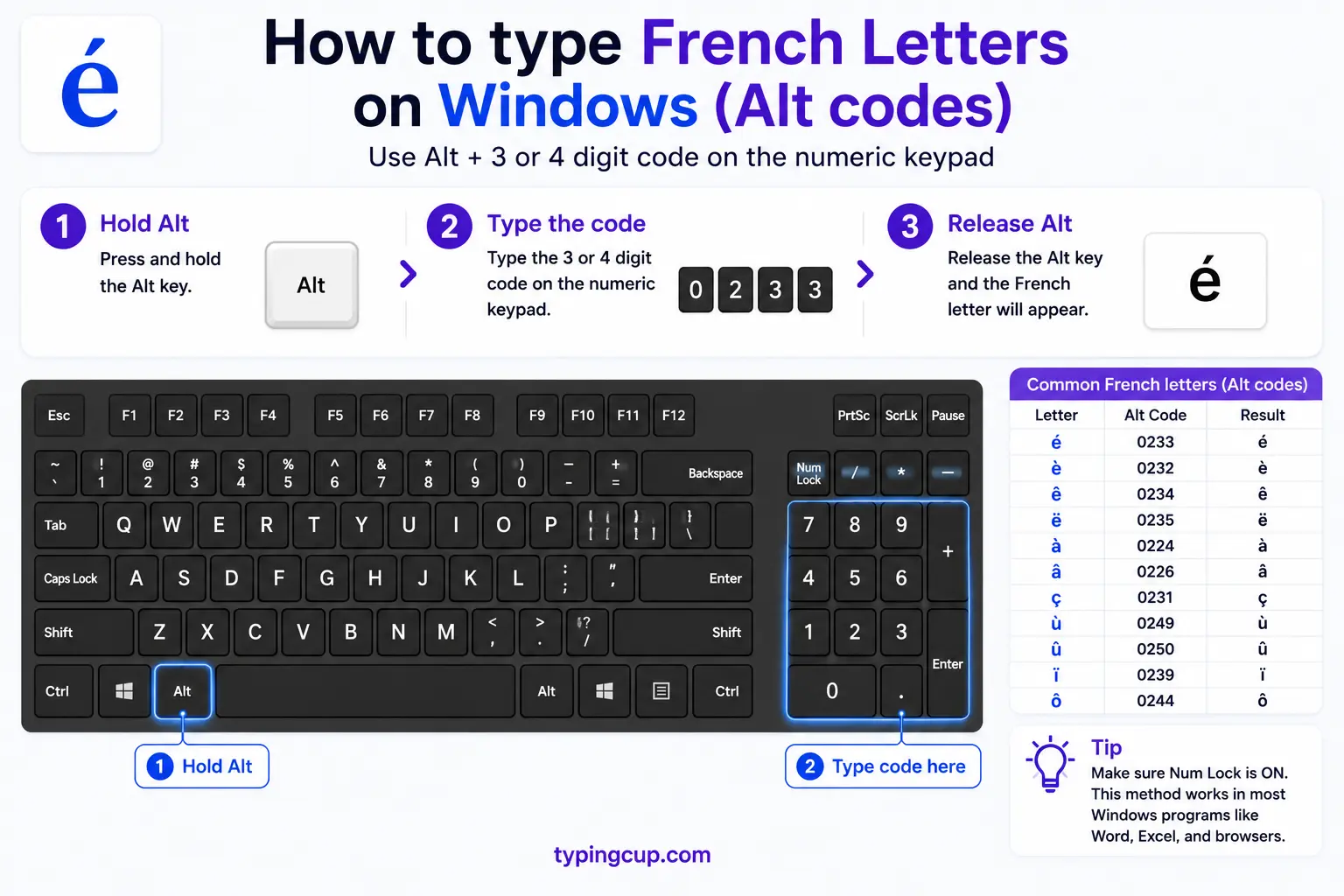
Hold Alt and type the four-digit code on the numeric keypad (Num Lock on): 0233 for é, 0232 for è, 0224 for à, 0231 for ç. The full list is in the table above. Keep the leading zero, and use the keypad, not the top-row numbers.
The US-International keyboard (best for Windows)
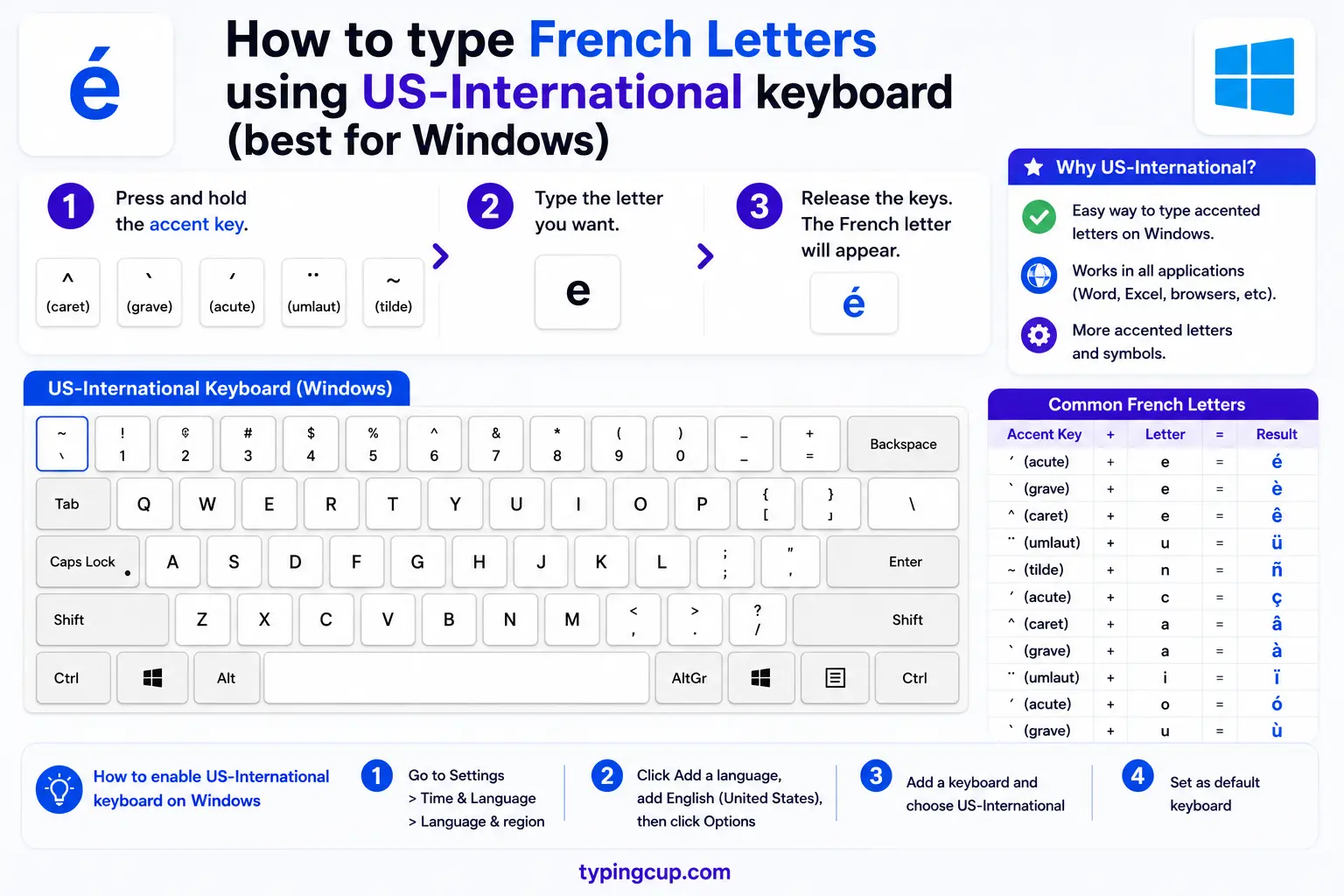
If you write French often, switch to the US-International layout in Windows settings. Then the accent keys become “dead keys”: type ‘ then e for é, ` then a for à, ^ then e for ê, and “ then e for ë. It is far faster than Alt codes once you get used to it.
On Mac
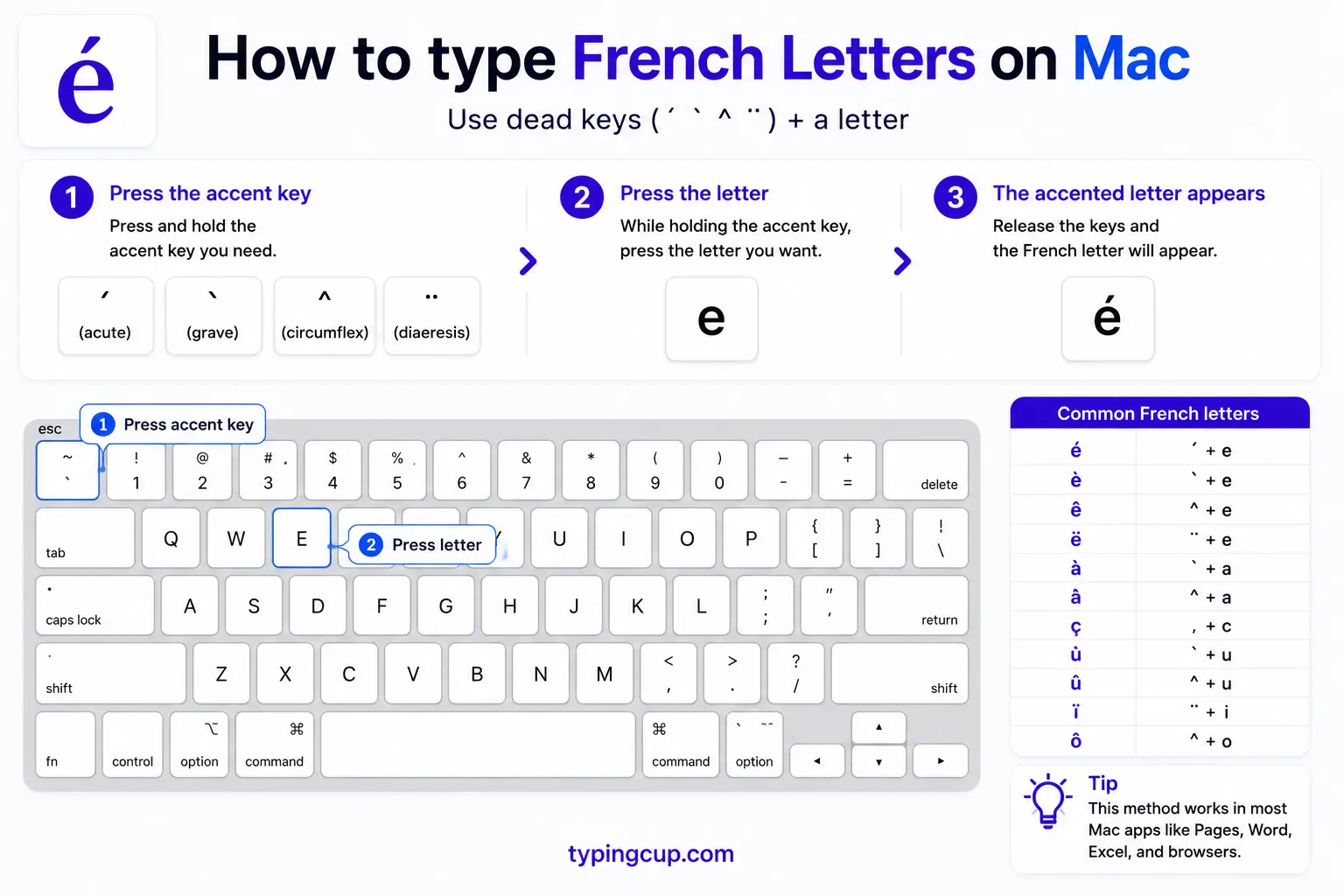
Mac uses Option dead keys: Option + e then the vowel for the acute (é), Option + ` then the vowel for the grave (à), Option + i then the vowel for the circumflex (ê), and Option + u then the vowel for the tréma (ë). The cedilla is Option + c (ç) and the œ ligature is Option + q.
On a French AZERTY keyboard
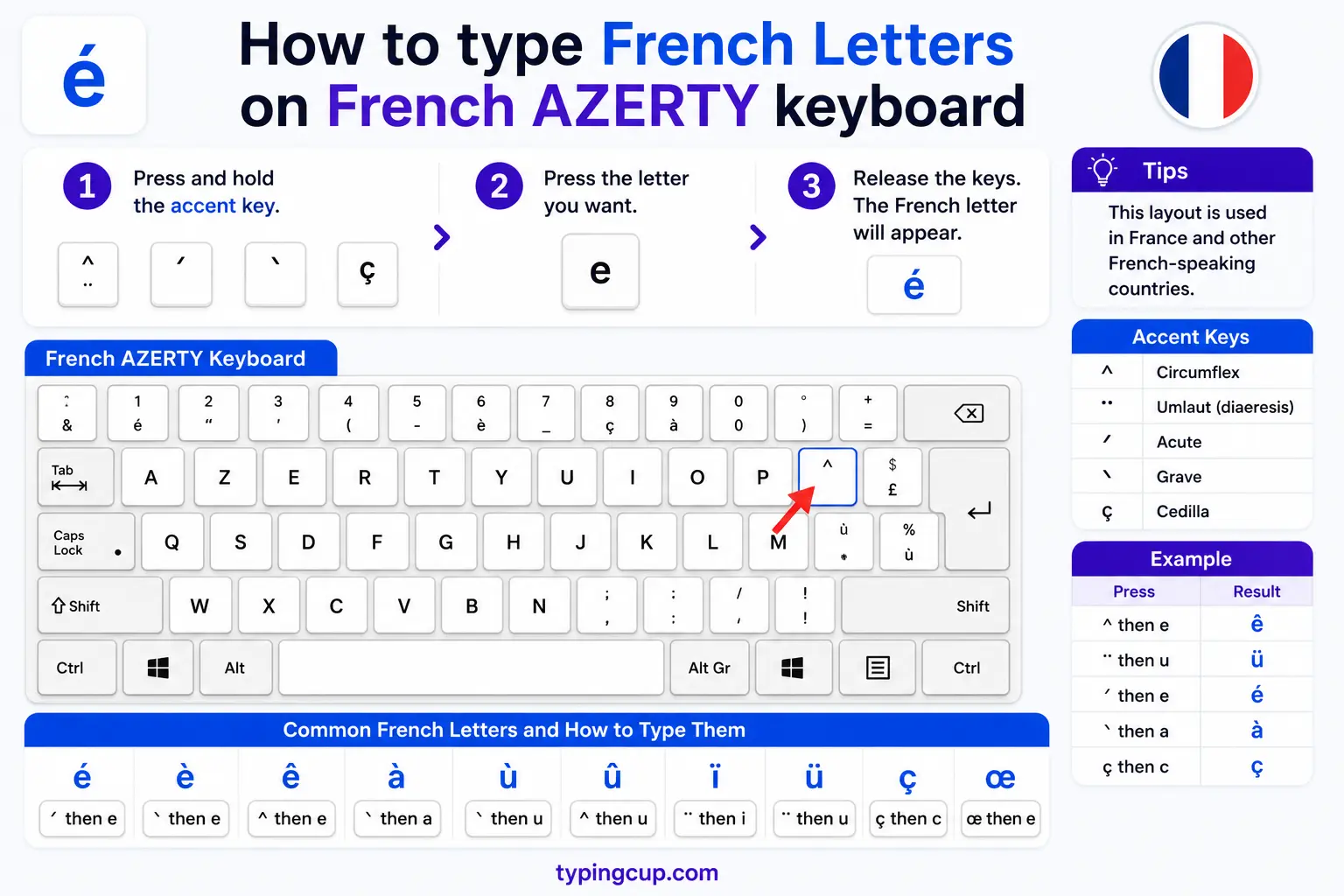
A French keyboard has dedicated keys: é, è, à, ù, and ç each have their own key along the top row and around the right side, and the circumflex and tréma sit on a dead key. If you type in French all day, this is the most comfortable option.
In Microsoft Word
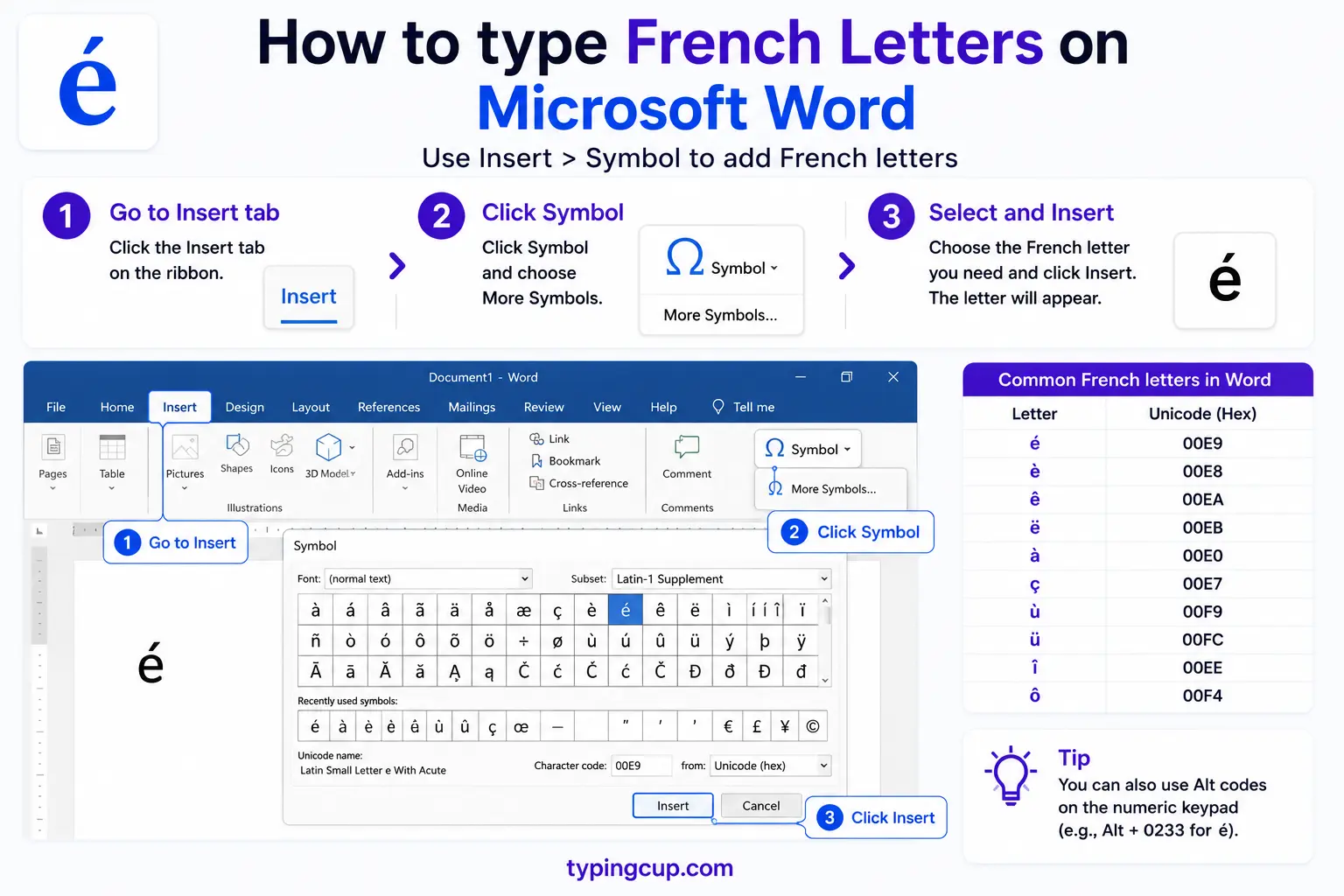
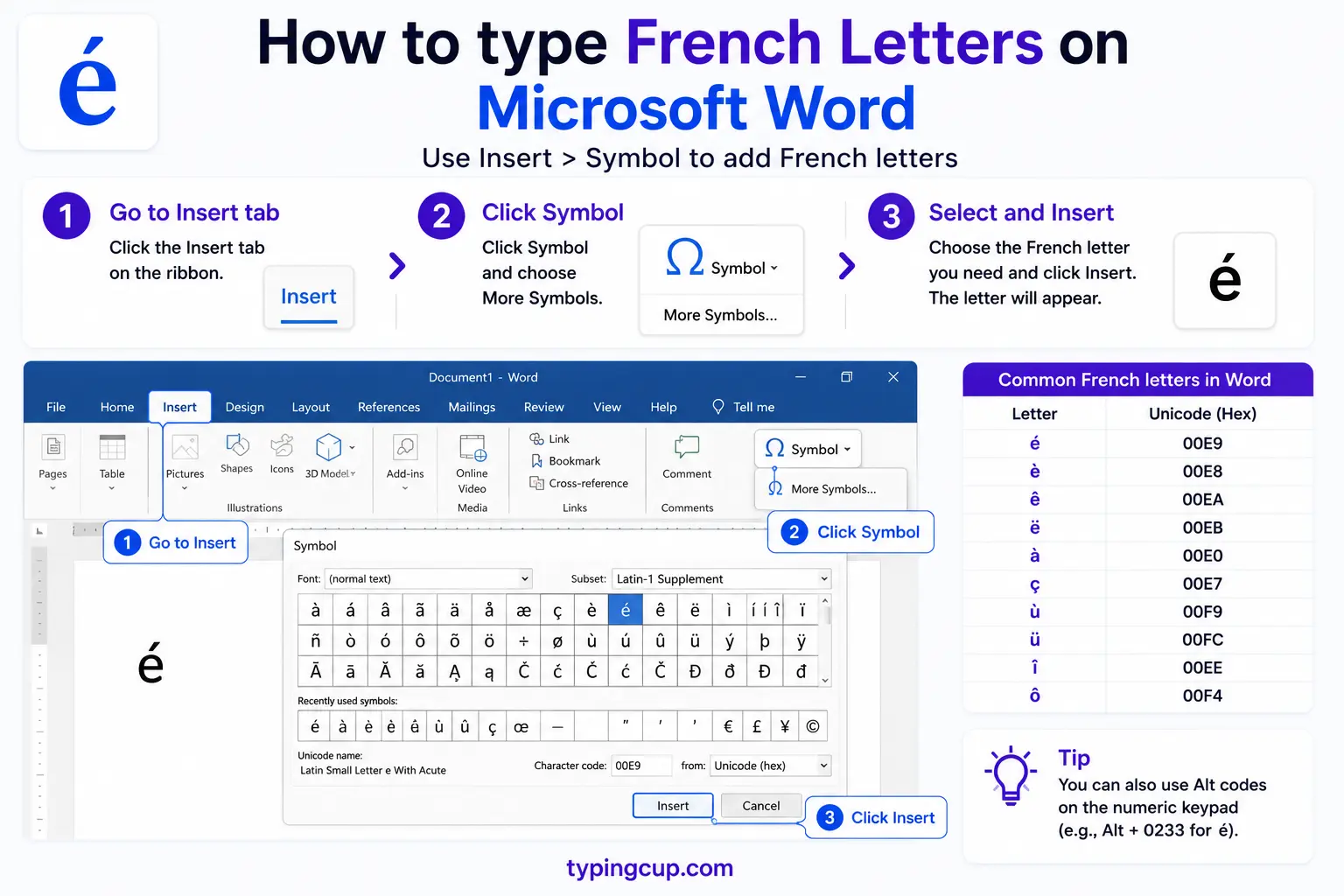
Word has built-in shortcuts that work on any layout: Ctrl + ‘ then the vowel for the acute (é), Ctrl + ` then the vowel for the grave (à), Ctrl + Shift + ^ then the vowel for the circumflex (ê), Ctrl + Shift + : then the vowel for the tréma (ë), and Ctrl + , then c for the cedilla (ç).
On iPhone and Android
Press and hold the base letter on the on-screen keyboard, and a row of accented options appears — hold e for é è ê ë, c for ç, and so on. Slide to the one you want and lift your finger. Adding a French keyboard also helps.
In HTML and CSS
Every French letter has a named HTML entity: é for é, à for à, ç for ç, œ for œ, and « / » for the guillemets. In a CSS content value, use the code point, like \00E9 for é. Serve the page as UTF-8.
When to use French accents
Accents in French are not optional flourishes — they carry sound and meaning. Here is when they actually matter.
- To tell words apart: a (“has”) vs à (“to”), ou (“or”) vs où (“where”), la (“the”) vs là (“there”), sur (“on”) vs sûr (“sure”), du (“of the”) vs dû (“owed”). Drop the accent and you write a different word.
- To set the vowel sound: é is a closed “ay” (café), è is an open “eh” (mère). Mixing them up mispronounces the word.
- To keep c soft: the ç keeps the /s/ sound before a, o, u — without it, garçon would read “gar-KON.”
- To split vowels: the tréma marks a vowel that is said on its own, as in naïf and Noël.
- In careful writing, always: leaving accents off is treated as a spelling mistake in French, not a shortcut.
e accent aigu vs e accent grave vs e circonflexe vs e trema
The letter e takes all four accents, and each one changes the sound. This is the set that trips learners up most, so here they are side by side.
| Letter | Accent | Sound | Example |
| é | aigu (acute) | closed “ay” | café, été |
| è | grave | open “eh” | mère, près |
| ê | circonflexe | open “eh” (dropped s) | forêt, fête |
| ë | tréma | e said separately | Noël, Canoë |
| e | none | silent or “uh” | le, petit |
So the accent on e is not cosmetic: é, è, and a plain e are pronounced differently, and the circumflex often marks a lost letter rather than a new sound.
French accent examples
Common words for each accent, so the patterns stick.
| Accent | Examples |
| é (aigu) | café, école, téléphone, marché |
| è / à / ù (grave) | mère, très, voilà, où |
| â ê î ô û (circonflexe) | pâte, fête, île, hôtel, coût |
| ë ï ü (tréma) | Noël, naïf, maïs, aigü |
| ç (cédille) | garçon, français, leçon, ça |
| œ (ligature) | cœur, œuf, sœur, œuvre |
The œ ligature: cœur, œuf, and sœur
One French character is not an accented letter at all but a ligature — two letters fused into one. The œ joins o and e, and it is required, not optional, in the words that use it: cœur (heart), œuf (egg), sœur (sister), œuvre (work). Writing “coeur” with a separate o and e is considered a spelling error in careful French, even though it is common online. Type it with Alt + 0156 on Windows, Option + q on a Mac, or œ in HTML — and copy it from the grid at the top. Its rarer cousin, æ (as in et cætera), works the same way.
Guillemets « »: French quotation marks and their spaces
French does not use English “curly quotes” for speech. It uses guillemets, the angled marks « », and there is a detail almost every guide misses: they take a space on the inside. You write « Bonjour », with a space after the opening « and before the closing ». That space should be a non-breaking space so the mark never slips to the start of a new line on its own. Type the marks with Alt + 0171 and Alt + 0187, Option + backslash on a Mac, or « and » in HTML. Getting the guillemets and their spaces right is one of the quickest ways to make French text look properly typeset.
Do French capitals take accents? (É, À, Ç)
Yes — despite a stubborn myth to the contrary. The Académie française is clear that accents belong on capital letters just as much as on lowercase ones: École, À bientôt, Ça va. Leaving them off is technically a spelling error. The reason so many people think capitals go bare is purely historical: old typewriters could not fit an accent above a capital, so the habit stuck. On a computer there is no such limit — use Alt + 0201 for É, Alt + 0192 for À, Alt + 0199 for Ç, or add Shift to the Mac dead-key shortcut.
The 2016 spelling reform and the circumflex
If you have seen French spelled two ways, this is why. A reform first proposed in 1990 became official in schoolbooks in 2016, and one of its headline changes was dropping the circumflex on i and u in many words: goûter became gouter, huitre lost its hat, and août can now be aout. The catch: the circumflex stays wherever removing it would blur two words — sur (“on”) keeps its plain u while sûr (“sure”) keeps the hat. Both the old and new spellings are accepted, so you will see î and û alive and well; the reform simply made the barer forms correct too.
French spacing: the space before ; : ? ! and »
Here is a rule that surprises English writers: French puts a space before the “two-part” punctuation marks — the semicolon, colon, question mark, exclamation mark, and closing guillemet. You write Vraiment ?, Attention !, and trois : deux, each with a (thin, non-breaking) space in front. English uses no space there at all. The period and comma, though, behave the same as in English — tight against the word. Getting this spacing right, along with the guillemets, is what separates text that merely has the accents from text that reads as genuine French typesetting.
Copy-paste HTML codes
The French letters and marks with their HTML entities and code points, in one place.
| Letter | Named entity | Numeric | Code point |
| é | é | é | U+00E9 |
| è | è | è | U+00E8 |
| ê | ê | ê | U+00EA |
| à | à | à | U+00E0 |
| ç | ç | ç | U+00E7 |
| œ | œ | œ | U+0153 |
| « | « | « | U+00AB |
| » | » | » | U+00BB |
Capitals use the same names capitalized (É, Ç). For the sibling guides, see e with an accent, a with an accent, the full letters with accents list, and how to type Spanish letters.
Troubleshooting
My accents show as gibberish like é or ç
That is an encoding mismatch — UTF-8 text is being read as an older encoding. é is a mangled é and ç is a mangled ç. Set the file, database, and page charset to UTF-8 and the accents return.
My Alt code types the wrong letter
Usually a missing leading zero or Num Lock being off. French letters use the four-digit codes with a zero, like 0233 for é — the shorter three-digit codes give different characters. Use the numeric keypad with Num Lock on.
I can’t get accents on capital letters
Add Shift to the Mac dead-key shortcut (Option + e, then Shift + e for É), or use the capital Alt code (Alt + 0201 for É). French capitals do take accents, so this is worth setting up.
Frequently asked questions
How do I type French accents on a keyboard?
On Windows, hold Alt and type the code (0233 for é), or switch to the US-International layout and use dead keys. On a Mac, use Option shortcuts (Option + e, then e for é). On a phone, press and hold the base letter. Or copy any letter from the grid above.
When do you use é versus è?
é (aigu) makes a closed “ay” sound, as in café. è (grave) makes an open “eh” sound, as in mère, and on à and où it separates look-alike words. They are not interchangeable.
Do French capital letters need accents?
Yes. The Académie française treats accents on capitals as correct spelling (École, Ça). The idea that capitals go bare comes from old typewriters, not the language.
How do I type the French quotation marks « »?
On Windows, Alt + 0171 for « and Alt + 0187 for »; on a Mac, Option + backslash and Option + Shift + backslash; in HTML, « and ». Remember the non-breaking space on the inside.
How do I write French letters in HTML?
Use named entities: é for é, à for à, ç for ç, œ for œ. Serve the page as UTF-8 and the letters also work typed directly.
