How to Type German Letters: ä, ö, ü, ß and the Capital ẞ
German adds only four special characters to the Latin alphabet, but they matter: the three umlauts ä ö ü and the eszett ß (the “sharp s”). The umlauts change a word’s sound and often its meaning, and ß stands in for a double s after a long vowel. There is even a capital eszett, ẞ, that most people have never seen. Here is how to type every German letter on any device, when each one is needed, examples, and the ss-versus-ß rule that trips learners up.
In a hurry?
- Copy it: click any letter in the grid below.
- Windows: hold Alt and type the code — ä is Alt + 0228, ö is 0246, ü is 0252, ß is 0223.
- Mac: Option + u then a, o, or u for the umlauts (ä ö ü); Option + s for ß.
- For regular writing: switch to the German (QWERTZ) or US-International keyboard layout.
- In HTML, ä is
äand ß isß.
Table of Contents
The grid above has the three umlauts, the eszett, and their capitals — including the capital eszett ẞ. The sections below explain when to use each one.
German special letters: the full list
Every German special letter with its name and the code for each method. Copy from the grid above, or type it with one of these.
| Letter | Name | Windows | Mac | HTML |
| ä | a-Umlaut | Alt + 0228 | Option + u, a | ä |
| ö | o-Umlaut | Alt + 0246 | Option + u, o | ö |
| ü | u-Umlaut | Alt + 0252 | Option + u, u | ü |
| ß | Eszett (scharfes S) | Alt + 0223 | Option + s | ß |
| Ä | A-Umlaut | Alt + 0196 | Option + u, Shift + A | Ä |
| Ö | O-Umlaut | Alt + 0214 | Option + u, Shift + O | Ö |
| Ü | U-Umlaut | Alt + 0220 | Option + u, Shift + U | Ü |
| ẞ | Capital eszett | Alt + 7838* | Character Viewer | ẞ |
*Alt + 7838 for the capital ẞ works only in apps that accept decimal Unicode (like Word); everywhere else, copy it from the grid or use Character Map. The umlaut and eszett codes above work on any Windows app with a numeric keypad.
The German umlauts and the eszett explained
Two ideas cover all of German’s special letters: the umlaut dots and the sharp s.
- The umlauts (ä ö ü): the two dots change the vowel sound. They come from an old e that once followed the vowel and merged into it, which is why the substitute spelling is ae, oe, ue. Roughly, ä sounds like “eh,” ö like the vowel in French peu, and ü like French tu.
- The eszett (ß): called the “sharp s” or scharfes S, it is a single letter for a sharp, voiceless “s” sound. It began as a ligature of a long s and a short s. It only appears after a long vowel or a diphthong, it never starts a word, and where a short vowel comes before the sound you write ss instead.
How to type German letters on any device
On Windows (Alt codes)
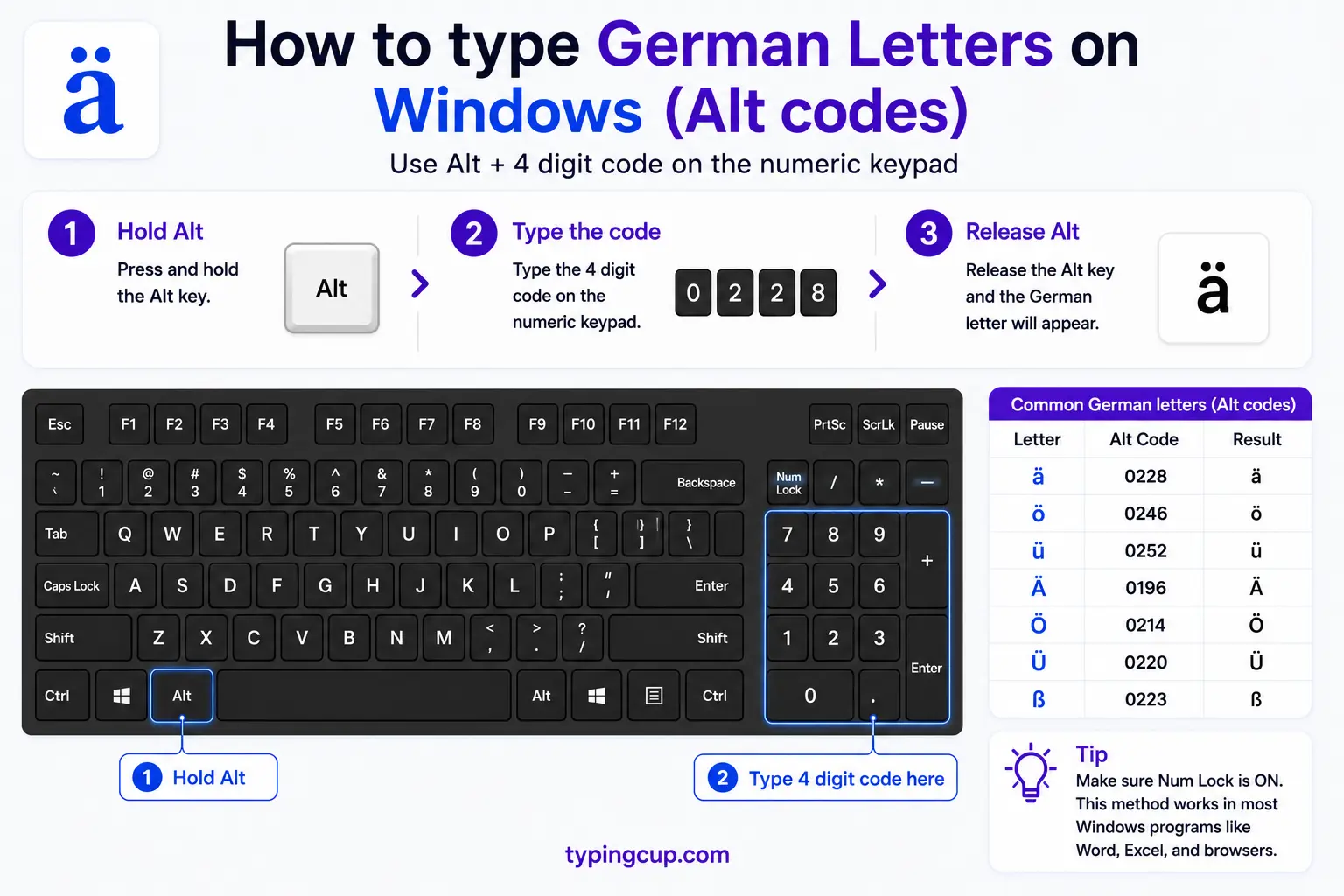
Hold Alt and type the four-digit code on the numeric keypad (Num Lock on): 0228 for ä, 0246 for ö, 0252 for ü, and 0223 for ß. Capitals use 0196 (Ä), 0214 (Ö), 0220 (Ü). Keep the leading zero and use the keypad, not the top-row numbers.
The US-International keyboard (best for Windows)
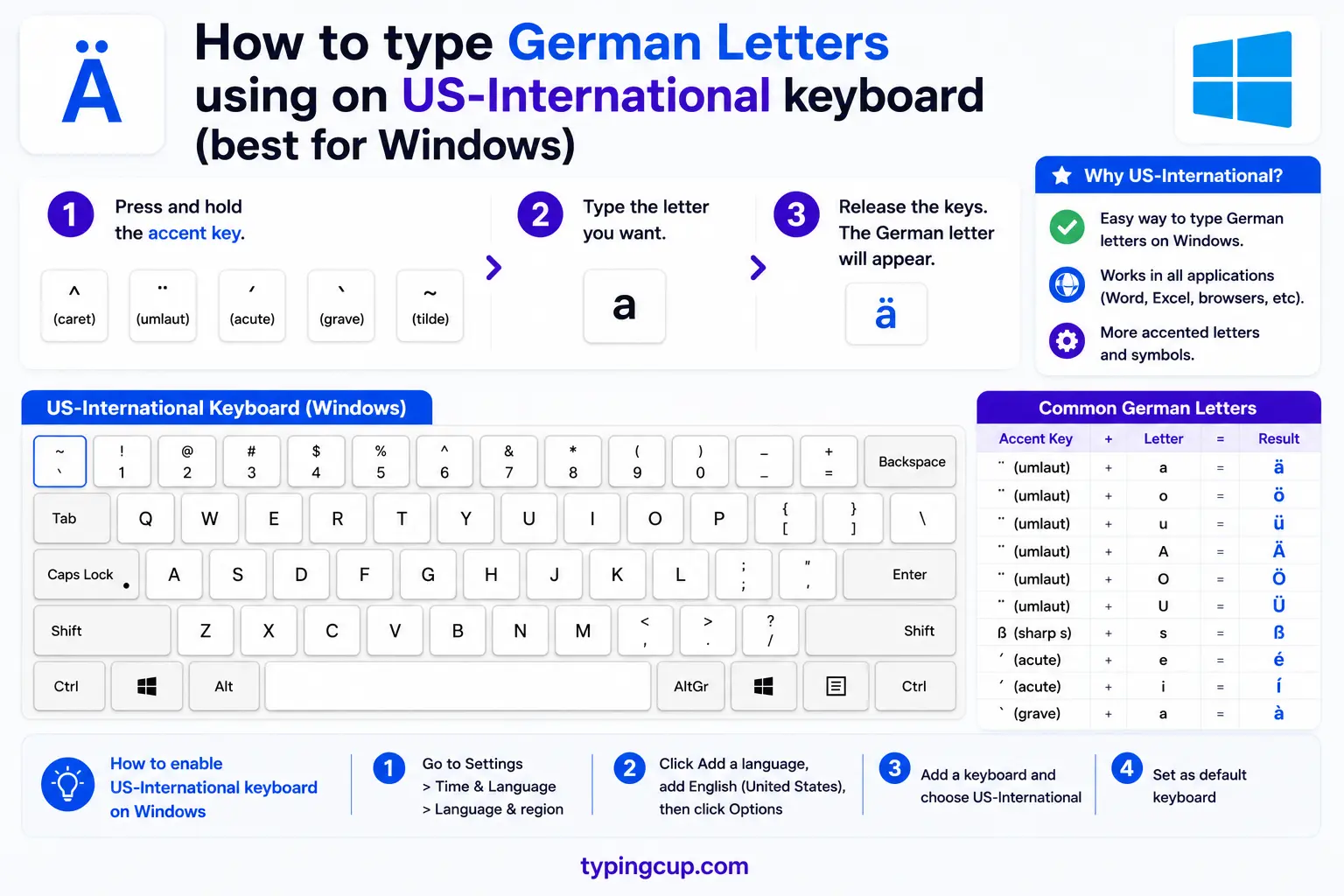
Switch to the US-International layout and the umlauts become easy: type “ (Shift + apostrophe) then a for ä, then o for ö, then u for ü. The eszett is AltGr + s (right Alt plus s). This is much faster than Alt codes for regular writing.
On Mac
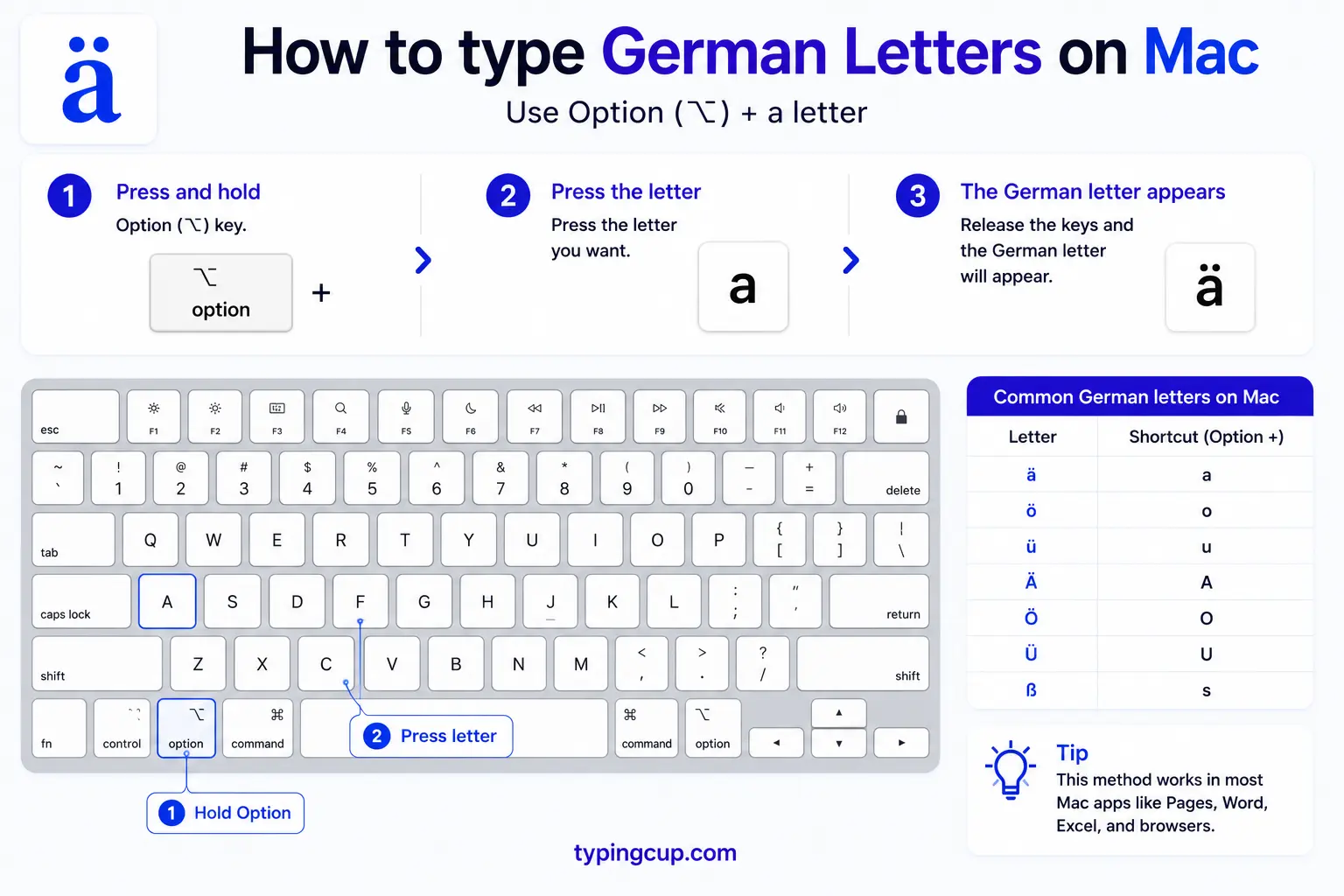
Mac uses an Option dead key for the umlauts: press Option + u (nothing appears yet), then the vowel — a for ä, o for ö, u for ü. Add Shift for the capital. The eszett is a direct Option + s (ß).
On a German QWERTZ keyboard
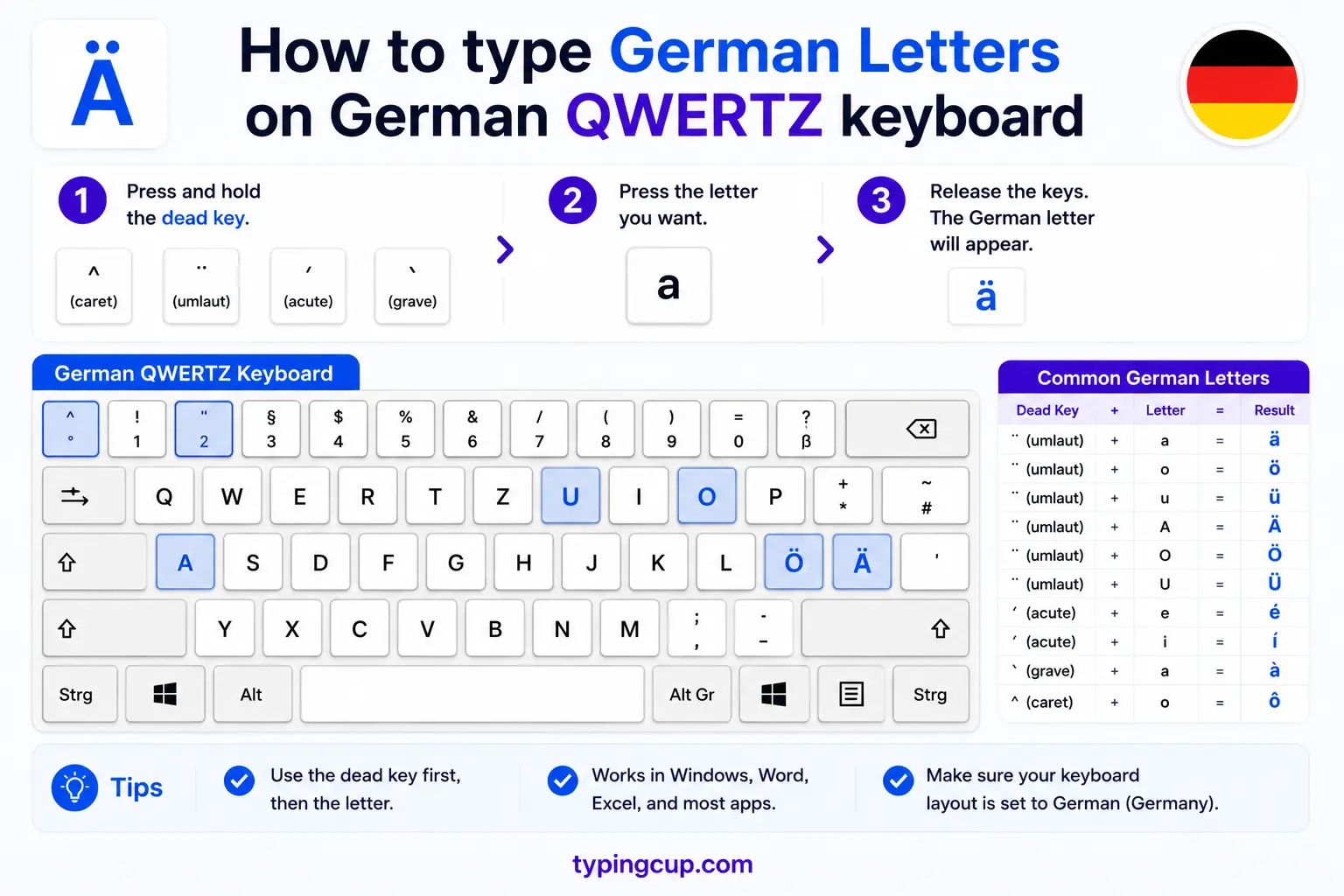
A German keyboard has dedicated keys for ä, ö, ü, and ß to the right of the letters and near the number row (and yes, z and y are swapped, hence “QWERTZ”). If you type German all day, this layout is the most comfortable by far.
In Microsoft Word
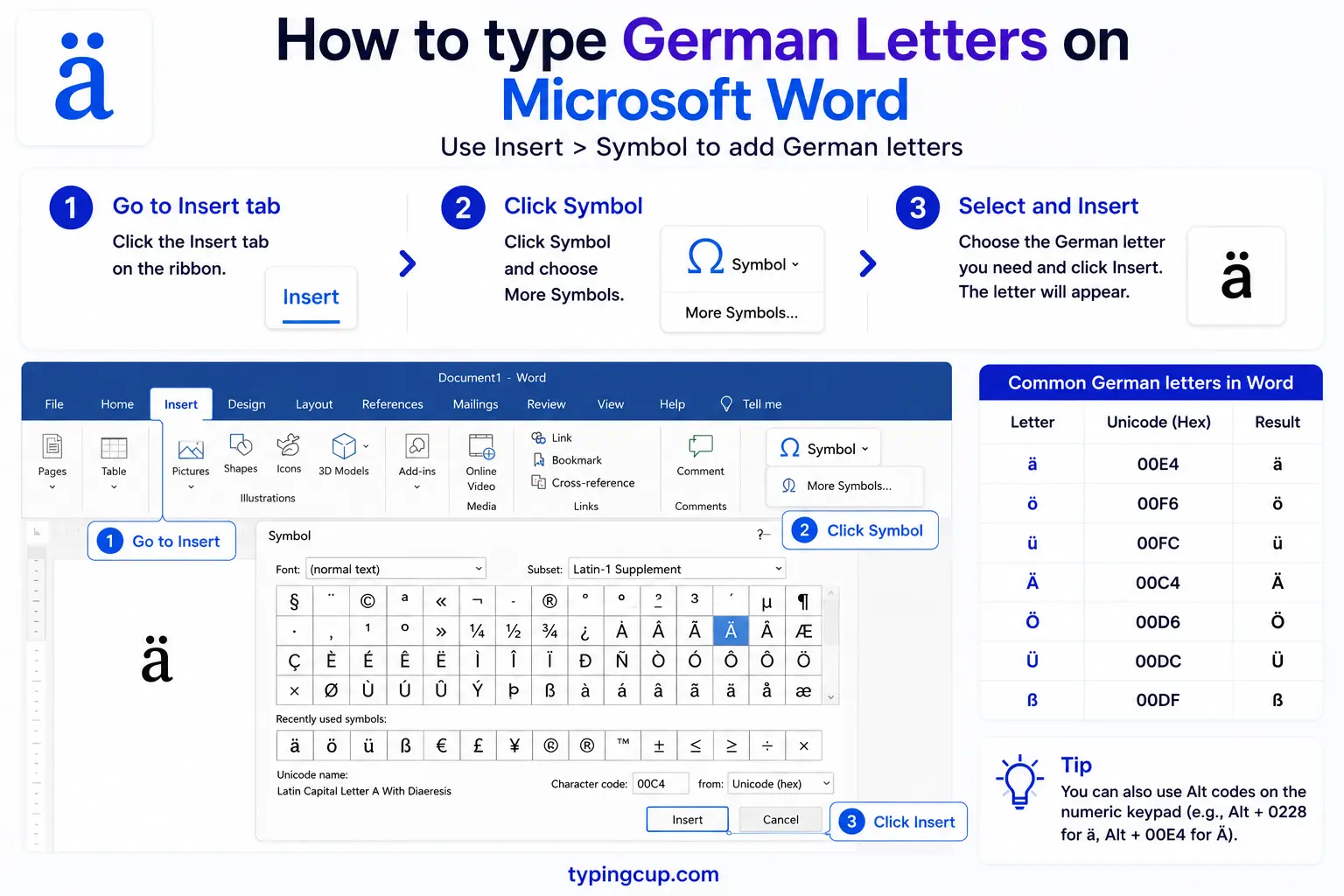
Word has a built-in umlaut shortcut that works on any layout: Ctrl + Shift + : (the colon), then the vowel — so Ctrl + Shift + : then a gives ä. For the eszett, type 00DF then Alt + X, or use Insert → Symbol.
On iPhone and Android
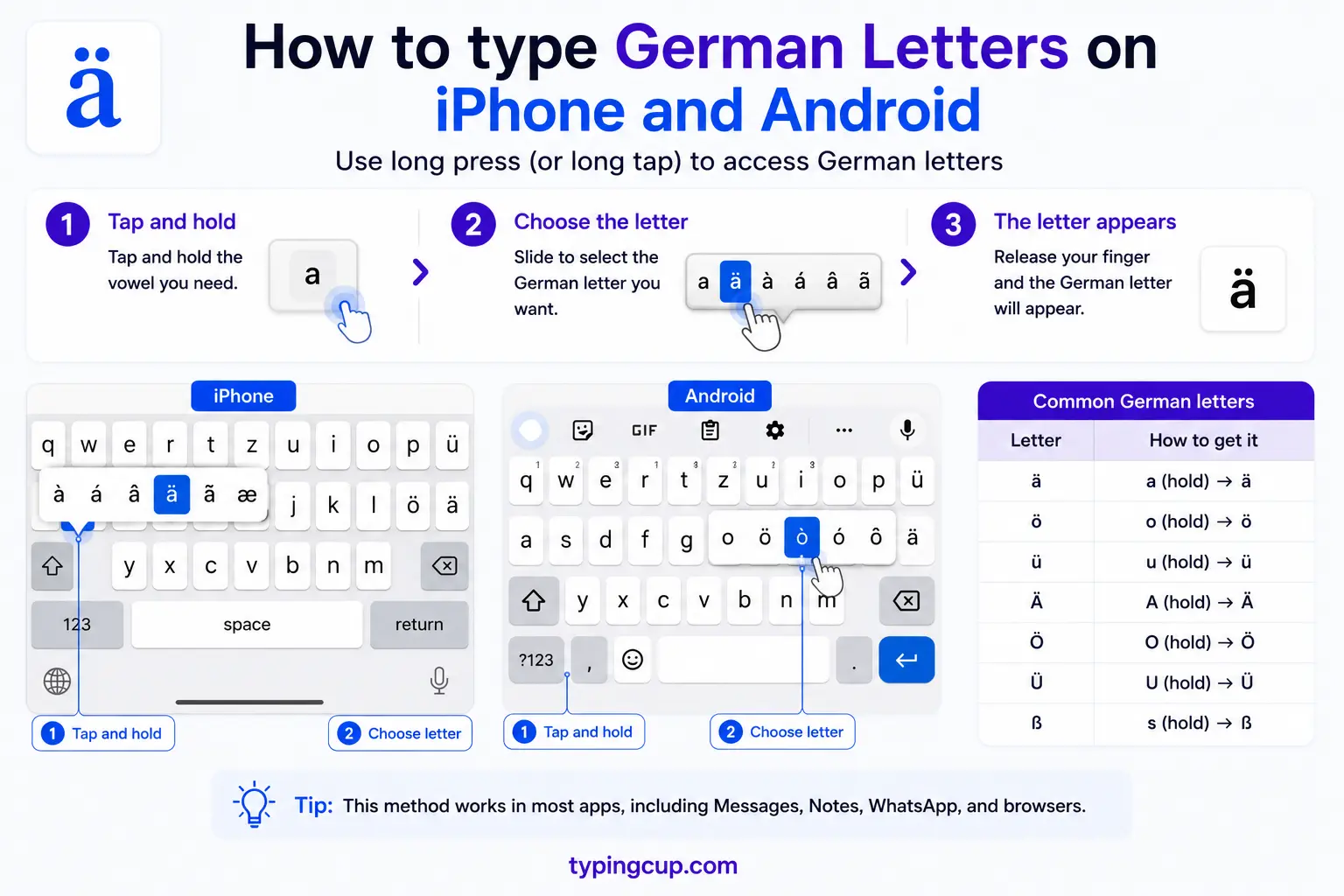
Press and hold the base letter on the on-screen keyboard: hold a for ä, o for ö, u for ü, and s for ß. Slide to the character and lift your finger. Adding a German keyboard puts them front and center.
In HTML and CSS
Each letter has a named entity: ä for ä, ö for ö, ü for ü, and ß for ß (capitals capitalize the name). The capital eszett has no short name — use ẞ. In CSS content, use the code point like \00E4 for ä. Serve the page as UTF-8.
When to use umlauts and the eszett
These letters are not optional decoration. Swapping them for plain vowels or an s changes the word, so here is when they matter.
- Umlauts mark the plural: many nouns add an umlaut to go from singular to plural — Mutter (mother) becomes Mütter (mothers), Bruder becomes Brüder, Apfel becomes Äpfel.
- Umlauts change the word: schon means “already,” but schön means “beautiful”; drucken is “to print,” drücken is “to press.” One dot pair, a different meaning.
- ß vs ss depends on the vowel: use ß after a long vowel or diphthong, ss after a short one — and that changes meaning too: Maße (measurements, long a) vs Masse (mass, short a).
- In careful writing, always: dropping an umlaut or using ss where ß belongs is a spelling error, not a shortcut — except in Switzerland, which is covered below.
eszett vs double-s: when to use ß and when to use ss
This is the rule learners ask about most, and it comes down to the vowel before the sound. It is entirely predictable.
| Comes after | Use | Example | Meaning |
| long vowel | ß | Maß | measure / moderation |
| diphthong (ei, au…) | ß | weiß | white |
| short vowel | ss | Masse | mass, quantity |
| start of a word | never ß | Sonne | sun |
| long vowel | ß | Straße | street |
| short vowel | ss | Küsse | kisses |
So Maße and Masse are different words, and the choice is not style but spelling: a long vowel before the s-sound takes ß, a short vowel takes ss, and ß never begins a word.
German examples
Common words for each letter, so the patterns stick.
| Letter | Examples |
| ä | Mädchen, spät, Bäcker, Käse |
| ö | schön, Köln, hören, größer |
| ü | über, fünf, Tür, grün |
| ß | Straße, weiß, heiß, groß |
| Ä Ö Ü | Äpfel, Österreich, Übung |
ae, oe, ue, ss: the substitution spellings
When you cannot type the special letters — in an email address, a URL, an old system, a crossword, or a game of Scrabble — German has an official fallback. Replace ä with ae, ö with oe, ü with ue, and ß with ss. So Müller becomes Mueller, Österreich becomes Oesterreich, and Straße becomes Strasse. This is not a mistake; it is the standard transcription, and it is exactly why the substitute uses e — the umlaut grew out of an old following e. Many German surnames are officially spelled both ways for this reason, so Mueller and Müller are the same name.
The capital eszett ẞ: German’s newest letter
For most of its history, the eszett had no capital, so a word set in all caps became STRASSE, with the ß expanded to SS. That changed recently. The capital eszett ẞ was added to Unicode in 2008, and in 2017 the Council for German Orthography officially recognized it as an accepted spelling — and since 2024 it is the preferred form over SS in capitals. So Straße in capitals can now be written STRAẞE, keeping the letter instead of expanding it. It is genuinely new, which is why most keyboards and guides still ignore it; type it with Alt + 7838 in Word, or copy it from the grid above.
Why Switzerland does not use ß
If you see German with ss everywhere and never a ß, it is probably Swiss. Switzerland and Liechtenstein dropped the eszett entirely during the twentieth century and now write ss in every case — Strasse, weiss, gross. The official rules even spell it out: in Switzerland one may always write ss. The reasons are practical history: Swiss typewriters favored French and Italian characters and left the ß off, and the habit stuck. So the same word is Straße in Germany and Austria but Strasse in Switzerland, both correct in their own country.
Umlaut vs diaeresis: the same two dots, a different job
The German umlaut looks identical to the two dots English and French call a diaeresis or tréma, but they do opposite things. A German umlaut (ä ö ü) changes the vowel sound and stands for an old merged e. A diaeresis (as in naïve or Noël) instead tells you to pronounce a vowel separately from the one before it. Same dots, unrelated purpose — which is why ü in German (a new sound) and ë in French (a split) are not the same idea even though they share the mark. For the French version, see the guide to French letters.
Copy-paste HTML codes
The German letters with their HTML entities and code points, in one place.
| Letter | Named entity | Numeric | Code point |
| ä | ä | ä | U+00E4 |
| ö | ö | ö | U+00F6 |
| ü | ü | ü | U+00FC |
| ß | ß | ß | U+00DF |
| Ä | Ä | Ä | U+00C4 |
| Ö | Ö | Ö | U+00D6 |
| Ü | Ü | Ü | U+00DC |
| ẞ | (none) | ẞ | U+1E9E |
For the substitute spellings, just write ae, oe, ue, and ss. For related guides, see umlaut letters, the full letters with accents list, how to type French letters, and how to type Spanish letters.
Troubleshooting
My umlauts show as gibberish like ä or ß
That is an encoding mismatch — UTF-8 text is being read as an older encoding. ä is a mangled ä and ß-style junk is a mangled ß. Set the file, database, and page charset to UTF-8 and the letters return.
My Alt code types the wrong character
Usually a missing leading zero or Num Lock being off. German letters use the four-digit codes with a zero — 0228 for ä, 0223 for ß — and the numeric keypad, not the top-row numbers. The three-digit codes give different characters.
I can only make SS, not the capital eszett
The capital ẞ is new and not on most keyboards. In Word, type 7838 then Alt + X, or copy it from the grid above. Writing SS in capitals is still accepted, so it is not wrong — the ẞ is just the newer, now-preferred option.
Frequently asked questions
How do I type German umlauts on a keyboard?
On Windows, hold Alt and type the code (0228 for ä), or use the US-International layout and type ” then the vowel. On a Mac, press Option + u then the vowel. On a phone, press and hold the base letter. Or copy any letter from the grid above.
When do you use ß instead of ss?
Use ß after a long vowel or a diphthong (Maß, weiß, Straße) and ss after a short vowel (Masse, Küsse). ß never starts a word, and Switzerland uses ss in every case.
How do I type the German letters if my keyboard has no umlaut keys?
Use the substitute spellings: ae for ä, oe for ö, ue for ü, and ss for ß. So Müller can be written Mueller. It is the official fallback, common in email addresses and surnames.
Is there a capital version of ß?
Yes — the capital eszett ẞ (U+1E9E). It was added to Unicode in 2008, officially recognized in 2017, and preferred over SS since 2024. So STRAẞE is now a valid all-caps spelling of Straße.
How do I write German letters in HTML?
Use named entities: ä for ä, ö for ö, ü for ü, ß for ß. The capital eszett is ẞ. Serve the page as UTF-8.
