How to Type Portuguese Letters: á, ã, ç, õ and Every Accent
Portuguese decorates its vowels more than most languages: á à â ã, é ê, í, ó ô õ, ú, plus the c-cedilha ç. It uses four accents — the acute, the circumflex, the tilde, and the grave — and each does a specific job, from marking stress to nasalizing a vowel. Here is how to type every Portuguese letter on any device, when each accent is needed, examples, and the quirks (like the accent Portuguese abolished) that other guides skip.
In a hurry?
- Copy it: click any letter in the grid below.
- Windows: hold Alt and type the code — á is Alt + 0225, ã is 0227, ç is 0231.
- Mac: Option + e then the vowel for the acute (á), Option + n then a for the tilde (ã), Option + c for ç.
- For regular writing: switch to the Brazilian ABNT2 or US-International keyboard layout.
- In HTML, á is
á, ã isã, and ç isç.
Table of Contents
The grid above has the accented vowels, the nasal ã and õ, and the ç. The sections below explain which accent goes where — including the tilde and the rare grave à.
Portuguese accented letters: the full list
Every Portuguese letter with its Portuguese name and the code for each method. Copy from the grid above, or type it with one of these.
| Letter | Portuguese name | Windows | Mac | HTML |
| á | a com acento agudo | Alt + 0225 | Option + e, a | á |
| à | a com acento grave (crase) | Alt + 0224 | Option + `, a | à |
| â | a com circunflexo | Alt + 0226 | Option + i, a | â |
| ã | a com til | Alt + 0227 | Option + n, a | ã |
| é | e com acento agudo | Alt + 0233 | Option + e, e | é |
| ê | e com circunflexo | Alt + 0234 | Option + i, e | ê |
| í | i com acento agudo | Alt + 0237 | Option + e, i | í |
| ó | o com acento agudo | Alt + 0243 | Option + e, o | ó |
| ô | o com circunflexo | Alt + 0244 | Option + i, o | ô |
| õ | o com til | Alt + 0245 | Option + n, o | õ |
| ú | u com acento agudo | Alt + 0250 | Option + e, u | ú |
| ç | c cedilha | Alt + 0231 | Option + c | ç |
For capitals, add Shift to the Mac shortcut, or use the capital Alt code (Á is Alt + 0193, Ã is Alt + 0195, Ç is Alt + 0199).
The Portuguese accents explained
Portuguese uses five diacritics, and each one has a clear job.
- Acute (agudo) — á é í ó ú: marks the stressed syllable and an open vowel, as in café and água.
- Circumflex (circunflexo) — â ê ô: marks a stressed syllable with a closed vowel, as in você and avô.
- Tilde (til) — ã õ: makes the vowel nasal, so the sound comes partly through the nose — não, pão, coração. This is the signature Portuguese accent.
- Grave (grave) — à: used almost only for crase, the merger of the preposition a with an article a — more on that below.
- Cedilha — ç: keeps c soft (like s) before a, o, or u — açúcar, França.
How to type Portuguese letters on any device
On Windows (Alt codes)
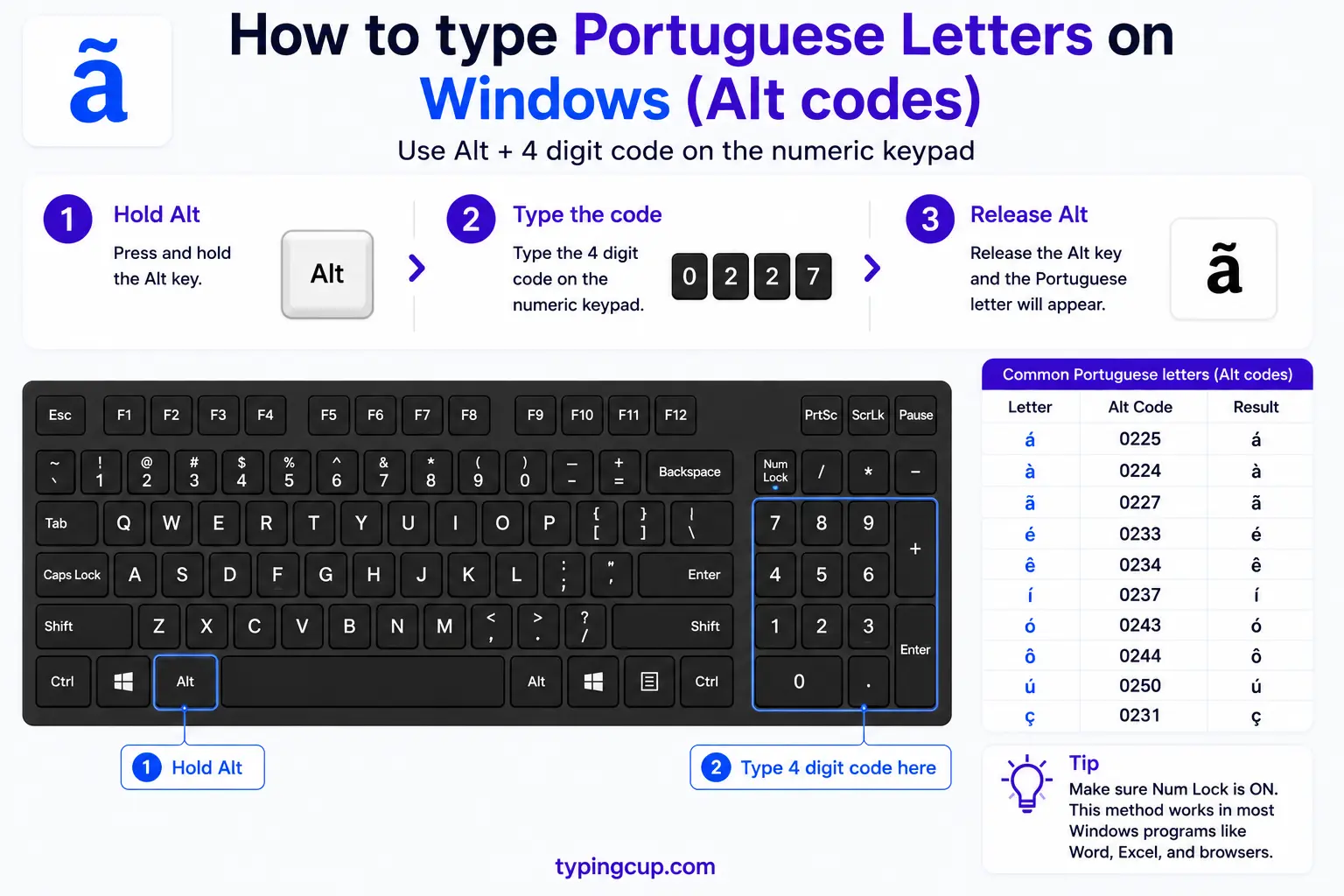
Hold Alt and type the four-digit code on the numeric keypad (Num Lock on): 0225 for á, 0227 for ã, 0245 for õ, 0231 for ç. The full list is in the table above. Keep the leading zero, and use the keypad, not the top-row numbers.
The US-International keyboard (best for Windows)
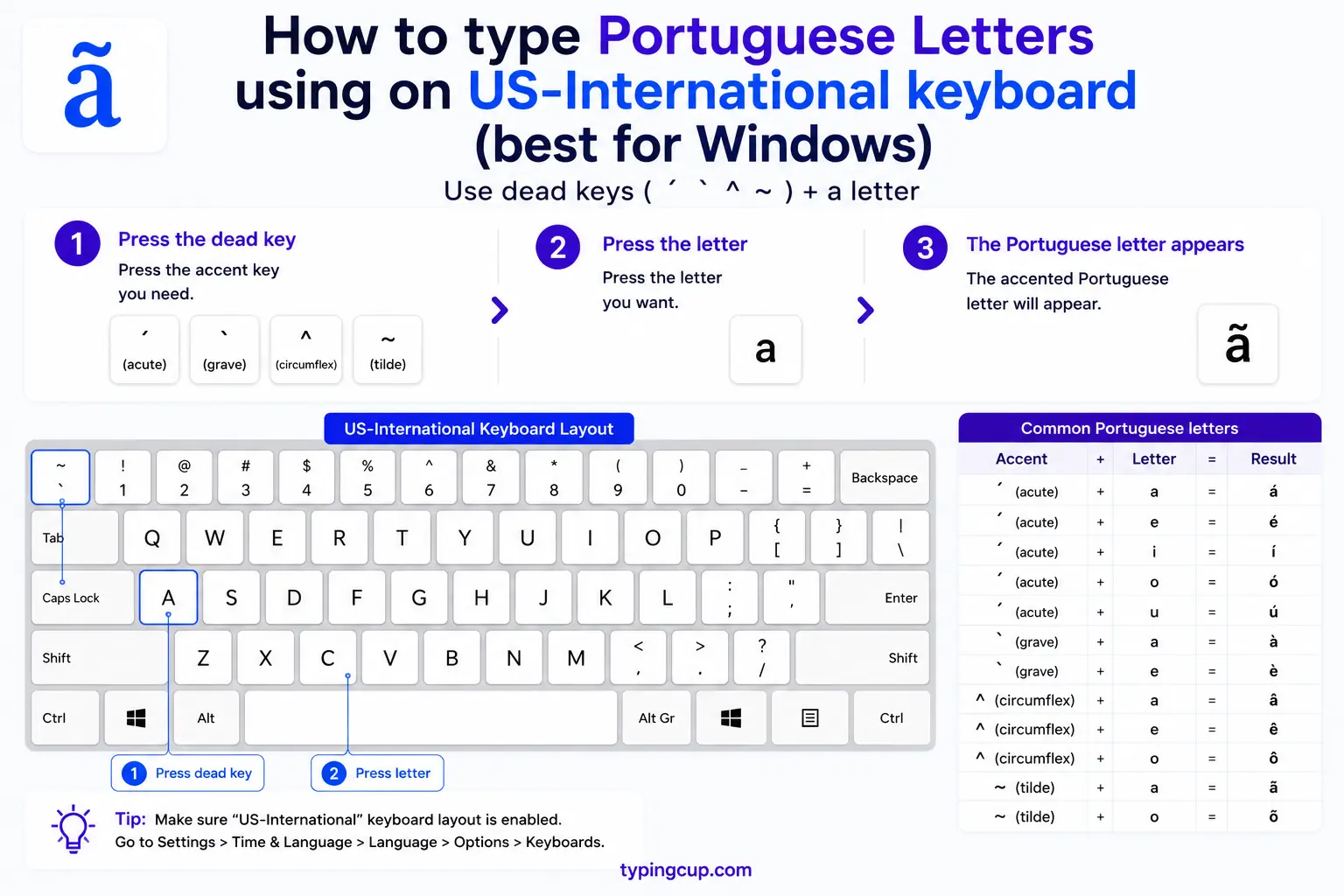
Switch to the US-International layout and the accents become dead keys: type ‘ then a vowel for the acute (á), ^ then a vowel for the circumflex (â), and — the useful one for Portuguese — ~ then a for the tilde (ã), or ~ then o for õ. The cedilha comes from ‘ then c.
On Mac
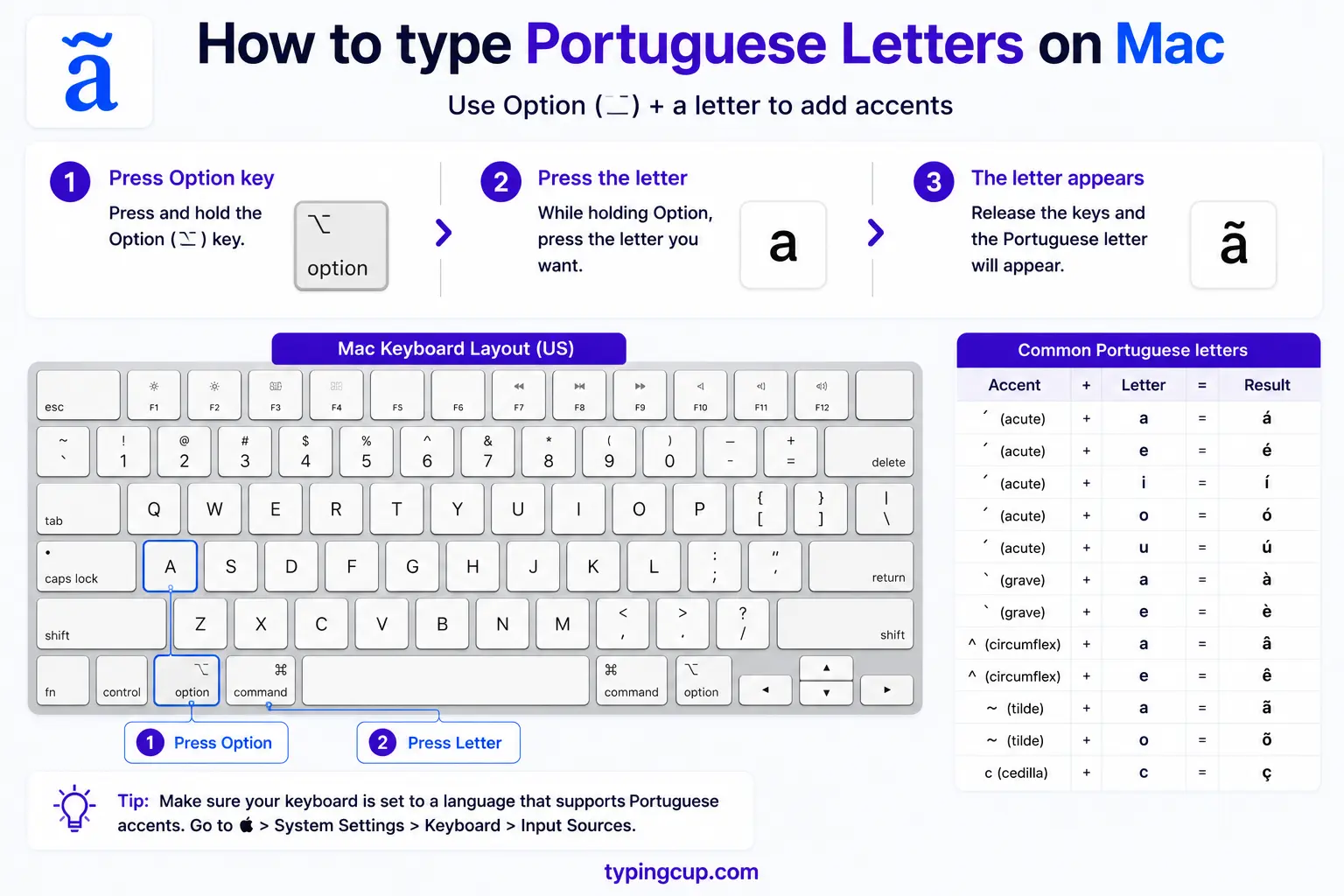
Mac uses Option dead keys: Option + e then the vowel for the acute (á), Option + i then the vowel for the circumflex (â), and Option + n then a or o for the tilde (ã, õ). The cedilha is a direct Option + c (ç), and the grave is Option + ` then a (à).
On a Brazilian ABNT2 keyboard
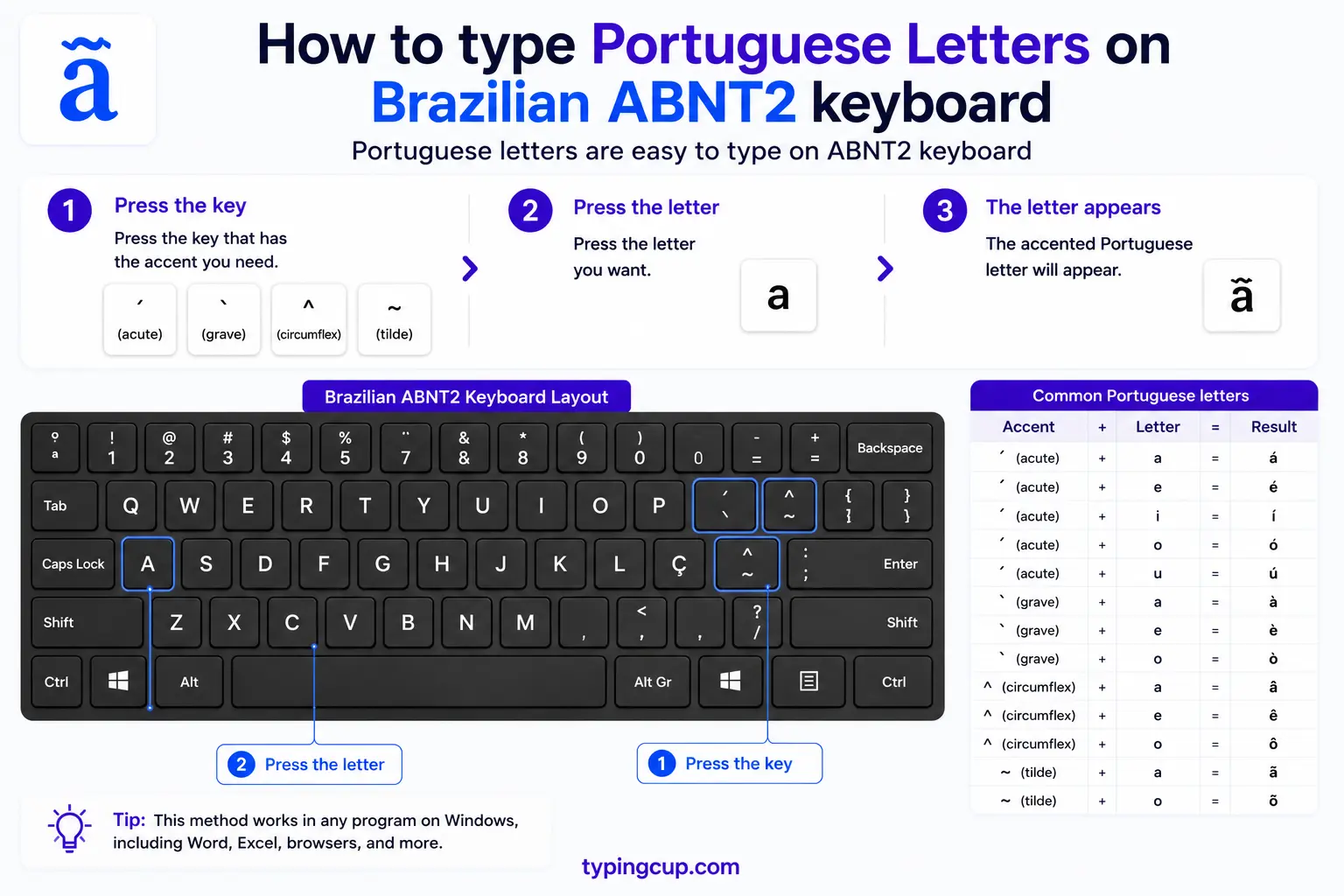
The Brazilian ABNT2 keyboard is built for Portuguese: it has a dedicated ç key to the right of the L, plus dead keys for the acute, circumflex, and tilde right where your fingers expect them. If you write Portuguese daily, this layout is the smoothest option.
In Microsoft Word
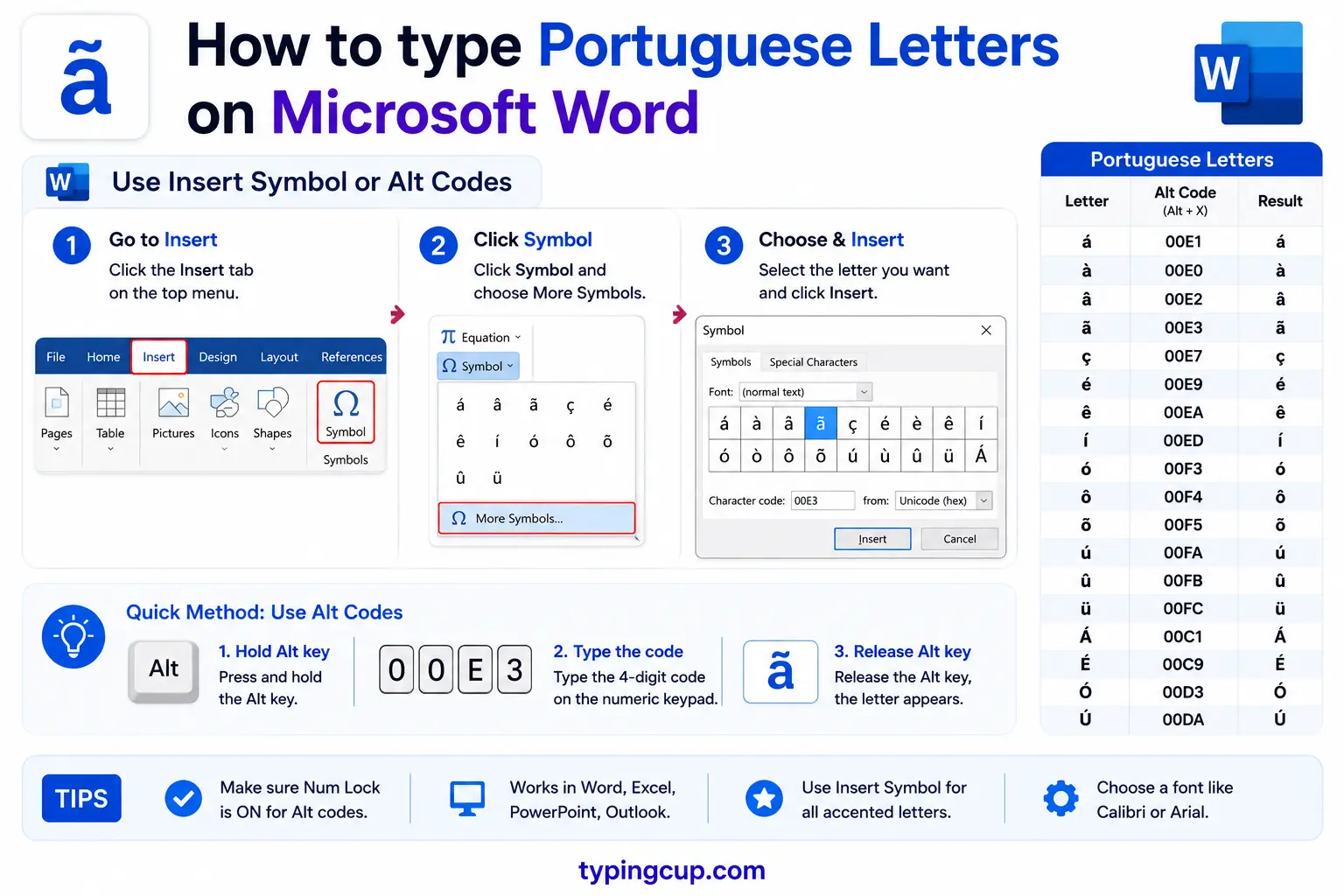
Word shortcuts work on any layout: Ctrl + ‘ then a vowel for the acute (á), Ctrl + Shift + ^ then a vowel for the circumflex (â), Ctrl + Shift + ~ then a vowel for the tilde (ã), Ctrl + ` then a for the grave (à), and Ctrl + , then c for the cedilha (ç).
On iPhone and Android
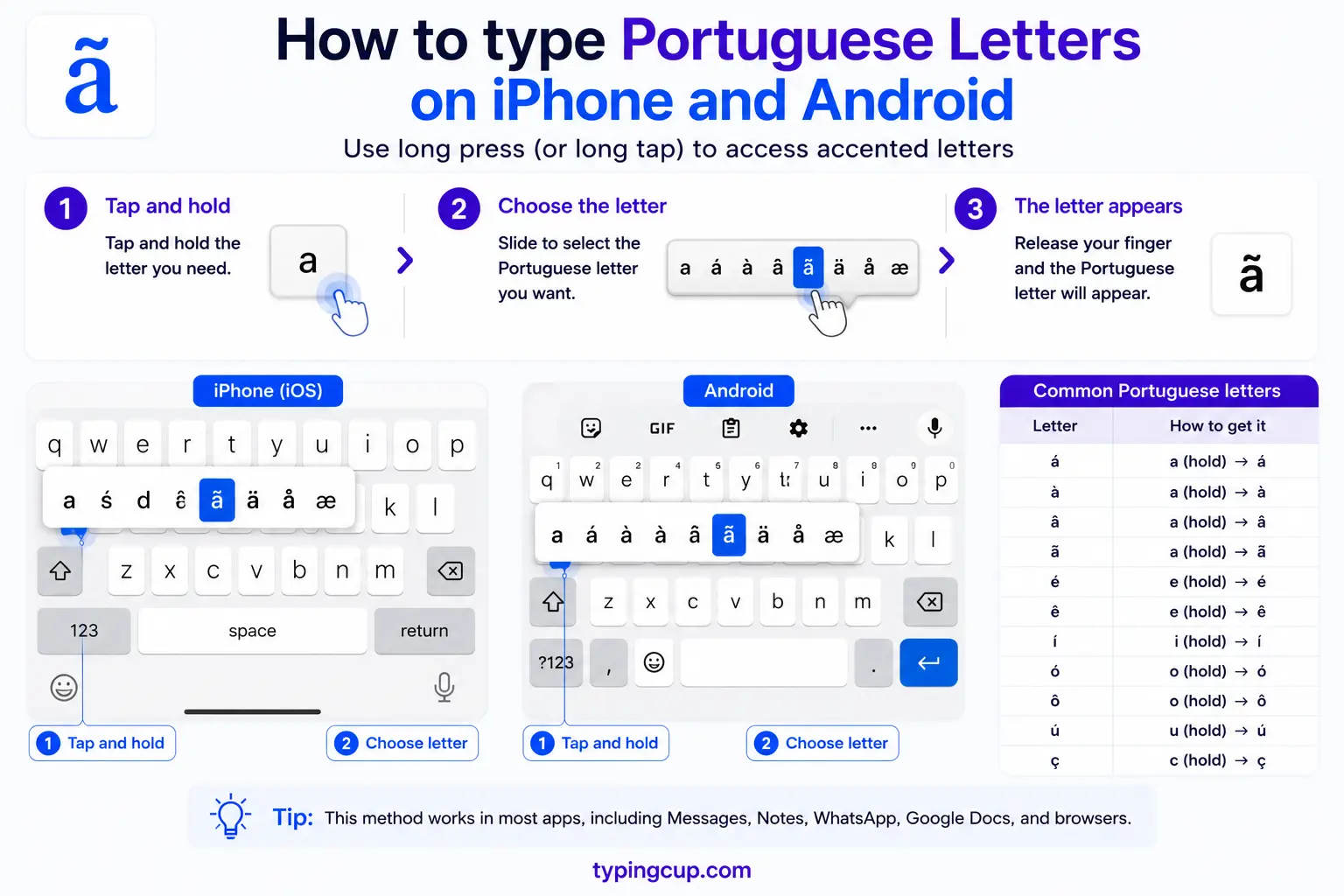
Press and hold the base vowel on the on-screen keyboard: hold a and you will see á à â ã; hold o for ó ô õ; hold c for ç. Slide to the one you want and lift your finger. A Portuguese keyboard makes it even quicker.
In HTML and CSS
Each letter has a named entity: á for á, ã for ã, õ for õ, ç for ç (capitals capitalize the name). In CSS content, use the code point, like \00E3 for ã. Serve the page as UTF-8.
When to use Portuguese accents
Accents in Portuguese carry sound and meaning, so leaving one off can change the word. Here is when they matter.
- To mark the stressed syllable: the acute and circumflex show which syllable is stressed when a word breaks the default rules — café, água, você.
- To set open vs closed vowels: the acute opens the vowel and the circumflex closes it, which distinguishes words — avó (“grandmother,” open o) vs avô (“grandfather,” closed o).
- To nasalize with the tilde: ã and õ turn a plain vowel nasal — pão (bread), irmã (sister), lições (lessons).
- To tell words apart: the accent alone separates look-alikes — pôde (“was able,” past) vs pode (“can,” present), é (“is”) vs e (“and”).
- For crase: the grave à marks the merge of a + a, as in vou à praia (“I’m going to the beach”).
agudo vs circunflexo vs til: á vs â vs ã
The letter a takes three different accents in Portuguese, and each changes the sound in its own way. This is the set that confuses learners most.
| Letter | Accent | What it does | Example |
| á | agudo (acute) | stressed, open “ah” | água, rápido |
| â | circunflexo | stressed, closed “uh” | câmara, lâmpada |
| ã | til (tilde) | nasal a | maçã, irmã |
| à | grave | crase (a + a) | às vezes |
| a | none | unstressed / default | casa, mala |
So on a single letter, á, â, and ã are three different sounds: open, closed, and nasal. The tilde in particular has no equivalent in English, which is why maçã (apple) is worth practicing out loud.
Portuguese examples
Common words for each accent, so the patterns stick.
| Accent | Examples |
| á é í ó ú (agudo) | café, água, aí, avó, saúde |
| â ê ô (circunflexo) | você, avô, três, pôr |
| ã õ (til) | não, pão, mãe, coração, lições |
| à (grave) | à, às, àquele |
| ç (cedilha) | açúcar, França, cabeça, moço |
The tilde (til): Portuguese nasal vowels ã and õ
If one accent says “Portuguese,” it is the tilde. Placed on ã and õ, it makes the vowel nasal — the air comes partly through the nose, a sound English does not have. It powers some of the most common words in the language: não (no), pão (bread), mão (hand), coração (heart), irmã (sister). It also builds the nasal diphthongs that end so many words: ão (lição), õe (põe), and ãe (mãe). Only a and o take the tilde in Portuguese, and getting it right is the difference between sounding fluent and sounding foreign.
The grave à and crase: Portuguese’s rarest accent
The grave accent shows up on just one vowel, à, and does one job: crase. Crase is the merger of the preposition a (“to”) with the feminine article a (“the”) — two little a’s that fuse into a single accented one. So “I’m going to the beach” is vou à praia, not “a a praia.” You also see it in fixed phrases like às vezes (“sometimes”) and à noite (“at night”). Because it only appears in this contraction, the grave is by far the rarest Portuguese accent — but skipping it is still a grammar mistake, and knowing crase is a mark of careful writing.
The trema ü: the accent Portuguese abolished (2009)
Here is the one almost no guide mentions. Portuguese used to have a fifth diacritic, the trema (two dots, as in ü), which marked a u that should be pronounced in groups like güe and qüi. The Orthographic Agreement, which took effect in Brazil in 2009, abolished it: lingüiça became linguiça, freqüente became frequente, and cinqüenta became cinquenta. The only place the trema survives is in foreign names and their derivatives, like Müller and mülleriano. The same reform also dropped some accents — idéia became ideia and vôo became voo — so if you see two spellings of a Portuguese word, this is usually why.
Brazilian vs European Portuguese spelling
The two main varieties spell some words differently, even after the 2009 Agreement tried to bring them together. A frequent split is circumflex versus acute: Brazil writes Antônio and econômico with a closed vowel, while Portugal writes António and económico with an open one. Portugal also keeps silent consonants that Brazil drops, so facto (Portugal) is fato (Brazil) and recepção (Portugal) is receção in some cases. The accents themselves are typed the same way on any keyboard — the differences are in which word takes which accent, so when in doubt, match the variety your reader uses.
Copy-paste HTML codes
The Portuguese letters with their HTML entities and code points, in one place.
| Letter | Named entity | Numeric | Code point |
| á | á | á | U+00E1 |
| ã | ã | ã | U+00E3 |
| â | â | â | U+00E2 |
| à | à | à | U+00E0 |
| é | é | é | U+00E9 |
| õ | õ | õ | U+00F5 |
| ç | ç | ç | U+00E7 |
| ê | ê | ê | U+00EA |
Capitals use the same names capitalized (Á, Ã, Ç). For related guides, see the full letters with accents list, how to type Spanish letters, French letters, and German letters.
Troubleshooting
My accents show as gibberish like ã or ç
That is an encoding mismatch — UTF-8 text is being read as an older encoding. ã is a mangled ã and ç is a mangled ç. Set the file, database, and page charset to UTF-8 and the accents return.
My tilde won’t combine with the vowel
On a dead-key layout, press the tilde key (or Option + n on a Mac) first, then the vowel — nothing appears until you type the a or o. If a plain ~ shows up alone, your layout may not be US-International or Portuguese; switch it, or copy ã and õ from the grid above.
My Alt code types the wrong letter
Usually a missing leading zero or Num Lock being off. Portuguese letters use the four-digit codes with a zero, like 0227 for ã — the shorter three-digit codes give different characters. Use the numeric keypad with Num Lock on.
Frequently asked questions
How do I type Portuguese accents on a keyboard?
On Windows, hold Alt and type the code (0225 for á), or use the US-International layout with dead keys. On a Mac, use Option shortcuts (Option + n then a for ã). On a phone, press and hold the vowel. Or copy any letter from the grid above.
How do I type the Portuguese tilde ã and õ?
On Windows, Alt + 0227 for ã and Alt + 0245 for õ, or type ~ then the vowel on the US-International layout. On a Mac, press Option + n then a or o. In HTML, ã and õ.
When do you use à in Portuguese?
The grave à is used for crase — the merger of the preposition a with the article a. For example, vou à praia (“I’m going to the beach”) and às vezes (“sometimes”).
Does Portuguese still use the trema (ü)?
No, not in native words. The 2009 Orthographic Agreement abolished it, so lingüiça is now linguiça. It survives only in foreign names like Müller.
How do I write Portuguese letters in HTML?
Use named entities: á for á, ã for ã, õ for õ, ç for ç. Serve the page as UTF-8 and the letters also work typed directly.
