Bitcoin Symbol (₿): How to Type, Copy, and Use It
The Bitcoin symbol ₿ is a capital B with two vertical strokes, the currency sign for the cryptocurrency, sitting in the same family as $, €, and £. It is newer than most: Unicode only added it in 2017, which is why you still see BTC, XBT, and even the Thai baht ฿ standing in for it. Here is how to type ₿, where to copy it, and how it differs from the tickers and look-alikes it gets mixed up with.
In a hurry?
- Copy it: click ₿ in the grid below.
- Windows: in Word, type 20BF then Alt + X for ₿.
- Mac: open the Character Viewer (Control + Command + Space) and search “bitcoin”.
- No dedicated key: ₿ is not on any keyboard, so copy it or use Word / Character Map.
- In HTML the Bitcoin sign is
₿; in a URL it is%E2%82%BF.
Table of Contents
The real Bitcoin sign is ₿ (U+20BF). The similar-looking ฿ is the Thai baht, a completely different currency — a mix-up with real history, covered below.
Bitcoin symbol: every code in one table
The Bitcoin sign with every code you are likely to need. Copy from the grid above, or use whichever method fits the app you are in.
| Property | Bitcoin sign |
| Character | ₿ |
| Name | Bitcoin Sign |
| Unicode | U+20BF |
| Windows Alt code | Alt + 8383* |
| Word (type + Alt+X) | 20BF |
| Mac | Character Viewer |
| HTML numeric | ₿ |
| HTML hex | ₿ |
| URL / percent | %E2%82%BF |
*Alt + 8383 works only in apps that accept decimal Unicode from the numeric keypad, such as Word; most text boxes ignore it. There is no dedicated key for ₿ on any keyboard, so the routes that always work are Word (20BF then Alt + X), Character Map, or copying from the grid above.
How to type the Bitcoin symbol on any device
On Windows
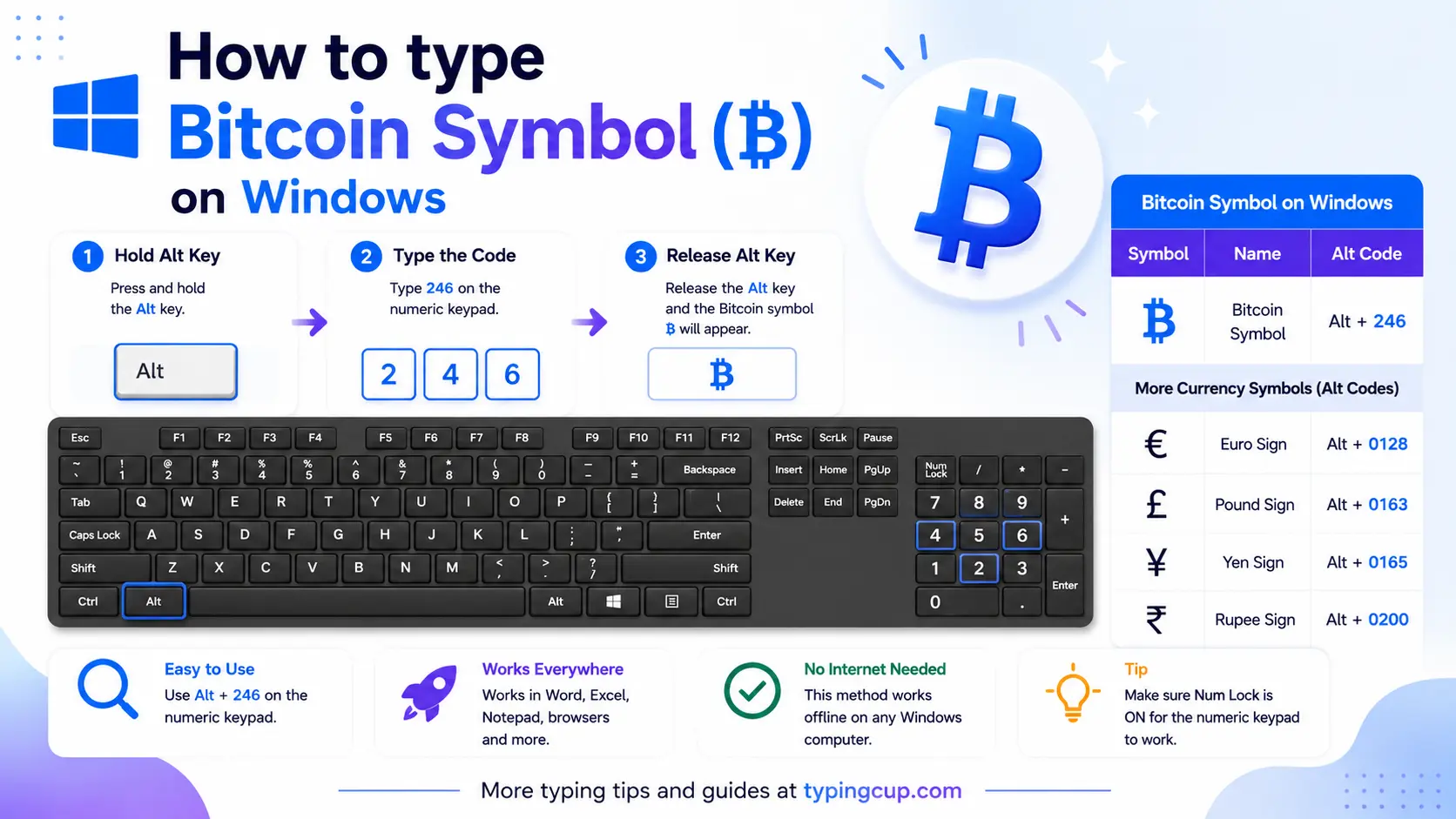
The reliable way is Word: type 20BF and press Alt + X to get ₿. In apps that accept decimal Unicode, Alt + 8383 on the numeric keypad works too (Num Lock on). Otherwise open Character Map (search charmap), find the Bitcoin sign in the Currency Symbols range, and copy it. There is no key for ₿, so most people just keep it on the clipboard.
On Mac
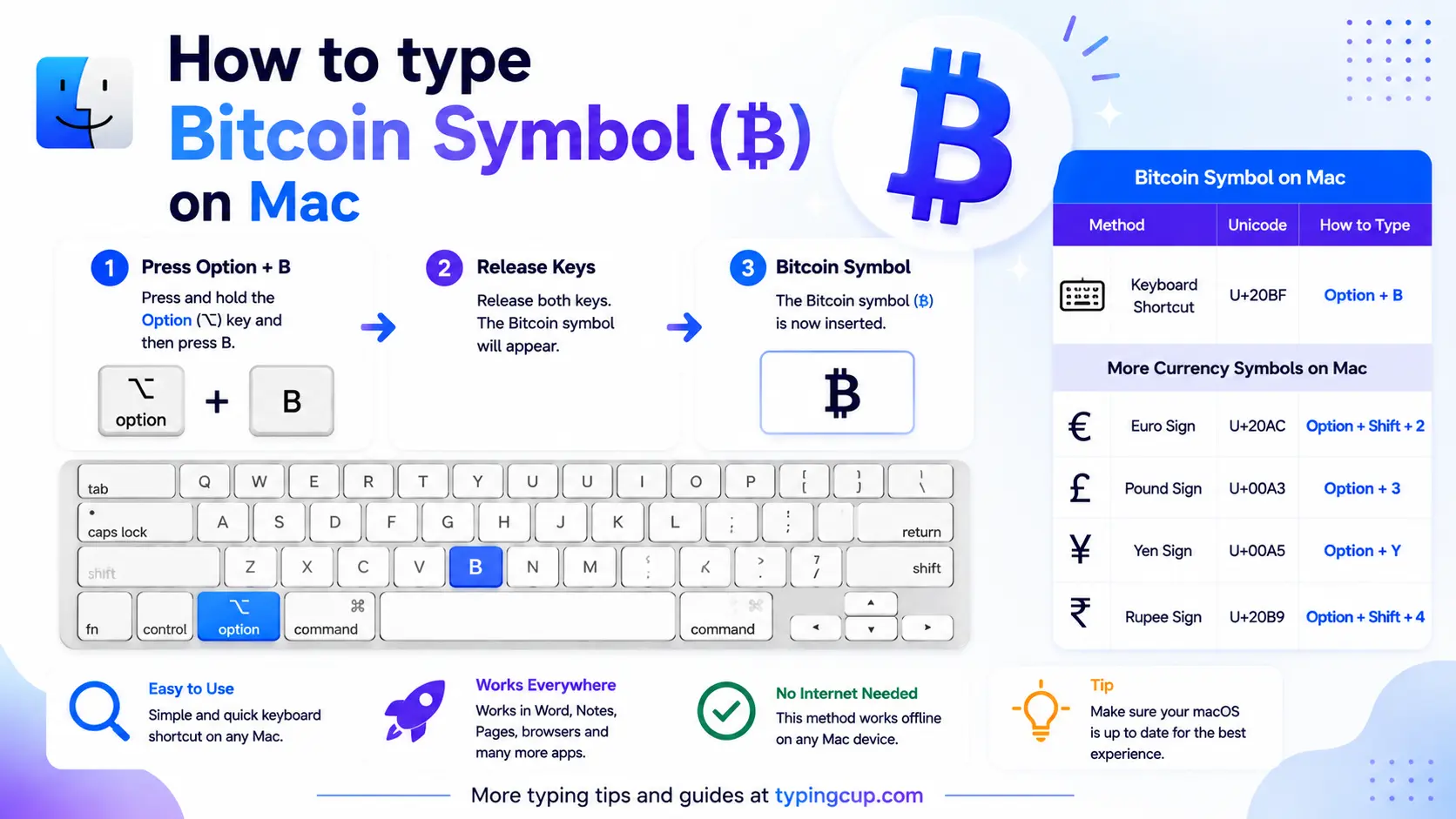
Open the Character Viewer with Control + Command + Space, search “bitcoin”, and double-click ₿. If you use it often, drag it into your Favorites in that panel so it is one click away.
On iPhone and Android
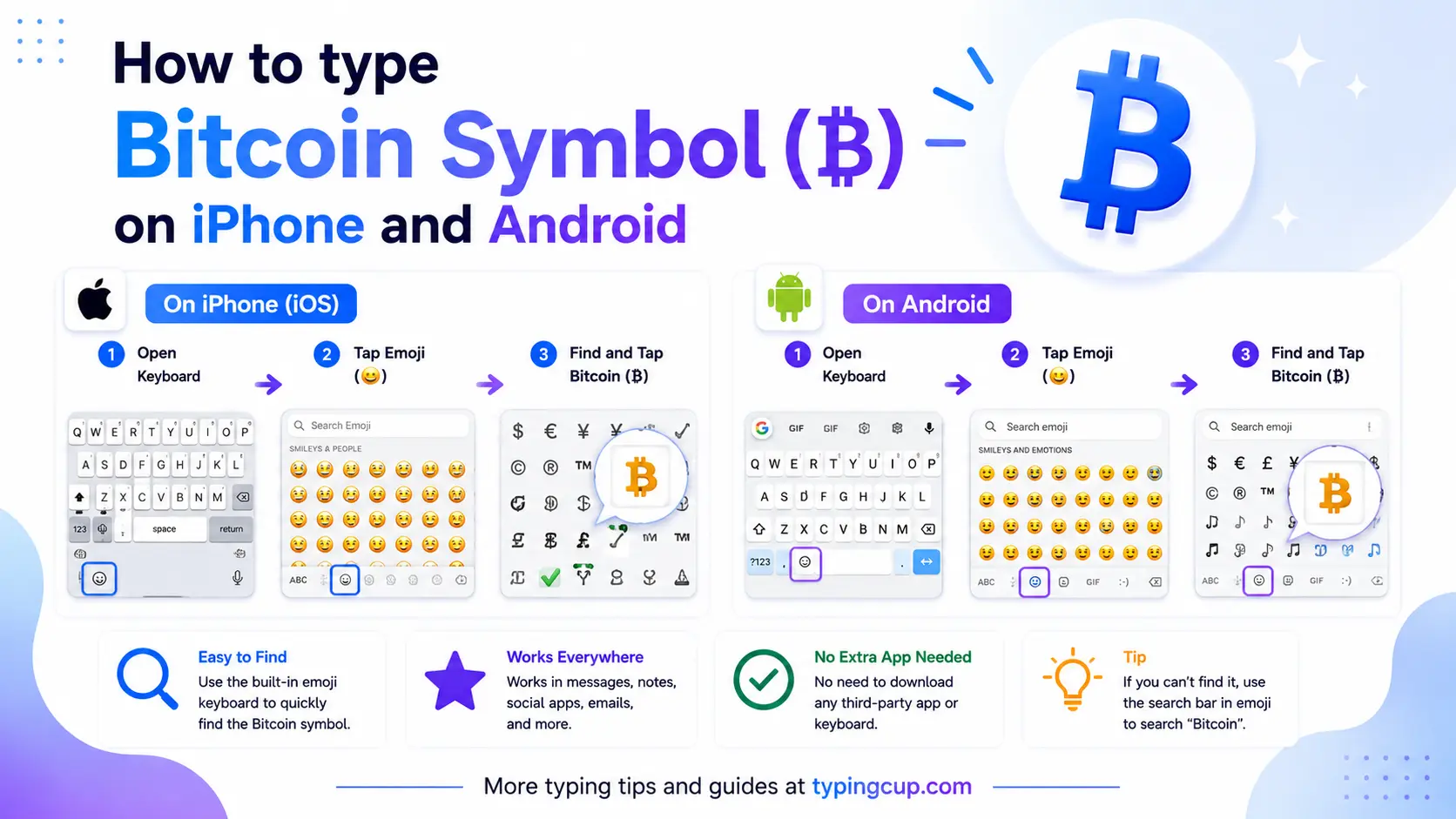
Phone keyboards do not include ₿, and long-pressing the $ key gives other national currencies, not Bitcoin. The quickest route is to copy ₿ from the grid above, or save it in a text-replacement shortcut so a code like “btcsym” expands to the sign.
In Microsoft Word
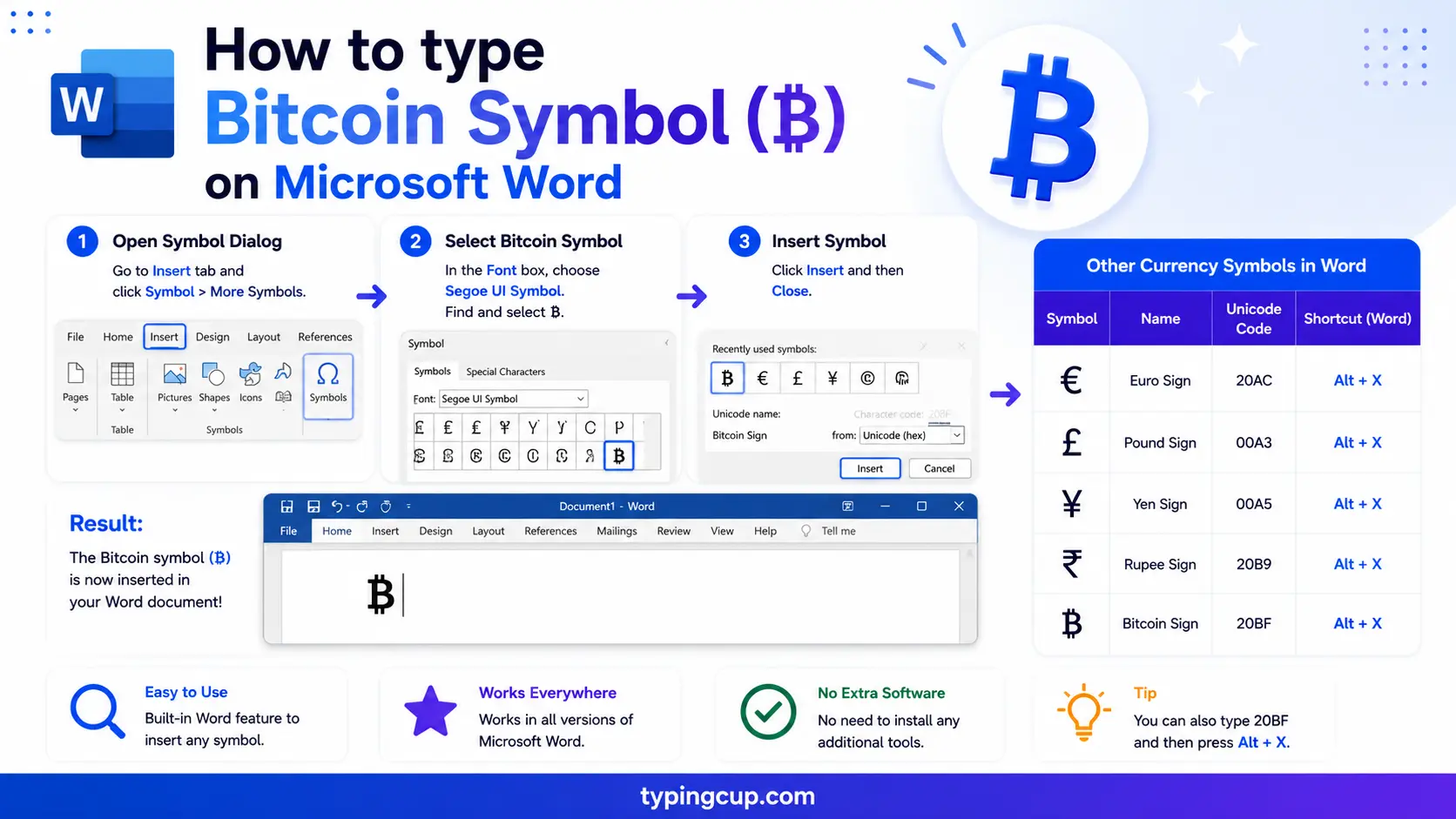
Type 20BF then press Alt + X, and Word turns it into ₿. You can also use Insert → Symbol → More Symbols and choose the Currency Symbols subset. Alt + X runs in reverse too, turning a selected ₿ back into its code.
On Linux
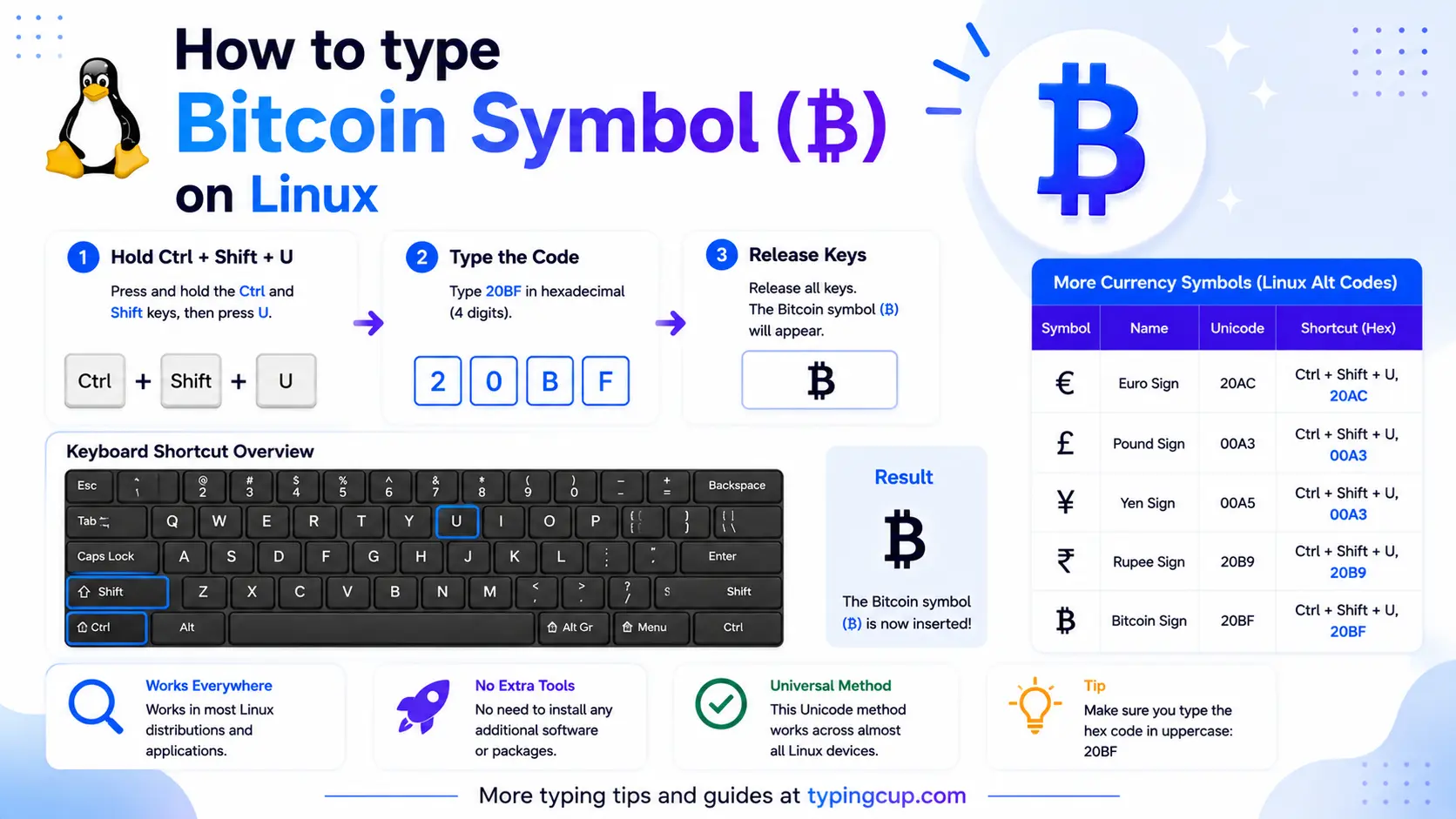
Press Ctrl + Shift + U, type 20bf, then Enter for ₿. On layouts with a Compose key, some setups also map it, but the Unicode entry works everywhere.
In HTML and CSS
In HTML, use ₿ or the hex form ₿ — there is no short named entity for it. In a CSS content value, use \20BF. Serve the page as UTF-8 and pick a font that includes the sign, since some older fonts predate it.
What the Bitcoin symbol means
₿ is a currency sign, the Bitcoin equivalent of $ or €. But Bitcoin is written several ways depending on the context: the sign ₿ in prices and branding, the ticker BTC on most exchanges, and the code XBT in finance. They all refer to the same thing, and knowing which is which saves confusion when a chart says one and a wallet says another.
₿, BTC, and XBT: the sign vs the tickers
Three labels, one currency. ₿ is the currency sign, used the way $ is, in front of an amount. BTC is the everyday ticker you see on wallets and most exchanges. XBT is the more formal code some platforms use (Kraken, and data feeds like Bloomberg) because it follows the ISO 4217 pattern: currencies not tied to one country start with an X. “BTC” breaks that rule, since BT is the country code for Bhutan, so the standards-minded code becomes XBT. Same bitcoin, just a naming convention — if you see XBT on an exchange, it is not a different coin.
₿ vs ฿ vs Ƀ: the look-alikes and the history
Before Bitcoin had its own character, people borrowed ones that looked close, and those substitutes still float around. The Thai baht ฿ (U+0E3F) was the most common stand-in — a B with a single vertical stroke — even though it is an entirely separate currency. Some used Ƀ (U+0243, a Latin B with stroke) instead. Then, in Unicode 10.0 (June 2017), Bitcoin finally got its own code point, ₿ (U+20BF), a B with two strokes. So if you are quoting a price today, use ₿; the baht ฿ is a different currency and will confuse anyone reading carefully.
Satoshis and subunits: sats, bits, and mBTC
One bitcoin is highly divisible. The smallest unit is the satoshi (or “sat”), and 1 BTC = 100,000,000 sats — a hundred million — named after Bitcoin’s pseudonymous creator, Satoshi Nakamoto. In between there are larger subunits: a millibitcoin (mBTC) is 0.001 BTC, and a bit (or microbitcoin) is 0.000001 BTC, which equals 100 sats. As prices climbed, sats became the everyday unit for small amounts, so “1,000 sats” is now a normal way to price a tip or a fee. There is no official Unicode character for the satoshi yet, though the community has floated a few designs.
How to write Bitcoin amounts: ₿ before or after?
Bitcoin follows the dollar convention: the sign goes before the number, so half a coin is ₿0.5, not 0.5₿. Amounts run to eight decimal places (one satoshi is 0.00000001 BTC), so a price might read ₿0.00042000. In running text, many style guides prefer spelling it out or using the ticker — “0.5 BTC” — and reserve the sign ₿ for tables and interfaces. One more convention worth knowing: capital-B Bitcoin usually means the network or protocol, while lowercase bitcoin means the unit of currency.
Bitcoin and other crypto symbols: Ethereum Ξ, and the ones without a sign
Bitcoin is unusual in having its own Unicode sign at all. Ethereum is often written with the Greek capital Ξ (Xi), but that is a borrowed letter, not an official currency character. Litecoin uses Ł and Dogecoin sometimes Ð, again repurposed letters. The reality is that most cryptocurrencies have no official symbol and are written by their ticker — ETH, SOL, ADA, and so on. So ₿ sits in rare company: a crypto asset that made it into the Unicode standard, alongside the dollar and the euro.
The ₿ symbol in spreadsheets and code
Neither Excel nor Google Sheets has a built-in Bitcoin currency format, so you add the sign yourself. To display one, use =UNICHAR(8383), or apply a custom number format like “₿”0.00000000 to show eight decimals with the sign in front. In code, the escape is \u20BF in JavaScript, Java, and Python, and ₿ in HTML. If you are storing amounts, keep them as integers of satoshis rather than decimals of BTC, so rounding never loses a fraction of a coin.
Which Bitcoin symbol? ₿ vs ฿ vs Ƀ
Only one of these is actually Bitcoin. The table makes the difference clear.
| Symbol | Name | Unicode | What it really is |
| ₿ | Bitcoin sign | U+20BF | the official Bitcoin currency sign |
| ฿ | Thai baht | U+0E3F | Thailand’s currency, an old stand-in |
| Ƀ | Latin B with stroke | U+0243 | an early unofficial substitute |
| BTC | Ticker | — | common exchange code |
| XBT | ISO-style code | — | formal / finance code |
Bitcoin symbol in URLs and encoding
In a link, ₿ is percent-encoded as %E2%82%BF — three UTF-8 bytes, since it lives in the Currency Symbols block high in Unicode. If ₿ shows up as â‚¿ or an empty box, either the text is being read in the wrong encoding or the font is older than 2017 and has no glyph for it. Set the file, database, and page to UTF-8, and use a current font so the sign renders.
Copy-paste HTML codes
The Bitcoin sign and its neighbors with their web codes, in one place. Copy the code you need.
| Symbol | Name | Numeric / hex | URL (percent) code |
| ₿ | Bitcoin sign | ₿ / ₿ | %E2%82%BF |
| ฿ | Thai baht | ฿ / ฿ | %E0%B8%BF |
| Ƀ | B with stroke | Ƀ / Ƀ | %C9%83 |
| Ξ | Xi (Ethereum) | Ξ / Ξ | %CE%9E |
In a CSS content value, use \20BF for the Bitcoin sign. For every other symbol and its codes, see the copy and paste symbols tool and the symbol Alt codes list.
Troubleshooting
My ₿ shows as a box or â‚¿
A box means the font predates 2017 and has no glyph for the Bitcoin sign; the â‚¿ pattern means UTF-8 bytes read as an older encoding. Set the file, database, and page to UTF-8, and switch to a current font (most modern system fonts include ₿).
Alt + 8383 does nothing
The app does not accept decimal Unicode from the Alt key — that is normal outside Word and a few others. Type 20BF then Alt + X in Word, open Character Map, or copy ₿ from the grid above. Num Lock also has to be on for any keypad code.
I typed the baht ฿ by mistake
Easy to do, since ฿ (Thai baht) looks like a one-stroke Bitcoin sign. Replace it with the real ₿ (U+20BF), which has two strokes. In accounting or anything public, the difference matters — they are different currencies.
Frequently asked questions
How do I type the Bitcoin symbol ₿?
In Word, type 20BF then Alt + X. On a Mac, open the Character Viewer (Control + Command + Space) and search “bitcoin”. In HTML it is ₿. There is no dedicated key, so copying it from the grid above is often quickest.
What is the difference between ₿, BTC, and XBT?
₿ is the currency sign, BTC is the common ticker, and XBT is the ISO-style code some exchanges use because “BTC” clashes with Bhutan’s country code. All three mean bitcoin.
What is the difference between ₿ and ฿?
₿ (U+20BF) is the Bitcoin sign, a B with two strokes. ฿ (U+0E3F) is the Thai baht, a different currency with one stroke that was used as a Bitcoin stand-in before 2017. Use ₿ for bitcoin.
How many satoshis are in one bitcoin?
Exactly 100,000,000 — one hundred million. A satoshi (sat) is the smallest unit of bitcoin, so 0.00000001 BTC equals one sat.
How do I write the Bitcoin symbol in HTML?
Use ₿ or the hex form ₿ — there is no short named entity. In a CSS content value it is \20BF, and in a URL it is %E2%82%BF.
