How to Type Á / á (A With an Acute Accent)
á is a lowercase a with an acute accent, the small stroke that leans to the right. Its capital is Á. It’s most familiar from Spanish, where it marks a stressed syllable, but the same letter does a range of jobs across other languages.
If you just need the character, copy á or Á from the grid below. You can also grab its HTML entity or URL code straight from there, which the rest of this page explains and most guides leave out.
Further down you’ll find how to type á on every device, how it differs from à and the other accented a’s, when Spanish actually requires it, and how it behaves in links and code.
In a hurry?
- Copy it: click á or Á in the grid below.
- On Windows: hold Alt and type 0225 for á (0193 for Á).
- On a Mac: press Option + e, then press a.
- On a phone: press and hold the a key, then slide to á.
- In a URL á is written %C3%A1; in HTML it’s á.
Click to copy: á, and its codes
Grab the letter, the HTML entity, or the URL code
Table of Contents
Copy and paste á
The two characters, with every code you’re likely to need in one row. Use the grid above to copy with a click; this table is the reference.
| Character | Name | Unicode | Windows | Mac | HTML |
|---|---|---|---|---|---|
| á | a with acute | U+00E1 | Alt + 0225 | Option + e, a | á |
| Á | A with acute | U+00C1 | Alt + 0193 | Option + e, Shift + A | Á |
How to type á on any device
á sits in the old Latin range, so it’s easy to reach almost everywhere.
Windows
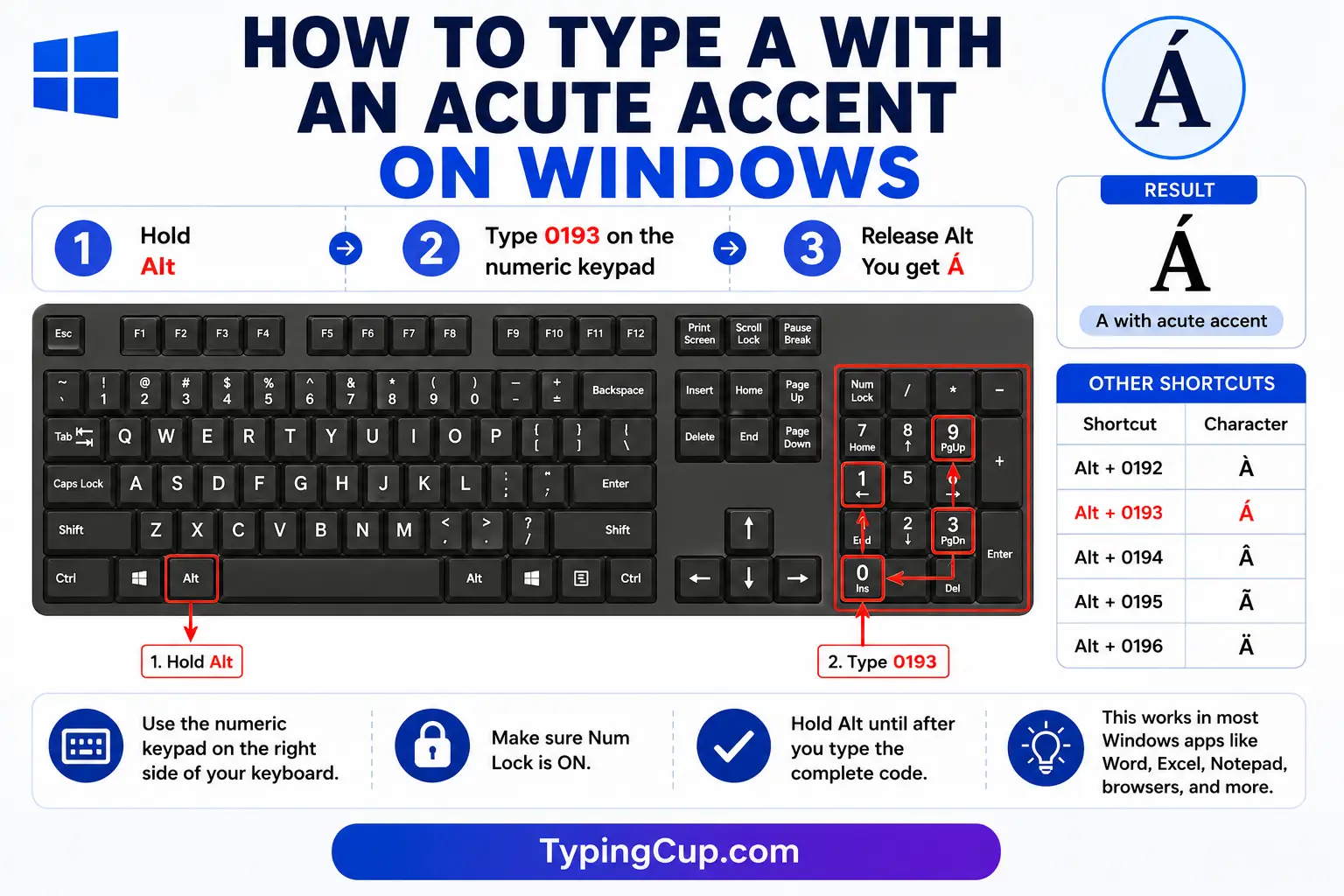
Turn on Num Lock, hold Alt, and type 0225 on the numeric keypad for á, or 0193 for Á. The top-row numbers won’t work; it has to be the keypad.
For regular use, switch to the US-International layout and type an apostrophe (‘) then a. You can also press Windows + . and pick á from the symbol panel.
Mac
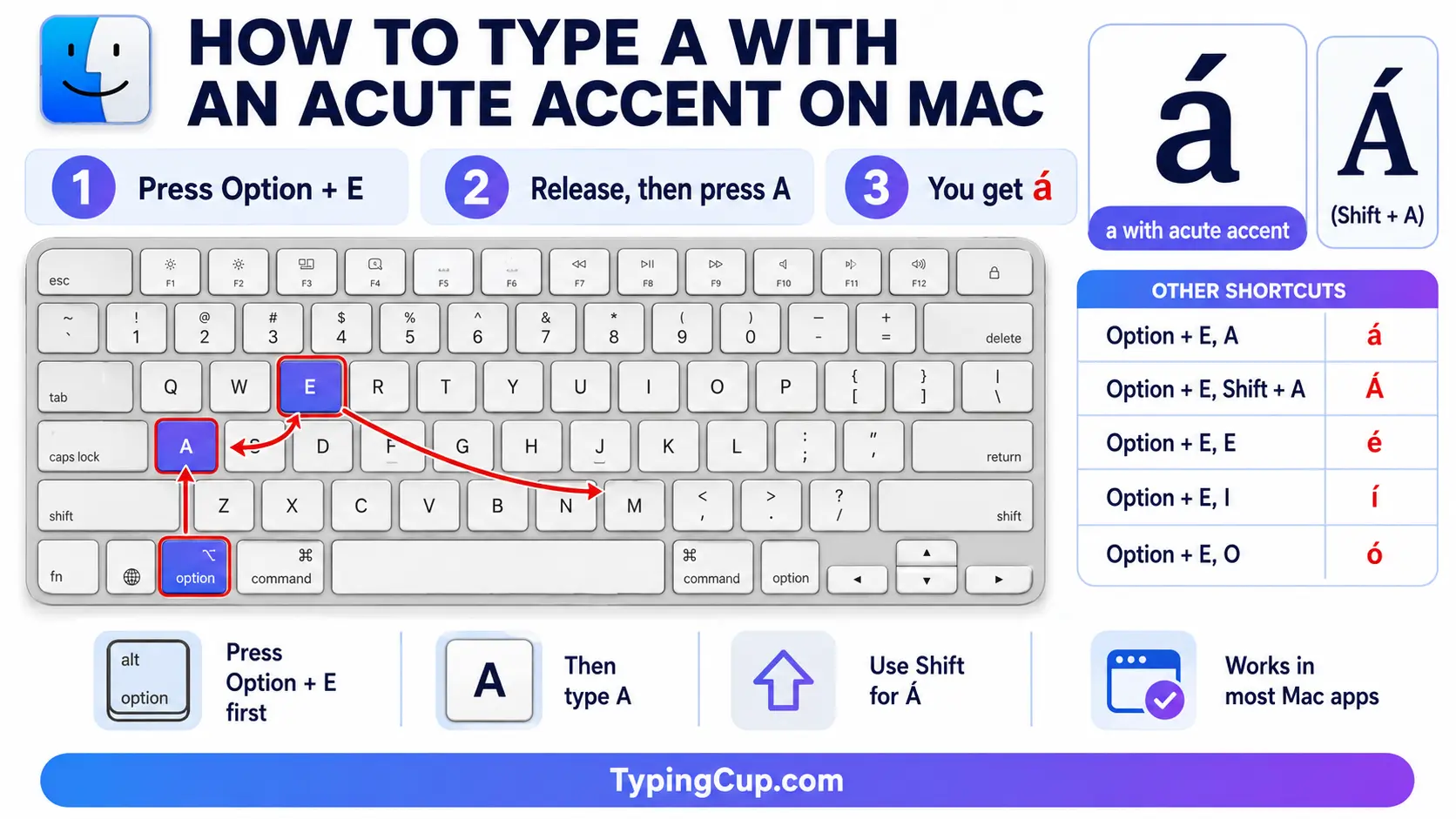
Press Option + e together and let go; nothing shows yet. Press a and á appears. For the capital, it’s Option + e, then Shift + A. Holding the a key down also brings up a menu with á on it.
iPhone and Android
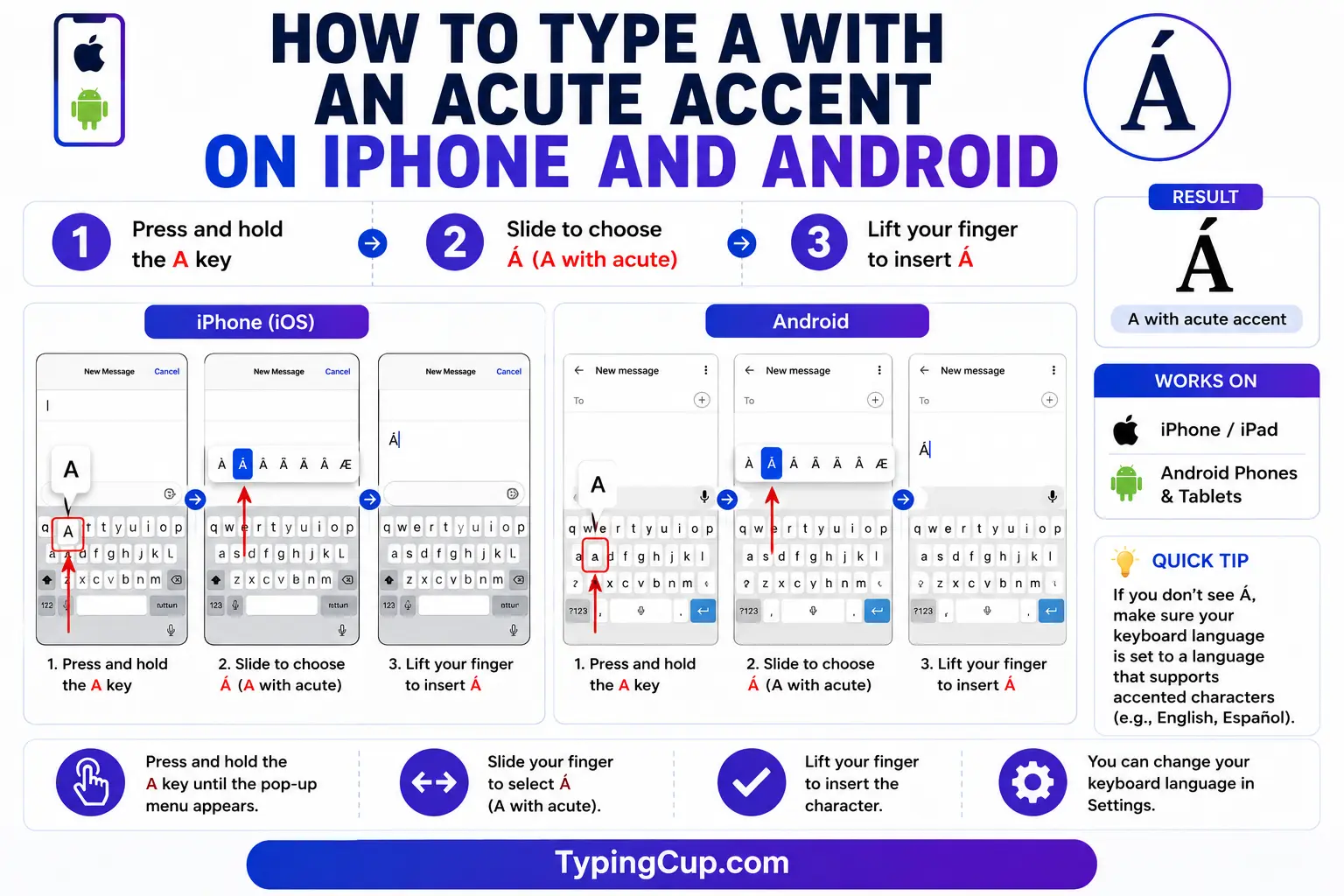
Press and hold the a key on the on-screen keyboard, then slide onto á and lift your finger. Nothing to set up, and it works the same in nearly every app.
Microsoft Word
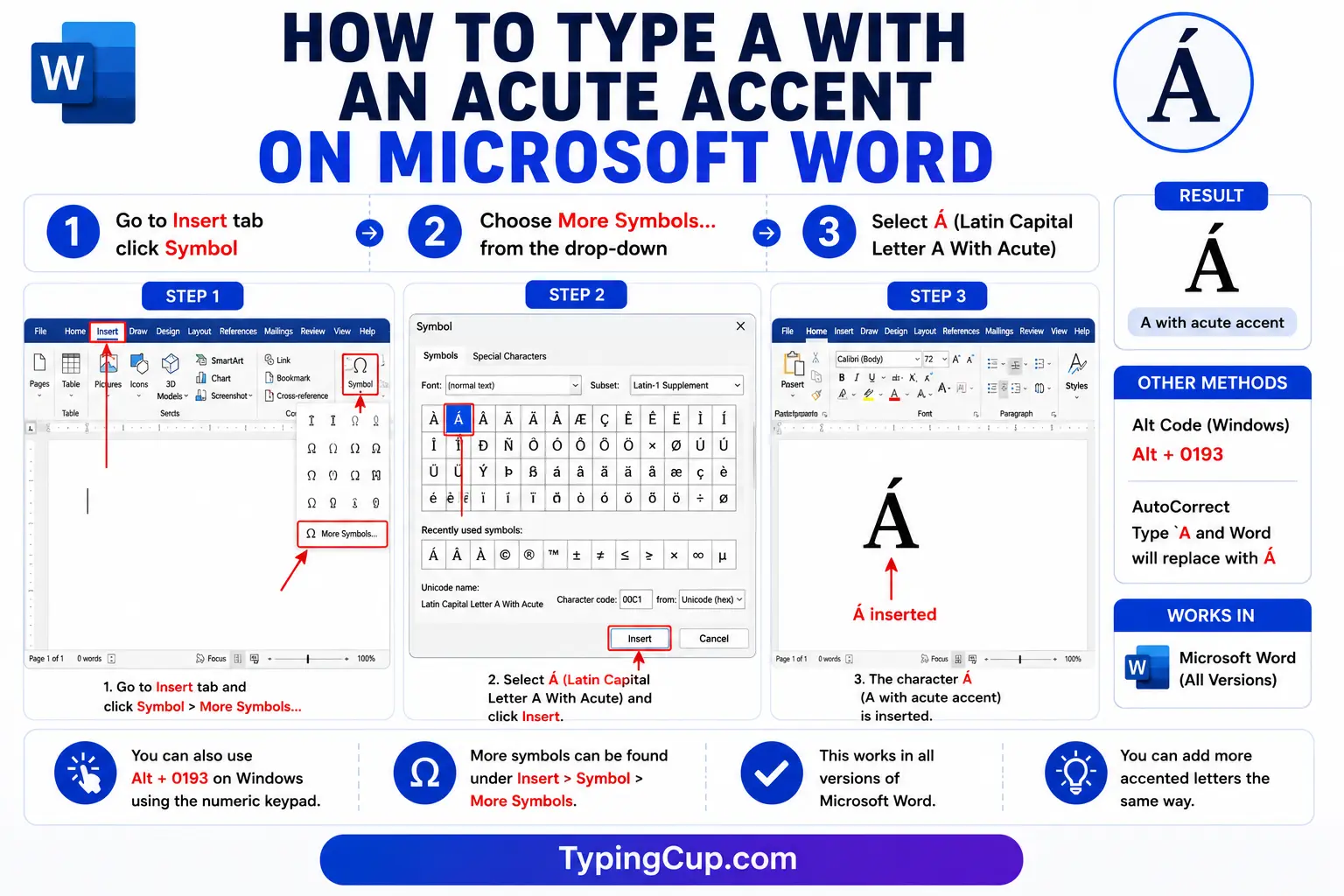
Press Ctrl + ‘ (the apostrophe), let go, then press a. Add Shift on the a for Á. The Windows Alt code works here too.
Linux
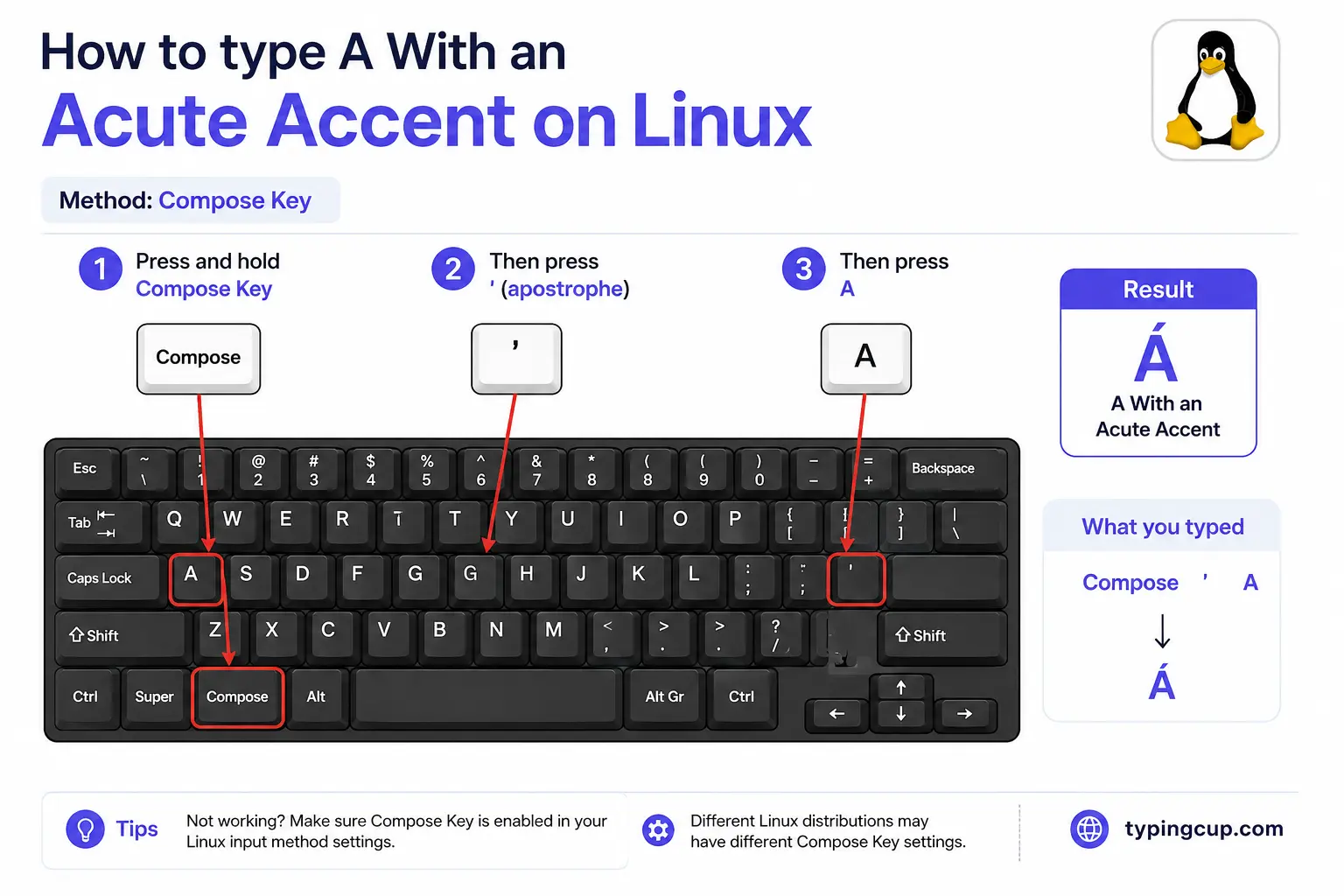
Press Ctrl + Shift + U, type 00e1, then press Enter. With a Compose key, it’s Compose, then ‘, then a.
Excel and Google Sheets
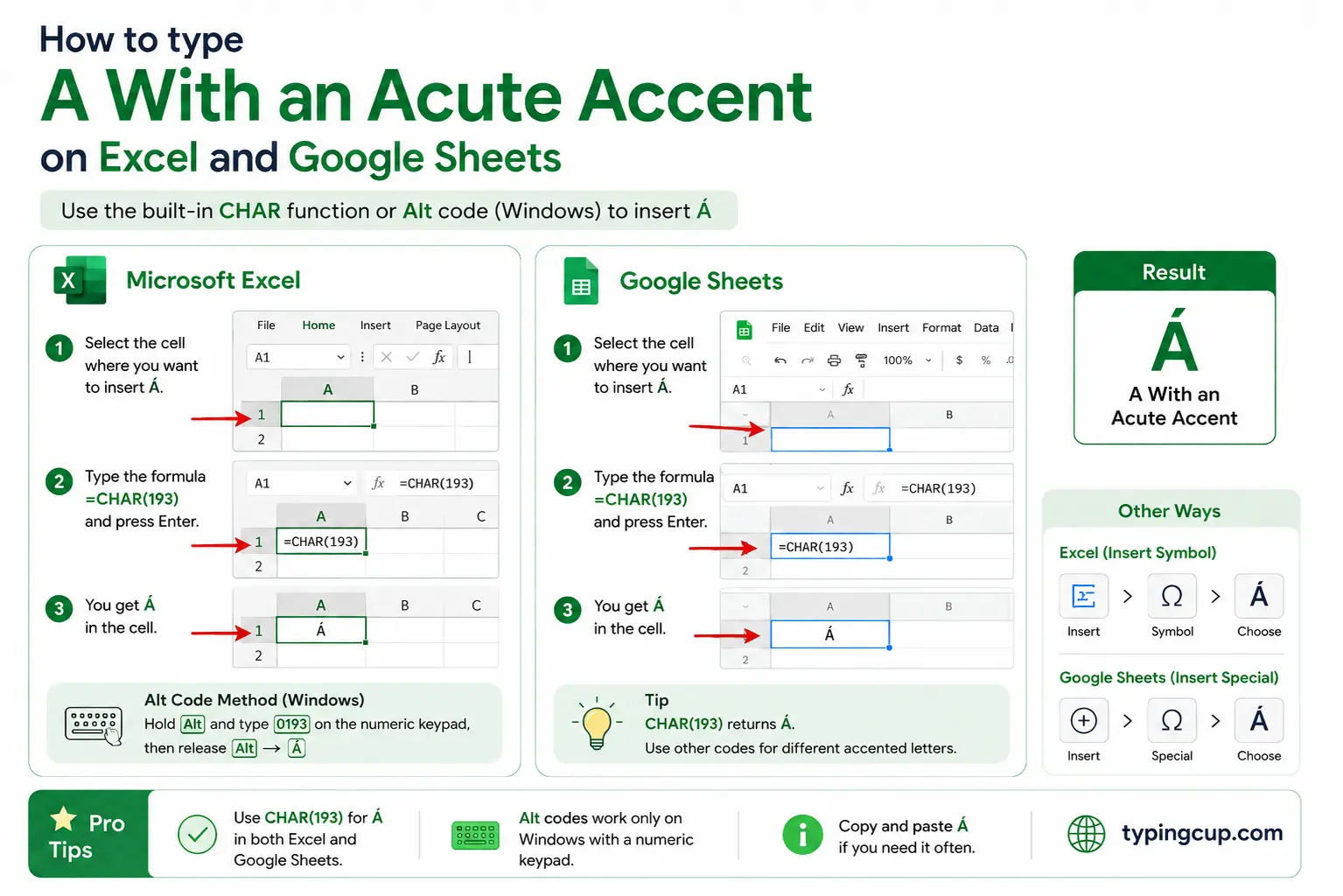
Use the Alt code on the keypad, or the UNICHAR formula: =UNICHAR(225) returns á and =UNICHAR(193) returns Á. The same works in Google Sheets.
á vs à, â, ä, ã, å, and ā: which mark when
The letter a takes more accents than almost any other vowel, and they aren’t interchangeable. á leans right and usually marks stress or a long vowel. The others each belong to different traditions.
| Letter | Mark | Where it is used | Example |
|---|---|---|---|
| á | acute | stress or a long vowel | árbol |
| à | grave | French “to, at” | voilà |
| â | circumflex | often a dropped s (French) | pâte |
| ä | diaeresis | German umlaut | Männer |
| ã | tilde | Portuguese nasal | São |
| å | ring | a Scandinavian letter | Åland |
| ā | macron | a long “a” | Māori |
So á is not just “a with a line on it”; the direction and shape of the mark carry meaning. For every accented a and how to type it, see the a with accent guide.
When Spanish needs the á
In Spanish the acute accent, the tilde, has one main job: it shows which syllable is stressed when a word breaks the default rules. That’s why árbol (“tree”), adiós (“goodbye”), and cámara (“camera”) carry it.
It also tells look-alike words apart. The clearest á example is más (“more”) versus mas (“but”): same letters, different word, and the accent is what separates them. Spanish only ever uses the acute on its vowels, never a grave or a circumflex, so if you see à or â, the word isn’t Spanish. For the whole Spanish set, see how to type Spanish letters.
á around the world
Outside Spanish, the same á takes on different roles. It’s a good example of one mark doing several jobs depending on the language.
| Language | What á does | Example |
|---|---|---|
| Spanish | marks the stressed syllable | árbol (“tree”) |
| Portuguese | a stressed, open “a” | água (“water”) |
| Irish | lengthens the vowel (the fada) | slán (“goodbye”) |
| Icelandic | its own letter, sounds like “ow” | þá (“then”) |
| Hungarian | a long, open vowel | ház (“house”) |
| Czech | a long “a” | káva (“coffee”) |
| Vietnamese | a rising tone | cá (“fish”) |
In Icelandic and Hungarian, á isn’t a decorated a at all; it’s a separate letter with its own sound and its own place in the alphabet, which is why dropping the mark there changes the word entirely.
á in web addresses, URLs, and email
You can use á in a domain name. It’s stored as a Punycode address beginning with xn--, which the browser turns back into á for display, so a real domain can briefly look like a run of random letters.
Inside a URL path or query, á is percent-encoded as %C3%A1, the two UTF-8 bytes (0xC3 and 0xA1) for the character written out. The capital Á is %C3%81. A link with %C3%A1 in it has an á hiding inside.
Email is more cautious. An address can carry á through the same system, but many mail servers still stumble over non-ASCII addresses, so keep á out of an email address unless you know both ends support it.
á in code and passwords
In code, á is an ordinary Unicode character and works fine in strings and comments. The usual snag is encoding: a file saved as UTF-8 but read as Latin-1 turns á into á, the classic sign of a crossed encoding rather than a broken character.
Passwords are the place to be careful. A á in a password can lock you out on another device, because a different keyboard or login form may encode the character differently and produce different bytes. For a password you’ll type across systems, plain ASCII is safer.
When you want á in code, the escapes help: \u00e1 in JavaScript, Java, JSON, and Python, and á or á in HTML.
Copy-paste HTML codes
Everything you need for the web and for links, in one place. Click a cell and copy.
| Character | Named entity | Numeric entity | URL (percent) code |
|---|---|---|---|
| á | á | á | %C3%A1 |
| Á | Á | Á | %C3%81 |
In a CSS content value, use the escaped code point \00e1. Serve the page as UTF-8 so the character holds. For the sibling é, the rest of the a family, and every other mark, see the full letters-with-accents list.
Troubleshooting
“My á shows up as á or a box.”
The text was saved as UTF-8 but is being read as an older encoding like Latin-1. Set the file or page to UTF-8 and the á returns. The á pattern is the classic UTF-8-read-as-Latin-1 mix-up.
“Alt + 0225 just beeps or types nothing.”
Num Lock is off, you’re using the top-row numbers, or the laptop has no keypad. Turn Num Lock on and use the keypad. No keypad? Use the copy grid, the US-International layout, or Windows + .
“Shift with the Alt code gives the wrong letter.”
The capital has its own code. Don’t hold Shift with 0225; type 0193 on its own for Á.
“A password with á won’t log me in elsewhere.”
Different keyboards and login forms can encode á differently, so the bytes may not match what you first set. For a password you’ll type on many devices, stick to plain ASCII.
FAQ
How do I type á?
On Windows, Alt + 0225 (Alt + 0193 for Á). On a Mac, Option + e then a. On a phone, long-press the a key. Or click it in the grid above.
What’s the difference between á and à?
The direction of the mark. á (acute) leans right and usually marks stress; à (grave) leans left and, in French, marks words like à (“to”) and voilà. They’re different letters with different uses.
When does a Spanish word take an á?
When the stress falls on that a against the normal rules, as in árbol, or to separate look-alike words, as with más (“more”) versus mas (“but”).
How do I write á in a URL or HTML?
In a URL, á is %C3%A1 (Á is %C3%81), and domains store it as Punycode beginning with xn--. In HTML, use á or á.
How do you pronounce á?
It depends on the language. In Spanish it’s the usual a, just stressed. In Irish and Czech it’s a longer a, and in Icelandic it sounds closer to “ow.”
