Infinity Symbol (∞): How to Type, Copy, and Use It
The infinity symbol, ∞, is the sideways figure eight that means “endless” or “without limit.” You’ll see it in maths (a series running to ∞), in physics, and, just as often, on jewellery and tattoos standing for “forever.” It isn’t on any keyboard, so most people copy it or use a shortcut. This page has both, plus a few things about infinity that go deeper than how to type it.
If you just need the character, copy ∞ from the grid below, or grab its HTML entity or URL code.
Below you’ll find how to type ∞ on every device, why infinity isn’t actually a number, the strange fact that some infinities are bigger than others, where the symbol came from, and how it behaves in code.
In a hurry?
- Copy it: click ∞ in the grid below.
- On Windows: hold Alt and type 236 on the numeric keypad.
- On a Mac: press Option + 5.
- In Word: type 221E then press Alt + X.
- In HTML: write ∞ (or ∞).
Click to copy: the infinity symbol
Grab the ∞ symbol, its HTML entity, or its URL code
Table of Contents
Copy and paste the infinity symbol
The infinity symbol with every code you’re likely to need in one place. Use the grid above to copy with one click; this table is the reference.
| Symbol | Name | Unicode | Windows | Mac | HTML |
|---|---|---|---|---|---|
| ∞ | infinity | U+221E | Alt + 236 | Option + 5 | ∞ |
There’s no infinity key on any keyboard, so it always takes a shortcut, a code, or a copy. The sections below cover each device, then the ideas the symbol actually stands for.
How to type the infinity symbol on any device
The ∞ sign isn’t on the keys, so here’s the quickest way to make one on each system.
Type the infinity symbol on Windows
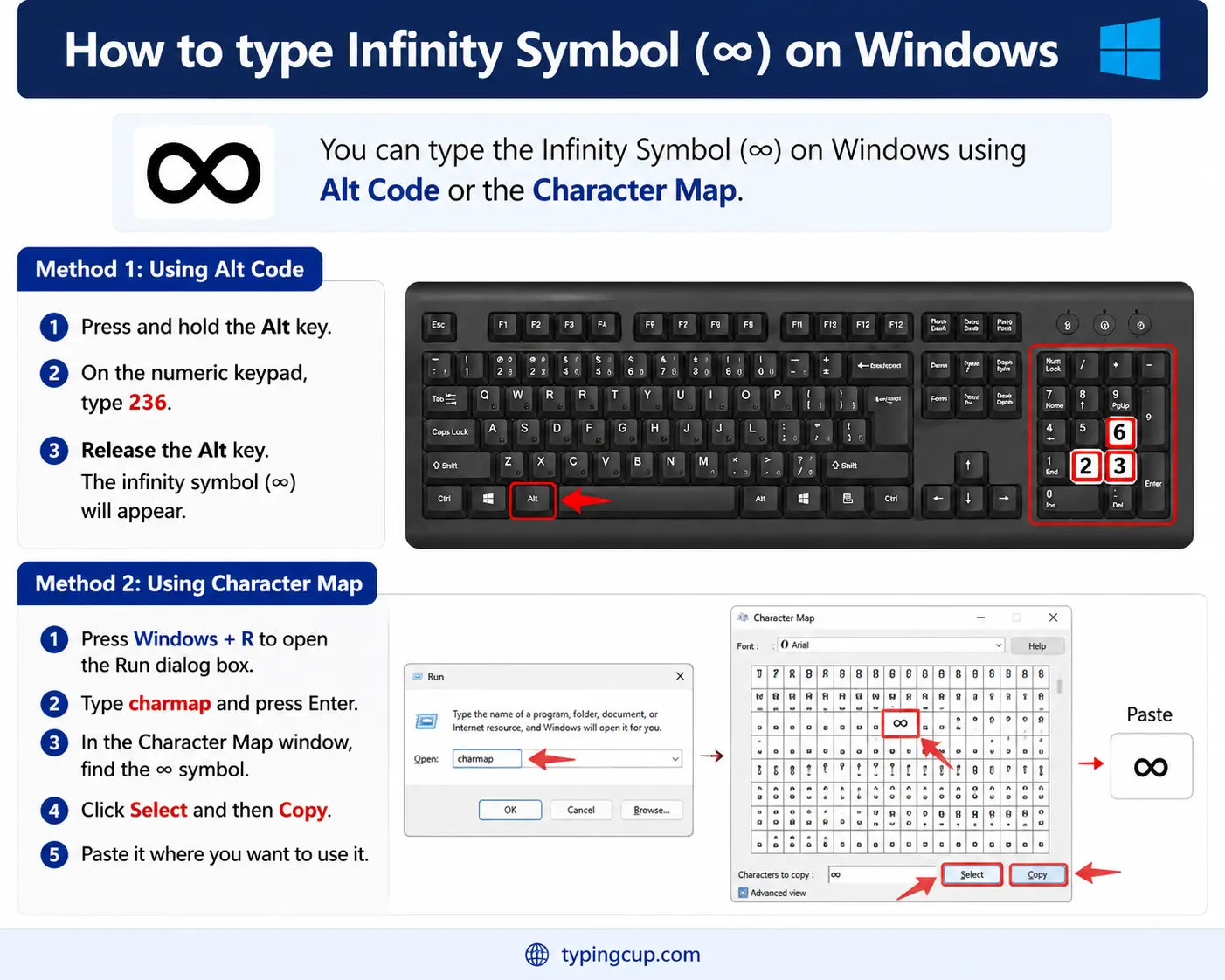
The quickest route is the Alt code: turn on Num Lock, hold Alt, and type 236 on the numeric keypad for ∞. The longer decimal code Alt + 8734 works in apps that support it. On a laptop with no keypad, press Windows + . for the symbol panel and search “infinity.”
Type the infinity symbol on Mac
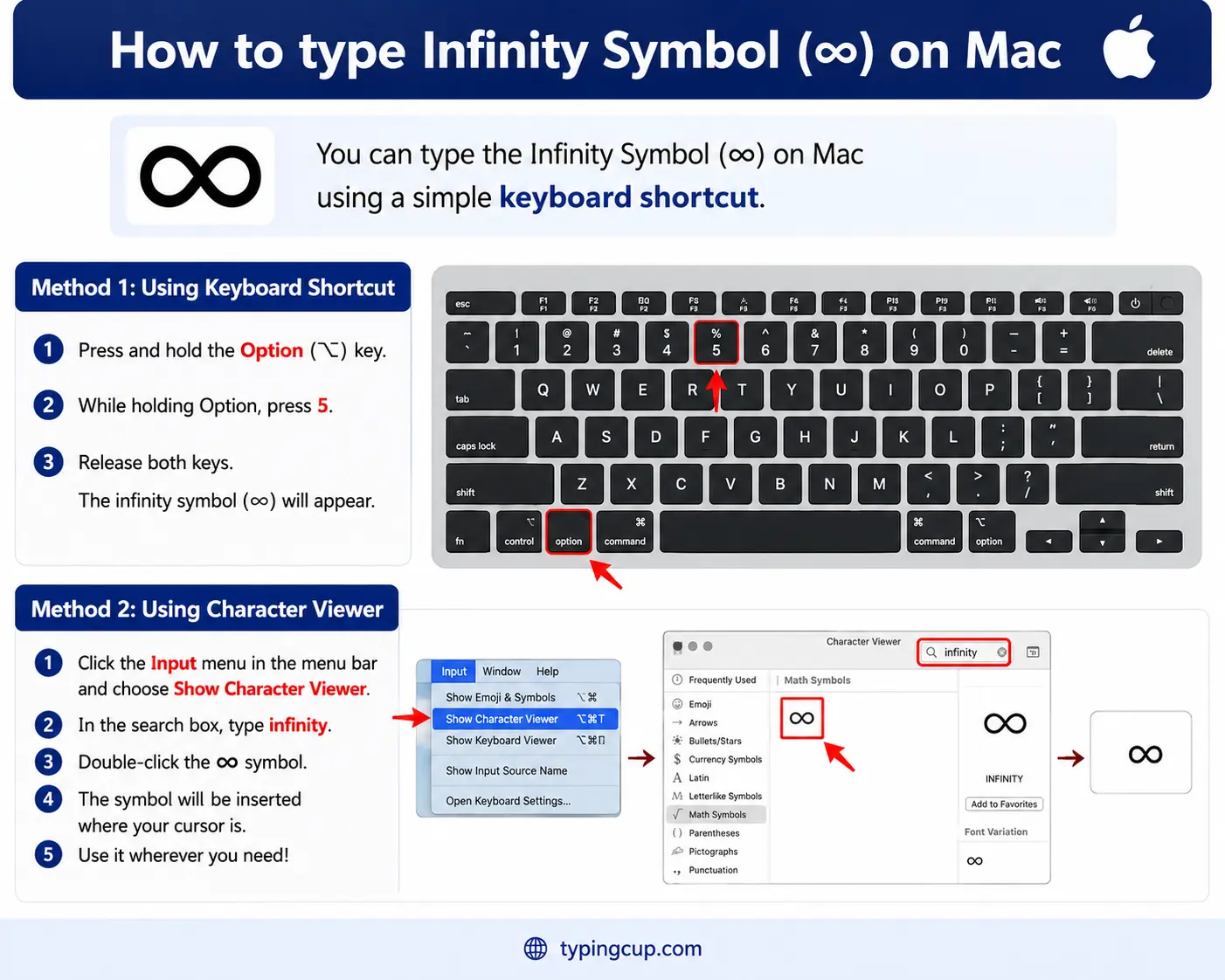
On a Mac, press Option + 5 for ∞. It’s a single shortcut with no dead-key step, which makes the Mac one of the easiest places to type it. If you forget the combination, Control + Command + Space opens the Character Viewer, where a search for “infinity” finds it.
Type the infinity symbol on iPhone and Android
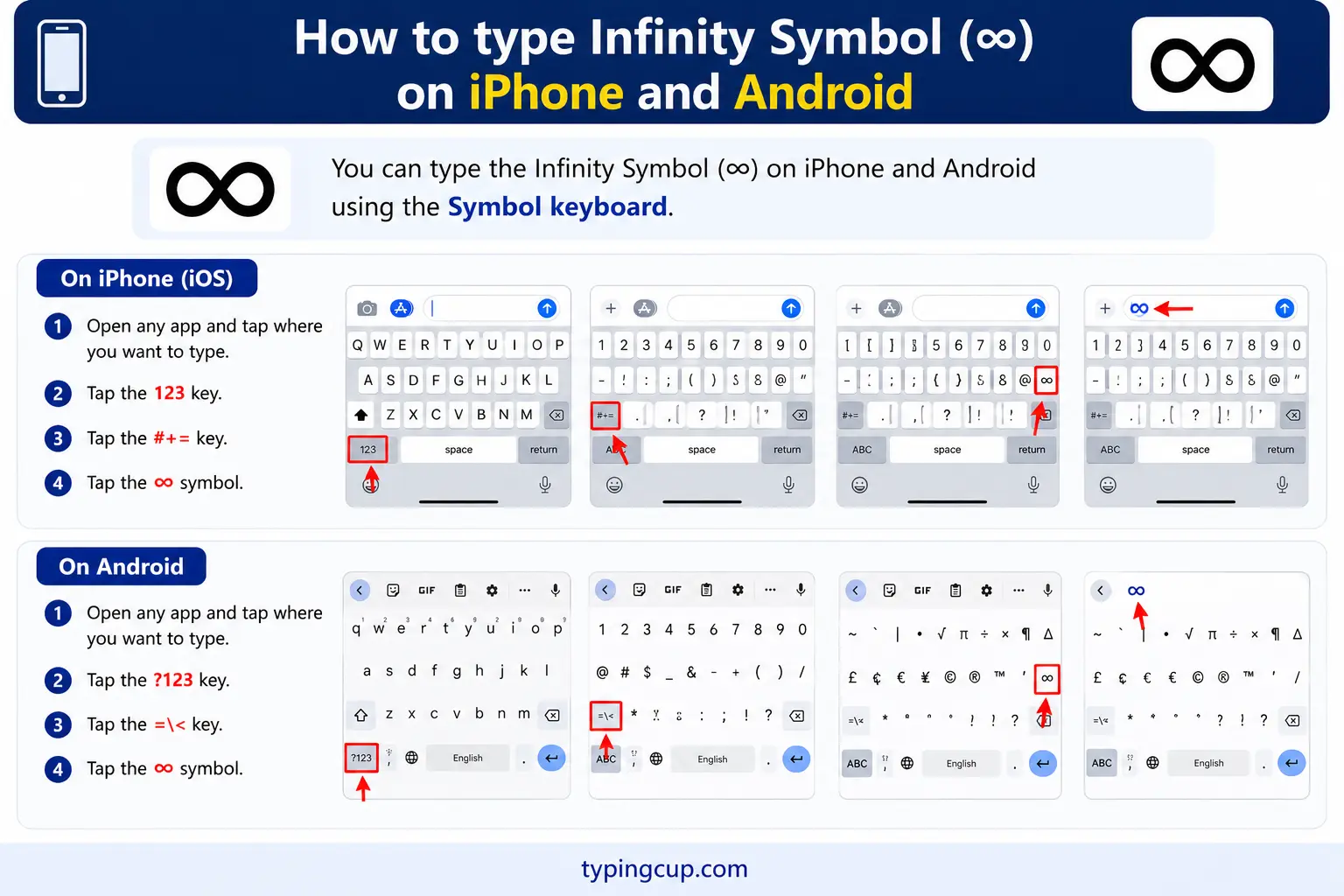
Neither phone keyboard has ∞ built in, so copying is easiest on mobile. Tap and hold in the grid above to copy it, then paste. Some third-party and scientific-calculator keyboards include it, but there’s no long-press for it on the default keyboards.
Type the infinity symbol in Microsoft Word
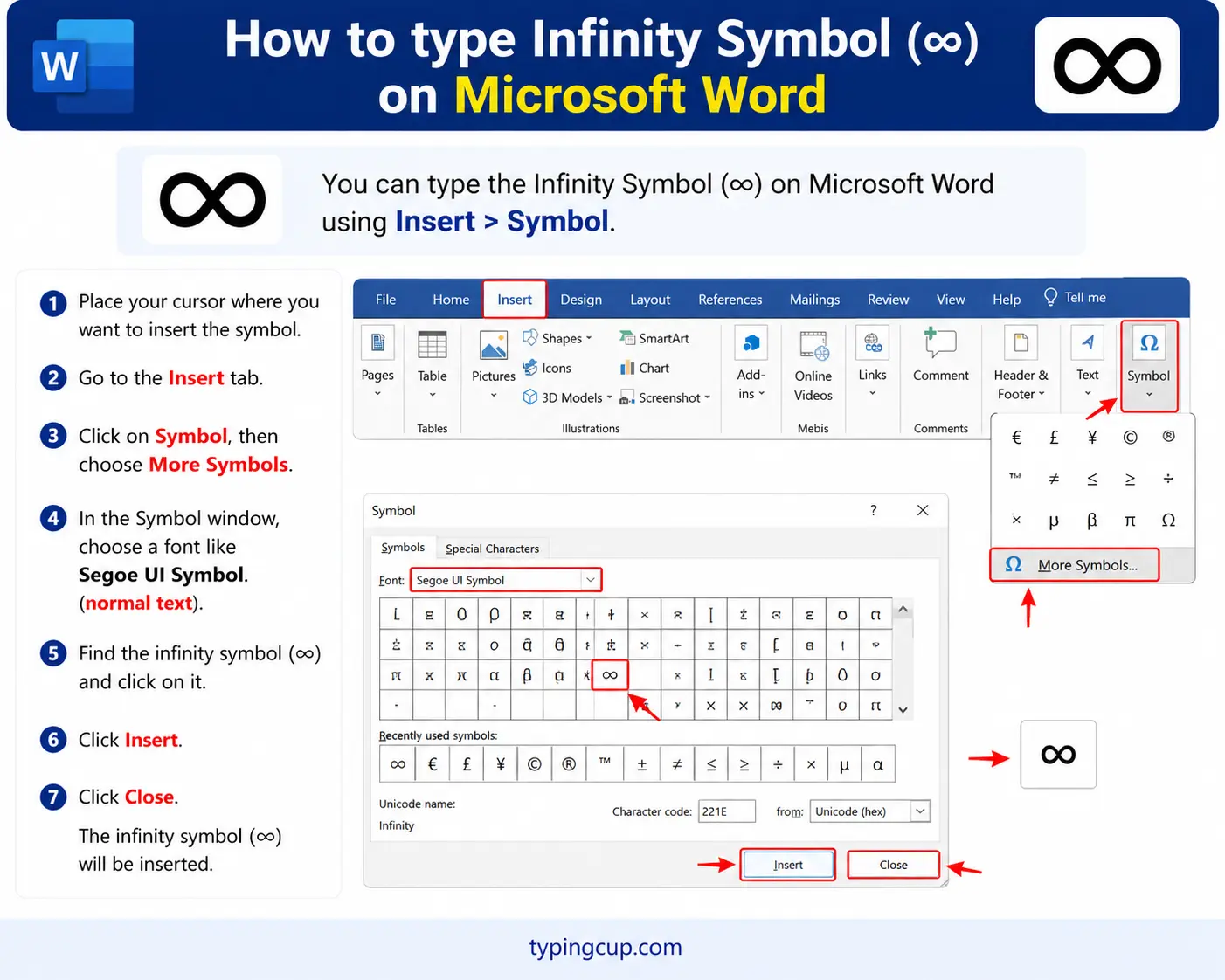
Two easy routes. Type 221E and press Alt + X to turn the code into ∞. Or use Insert → Symbol and find it among the mathematical operators. The Windows Alt code (Alt + 236) also works directly.
Type the infinity symbol on Linux
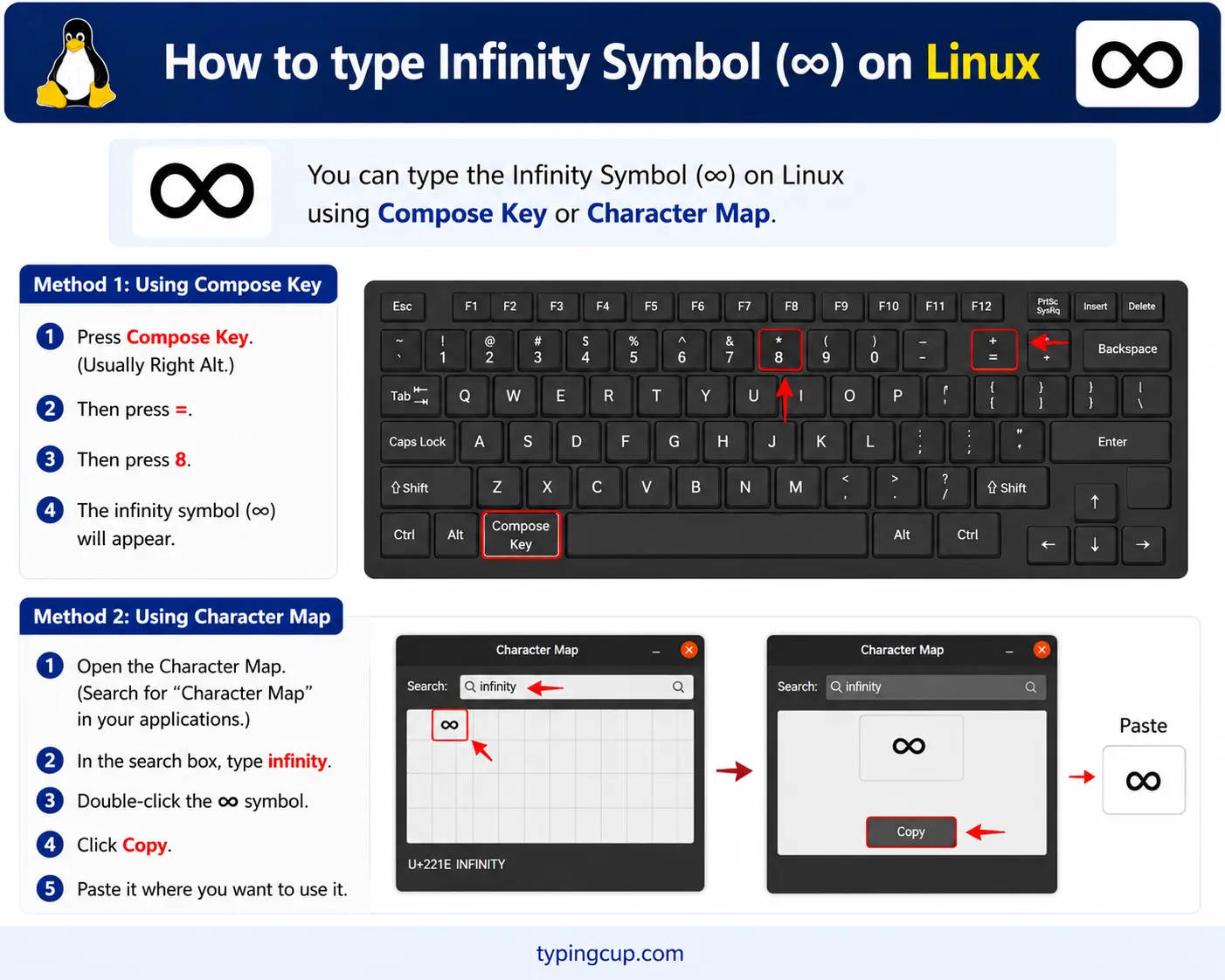
Press Ctrl + Shift + U, type 221e, then press Enter. That Unicode input method works in most GTK and Qt applications.
Type the infinity symbol in Excel and Google Sheets
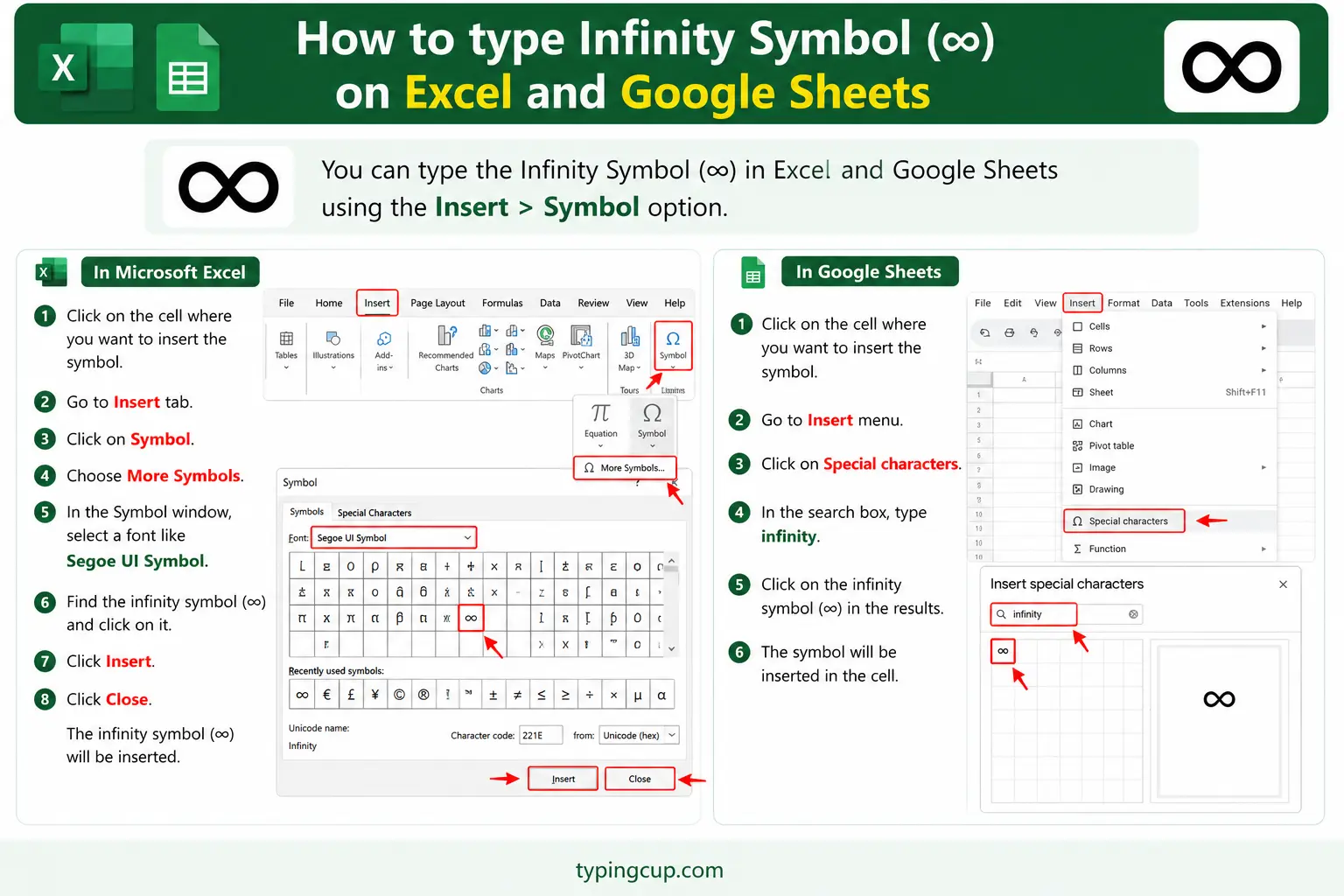
To show the character, use =UNICHAR(8734) in Excel or =CHAR(8734) in Google Sheets, or paste it in. Note that a spreadsheet has no concept of infinity as a value; the ∞ is only text, so it won’t behave like a number in a calculation.
Type the infinity symbol in HTML and CSS
In HTML, infinity is ∞ or the numeric ∞. In CSS, a literal ∞ in a content value is the escaped code point \221E.
Infinity is not a number
Almost every guide tells you how to type ∞ and stops there, but the interesting part is what it means, and the first surprise is that infinity isn’t a number at all. It’s an idea, the idea of something without end, and treating it like an ordinary value quickly breaks down.
Take a simple sum. If ∞ were a number, then ∞ + 1 would be bigger than ∞, but there’s nothing bigger than “without end,” so ∞ + 1 is still just ∞. Worse, ∞ − ∞ has no single answer at all: depending on how you got there it could be 0, or 5, or anything, which is why mathematicians call it undefined. That’s the giveaway that ∞ is playing by different rules from 3 or 100.
In maths, ∞ mostly shows up as a direction rather than a destination: a sum that “tends to infinity” is one that grows without ever stopping, and an integral “to ∞” means you keep going forever. So the symbol is less a quantity you reach and more a shorthand for “this never runs out.”
Some infinities are bigger than others
Here’s the fact that genuinely surprises people, and that no keyboard guide mentions: there isn’t just one infinity. Some infinities are provably larger than others.
In the 1870s the mathematician Georg Cantor showed it. Count the whole numbers 1, 2, 3, and so on, and you get an endless list; that size of infinity is called countable, written with the symbol ℵ₀ (“aleph-null”). Now try to count all the decimal numbers between 0 and 1. Cantor proved you can’t — there are so many that no list, however long, can include them all. That’s a strictly bigger infinity, called uncountable.
So the single symbol ∞ is hiding a whole hierarchy. For everyday writing it just means “endless,” but in set theory there’s an entire ladder of infinities, each one larger than the last, which is one of the strangest results in all of mathematics.
Where the ∞ symbol came from
The sideways-eight shape has a name and a birthday. It’s called a lemniscate, from a Greek word for a ribbon or a looped bow, which is more or less what it looks like.
The symbol was introduced by the English mathematician John Wallis in 1655. Why he chose that shape isn’t recorded, but there are two popular theories: that it’s a variant of the Roman numeral for a very large number (the old form of 1000 was written a bit like CIƆ, which drifted toward a looped shape), or that it comes from the last letter of the Greek alphabet, omega (ω), long used to mean “the end.” Either way, the looping line with no start and no finish is a neat picture of endlessness.
It caught on slowly, but by the 1700s the lemniscate was the standard symbol for infinity in mathematics, and it has stayed that way ever since — one of the rare mathematical symbols that also became a piece of everyday visual shorthand.
∞ in tattoos, jewellery, and its look-alikes
Away from maths, the infinity symbol has a whole second life. On necklaces, rings, and tattoos it usually means eternity — endless love, an unbreakable bond, “forever.” That’s why it turns up so often in wedding and friendship jewellery, sometimes woven together with a heart or a name.
A few look-alikes are worth knowing. There’s a coloured infinity emoji ♾ (the “permanent paper sign,” U+267E), which some apps show as a rainbow loop and which is also used as a symbol of the neurodiversity movement. The shape also appears in nature as the analemma, the figure-eight the sun traces in the sky over a year. And plenty of logos borrow the loop simply because it suggests “limitless.”
| Symbol | Name | Unicode | Typical use |
|---|---|---|---|
| ∞ | infinity | U+221E | maths, “forever” |
| ♾ | permanent paper / infinity | U+267E | emoji, neurodiversity |
| ω | omega | U+03C9 | “the end,” a possible origin |
Infinity in code: 1/0, Infinity, and NaN
Programming is the one place where infinity really is a value you can hold in a variable. Most languages follow a standard (IEEE 754) that includes a special Infinity, along with its negative, -Infinity. In JavaScript you can write Infinity directly; in Python it’s float('inf'); and dividing a positive number by zero often produces it rather than crashing.
It behaves a lot like the mathematical idea. Infinity + 1 is still Infinity, and 1 / Infinity is 0. But some operations have no sensible answer — Infinity - Infinity or 0 * Infinity — and those give a separate special value called NaN (“not a number”). To test for it, use isFinite() in JavaScript or math.isinf() in Python rather than comparing directly.
So the ∞ you paste into text and the Infinity in a program are cousins: the symbol is a label for the concept, while the code value is a working stand-in that lets calculations keep going without blowing up.
Copy-paste HTML codes
Every code for the infinity symbol in one place. Click a cell and copy.
| Symbol | Named entity | Numeric entity | URL (percent) code |
|---|---|---|---|
| ∞ | ∞ | ∞ | %E2%88%9E |
In a CSS content value, use \221E for the infinity symbol. For related maths symbols, the square root guide and the plus-minus guide get the same copy-and-code treatment.
Troubleshooting
My infinity symbol shows as a box or garbled text
That’s an encoding mismatch: the UTF-8 bytes for ∞ (E2 88 9E) are being read as an older encoding. Set the file, database, and page charset to UTF-8 and it displays correctly.
Alt + 236 isn’t giving me ∞
Make sure Num Lock is on and you’re using the numeric keypad, not the top-row numbers. In apps that prefer the decimal code, try Alt + 8734, or copy the symbol from the grid above.
My code says Infinity or NaN unexpectedly
A stray Infinity usually means you divided by zero somewhere; a NaN means an undefined operation like Infinity - Infinity or 0 * Infinity. Trace the calculation back and guard the division, or test with isFinite().
FAQ
How do I type the infinity symbol?
On Windows, hold Alt and type 236. On a Mac, press Option + 5. In Word, type 221E then Alt + X. In HTML, write ∞. On a phone, copy it. Or click ∞ in the grid above.
Is infinity a number?
No. Infinity is a concept, not a value, which is why ∞ + 1 is still ∞ and ∞ − ∞ is undefined. In maths it usually means “without end.” Programming has a special Infinity value, but that’s a stand-in, not an ordinary number.
Are there different sizes of infinity?
Yes. Georg Cantor proved that the infinity of whole numbers (countable) is smaller than the infinity of the decimals between 0 and 1 (uncountable). So some infinities are genuinely larger than others.
What does the infinity symbol mean on jewellery?
Usually eternity: endless love, an unbreakable bond, or “forever.” That’s why it’s popular in wedding and friendship pieces, often combined with a heart or a name.
How do I write the infinity symbol in HTML?
Use ∞ or ∞. In a URL it’s percent-encoded as %E2%88%9E.
