È / è (E With a Grave Accent): How to Type, Copy, and Use It
è is a lowercase e with a grave accent, the small stroke that leans to the left. Its capital is È. You’ll meet it most in French, where it marks an open “eh” sound, and in Italian, where a single è can be the whole difference between “and” and “is.”
If you just need the character, copy è or È from the grid below. You can also grab its HTML entity or URL code straight from there, which the rest of this page explains and most guides leave out.
Further down you’ll find how to type è on every device, how it differs from é, why Italian leans on it so hard, and how it behaves in links and code.
In a hurry?
- Copy it: click è or È in the grid below.
- On Windows: hold Alt and type 0232 for è (0200 for È).
- On a Mac: press Option + ` (the backtick), then press e.
- On a phone: press and hold the e key, then slide to è.
- In a URL è is written %C3%A8; in HTML it’s è.
Click to copy: è, and its codes
Grab the letter, the HTML entity, or the URL code
Table of Contents
Copy and paste è
The two characters, with every code you’re likely to need in one row. Use the grid above to copy with a click; this table is the reference.
| Character | Name | Unicode | Windows | Mac | HTML |
|---|---|---|---|---|---|
| è | e with grave | U+00E8 | Alt + 0232 | Option + `, e | è |
| È | E with grave | U+00C8 | Alt + 0200 | Option + `, Shift + E | È |
How to type è on any device
è sits in the old Latin range, so it’s easy to reach almost everywhere.
Windows
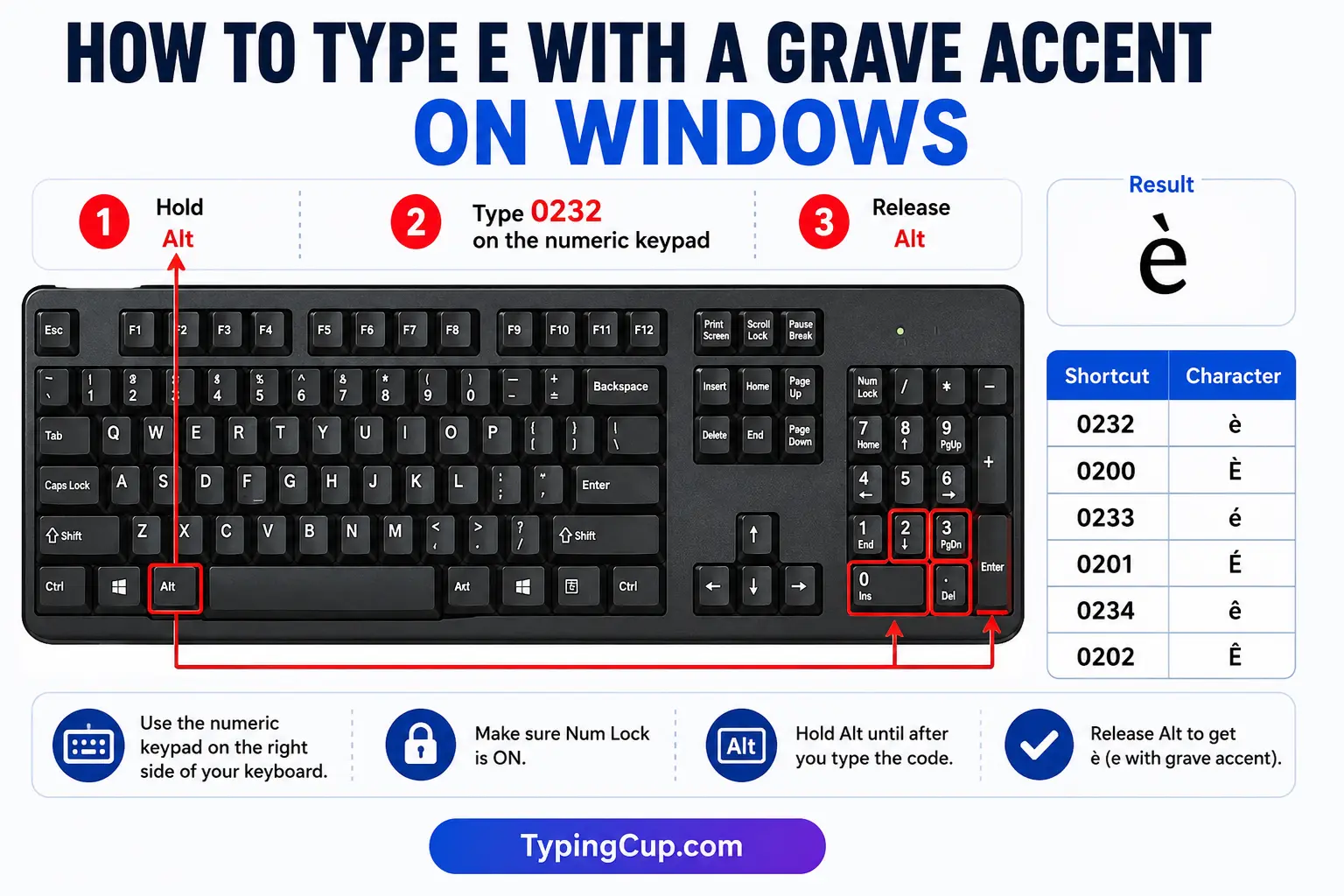
Turn on Num Lock, hold Alt, and type 0232 on the numeric keypad for è, or 0200 for È. The top-row numbers won’t work; it has to be the keypad.
For regular use, switch to the US-International layout and type a backtick (`) then e. You can also press Windows + . and pick è from the symbol panel.
Mac
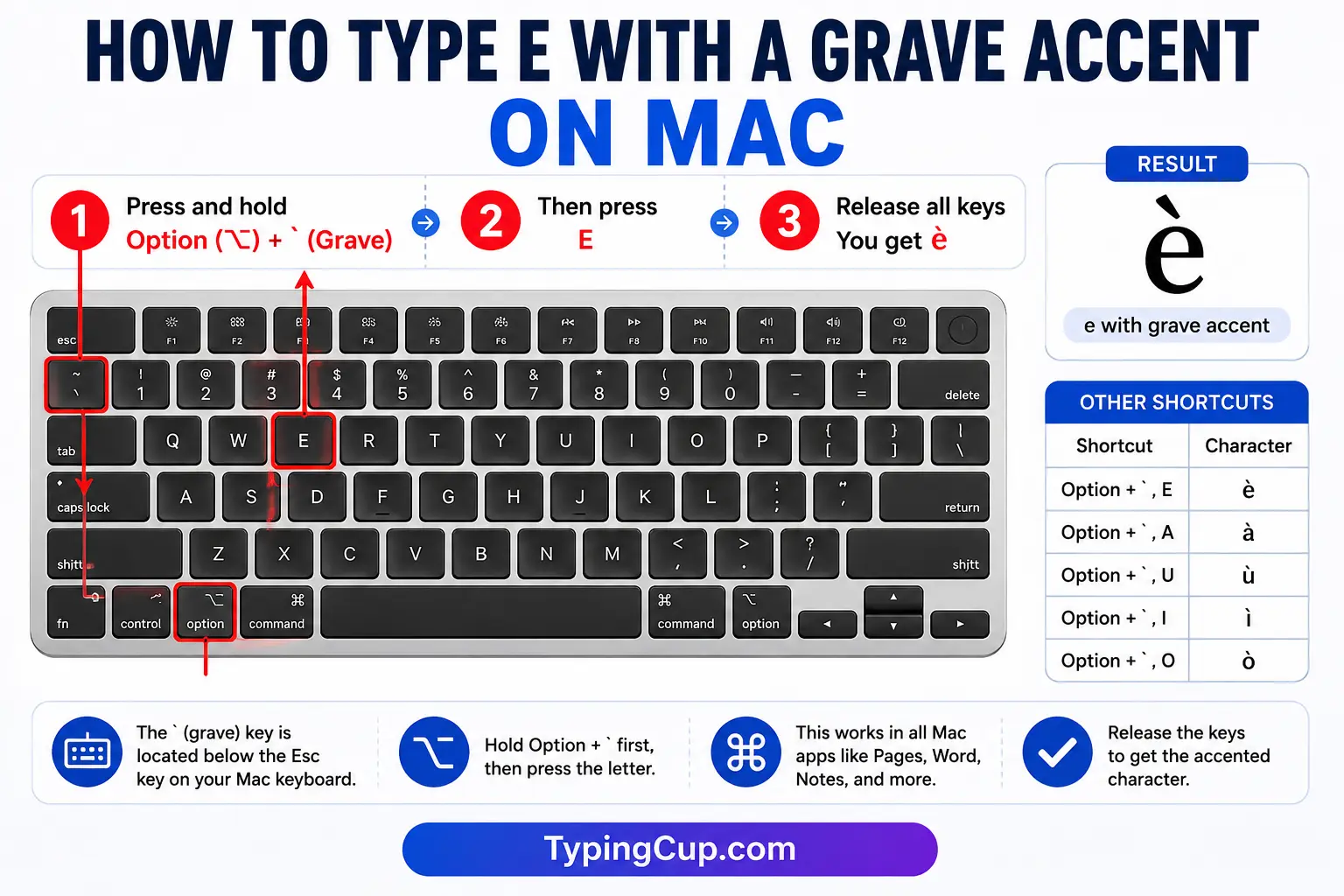
Press Option + ` (the backtick, top-left of the keyboard) and let go; nothing shows yet. Press e and è appears. For the capital, it’s Option + `, then Shift + E. Holding the e key down also brings up a menu with è on it.
iPhone and Android
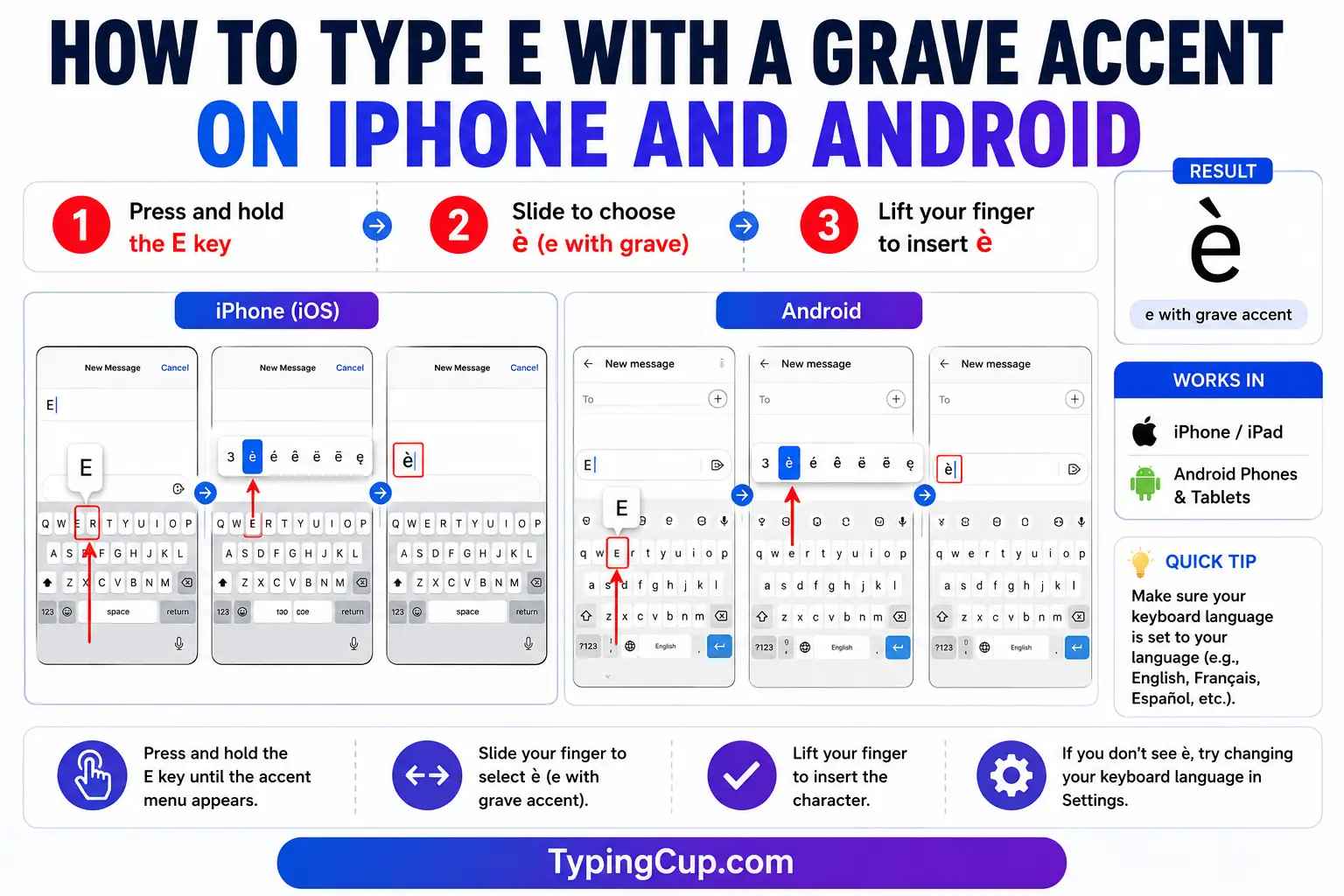
Press and hold the e key on the on-screen keyboard, then slide onto è and lift your finger. Nothing to set up, and it works the same in nearly every app.
Microsoft Word
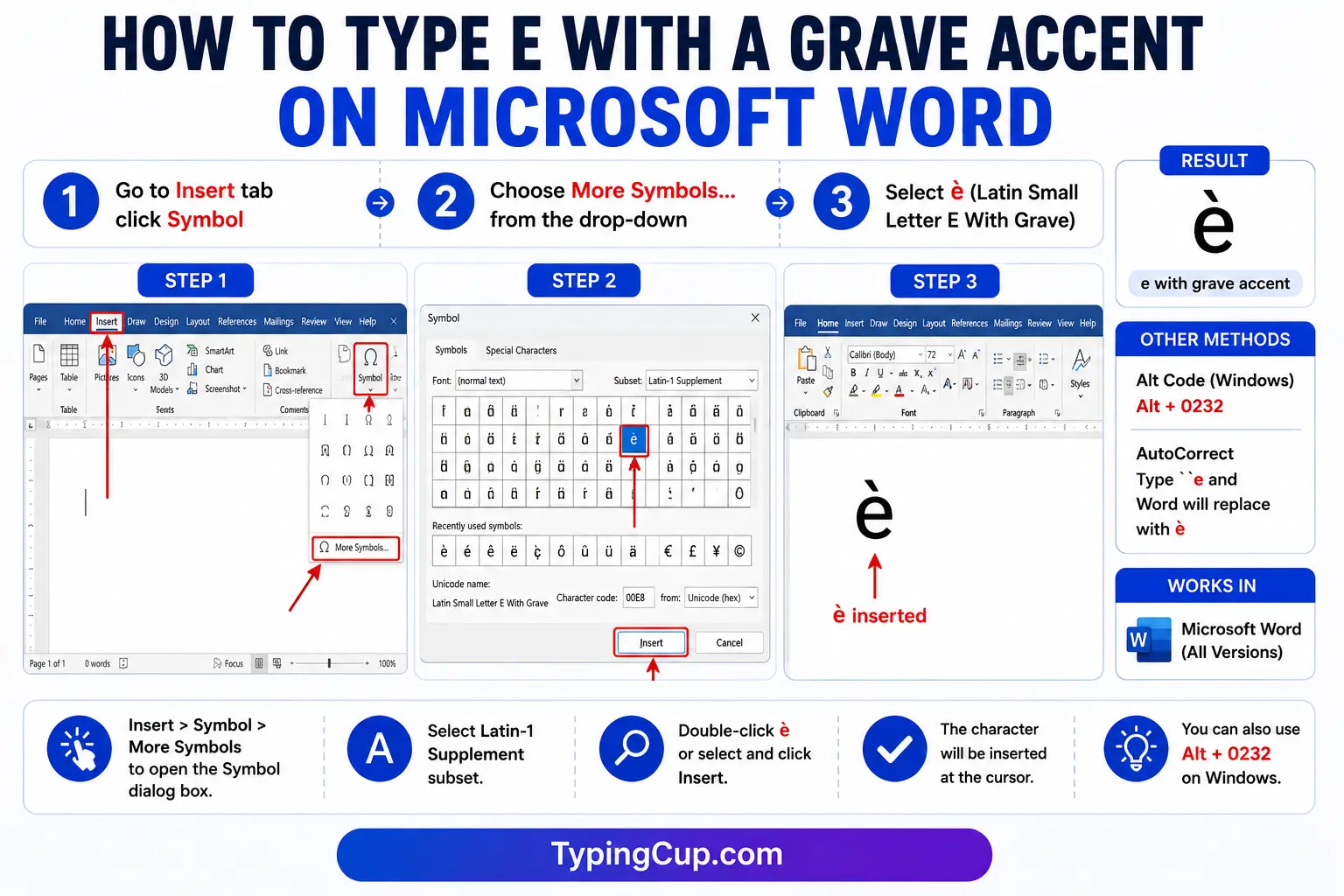
Press Ctrl + ` (the backtick), let go, then press e. Add Shift on the e for È. The Windows Alt code works here too.
Linux
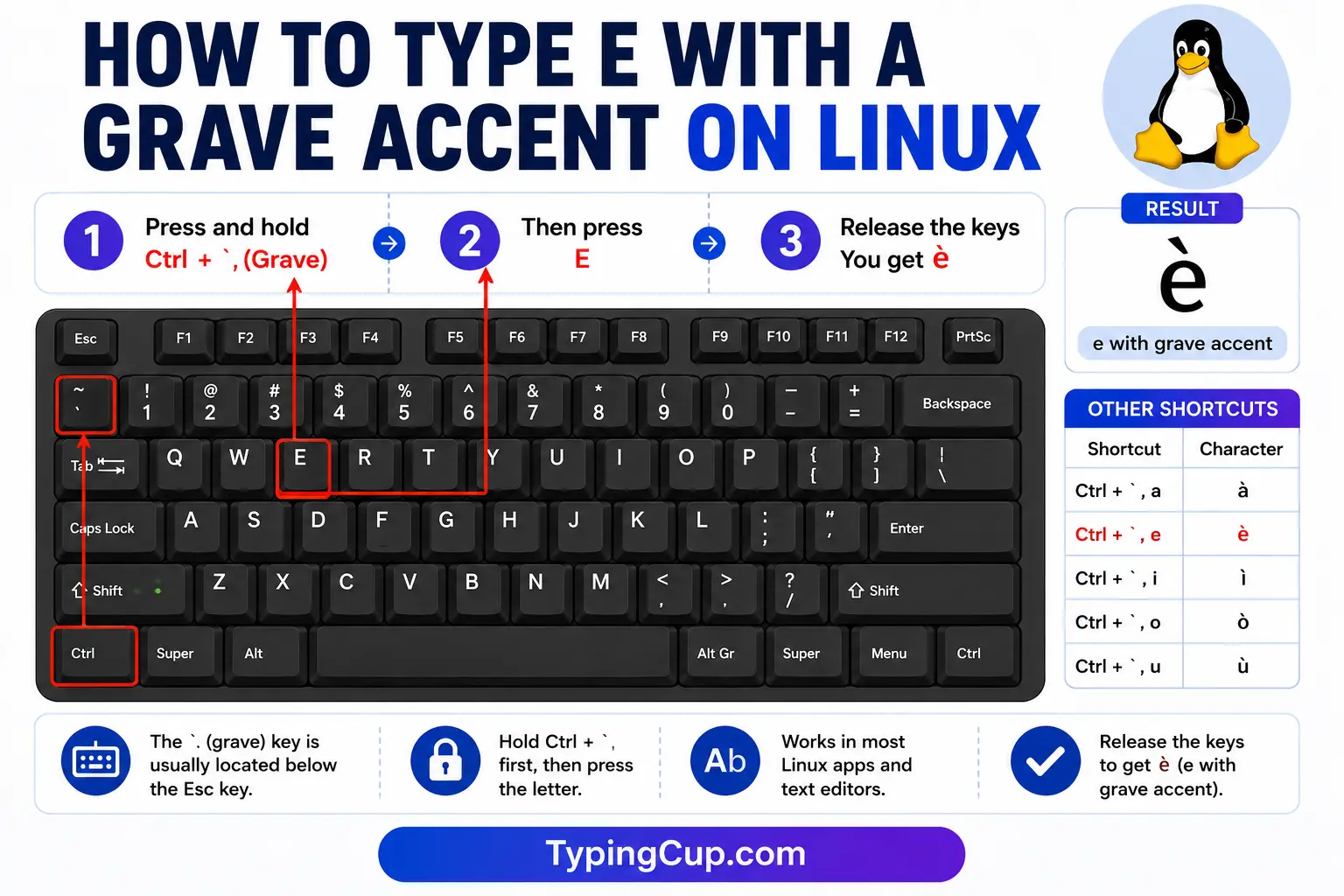
Press Ctrl + Shift + U, type 00e8, then press Enter. With a Compose key, it’s Compose, then `, then e.
Excel and Google Sheets
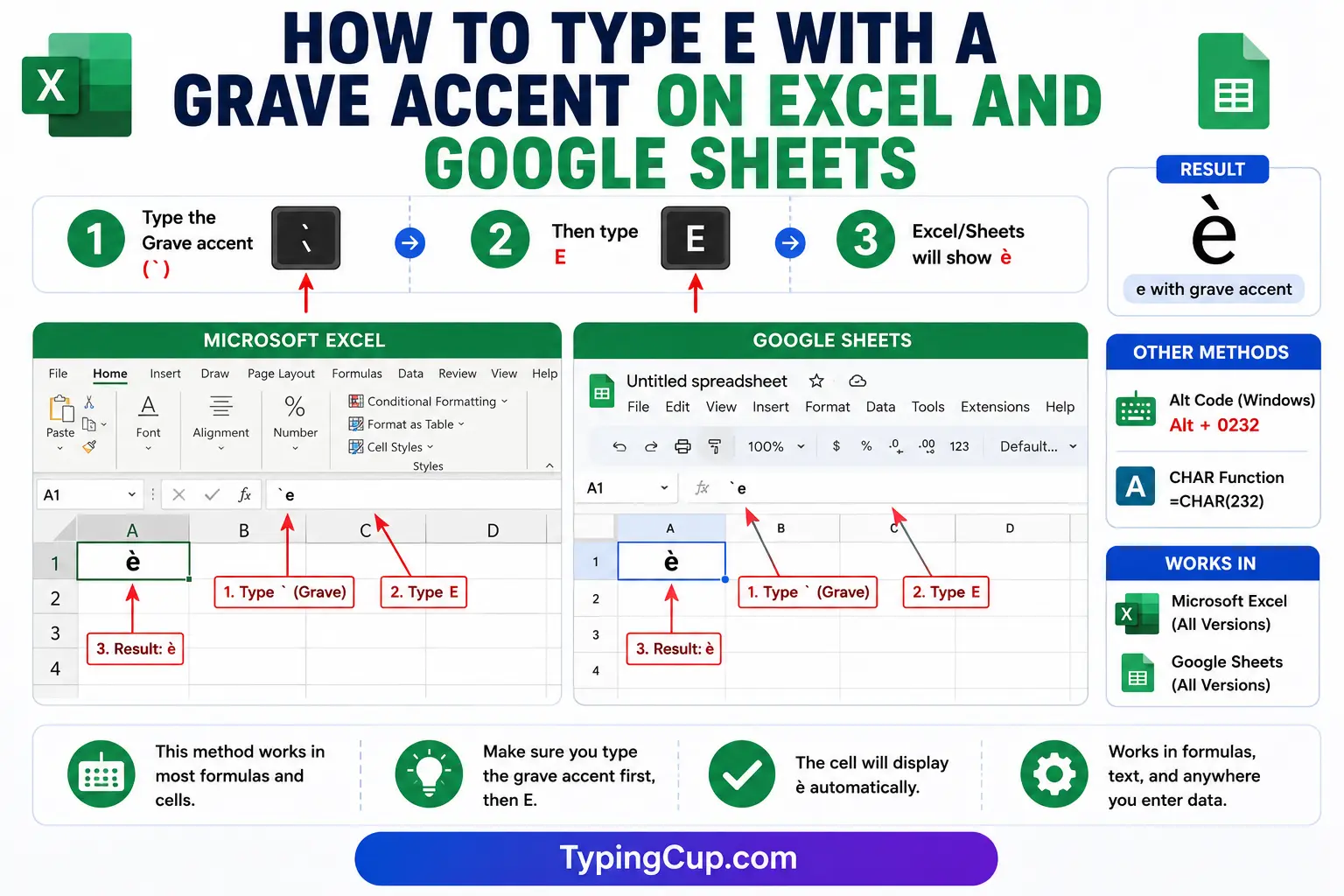
Use the Alt code on the keypad, or the UNICHAR formula: =UNICHAR(232) returns è and =UNICHAR(200) returns È. The same works in Google Sheets.
è vs é: which way the accent leans
The two accents point in opposite directions and make opposite sounds, which is why they get swapped so often. è (grave) leans to the left, like the top of the letter tipping backward; é (acute) leans to the right.
In French the difference is real, not decorative. è is an open vowel, the “eh” in père (“father”) and très (“very”). é is a closed, tight “ay,” as in été (“summer”) and café. Swap them and a French reader hears a different word, or none at all.
A simple memory aid: the grave leans back and sits lower, and it’s the more open, relaxed sound. For the acute and the rest of the family, see the é guide and the full e with accent guide.
| Accent | Letter | Direction | Sound | Example |
|---|---|---|---|---|
| Grave | è | leans left | open “eh” | père |
| Acute | é | leans right | closed “ay” | café |
The Italian è: how one accent changes the meaning
Italian gives è a job that catches learners out constantly: è with the accent means “is,” while e without it means “and.” So Marco è alto is “Marco is tall,” but Marco e Anna is “Marco and Anna.” The accent isn’t optional; leaving it off turns “is” into “and” and scrambles the sentence.
Italian also uses the grave to close certain words, like caffè (“coffee”) and tè (“tea”), where the final e is open and stressed. And it’s careful about direction: caffè takes the grave è, but perché (“why, because”) takes the closed acute é. Getting the lean right is part of writing correct Italian.
Because Italian keyboards give è its own key, this is second nature for native writers. Everywhere else, the copy grid above or the Alt code is the quick way in.
When French and English use è
In French, è turns up everywhere: mère, frère, très, après, problème, système, and the many words ending in -ès like progrès and succès. Wherever the e is open and stressed, the grave tends to appear.
English barely uses è at all, which is the mirror image of é. Where English happily borrows café and résumé with their acutes, the grave shows up mainly in a few French imports like crème (as in crème brûlée) and pièce de résistance. For many English readers the most familiar è is the fashion house Hermès, where the accent is simply part of the name.
è in web addresses, URLs, and email
You can use è in a domain name. It’s stored as a Punycode address beginning with xn--, which the browser turns back into è for display, so a real domain can briefly look like a jumble of letters.
Inside a URL path or query, è is percent-encoded as %C3%A8, the two UTF-8 bytes (0xC3 and 0xA8) for the character written out. The capital È is %C3%88. A link with %C3%A8 in it has an è hiding inside.
Email is more cautious. An address can carry è through the same system, but many mail servers still stumble over non-ASCII addresses, so keep è out of an email address unless you know both ends support it.
è in code and passwords
In code, è is an ordinary Unicode character and works fine in strings and comments. The usual snag is encoding: a file saved as UTF-8 but read as Latin-1 turns è into è, the classic sign of a crossed encoding rather than a broken character.
Passwords are the place to be careful. A è in a password can lock you out on another device, because a different keyboard or login form may encode the character differently and produce different bytes. For a password you’ll type across systems, plain ASCII is safer.
When you want è in code, the escapes help: \u00e8 in JavaScript, Java, JSON, and Python, and è or è in HTML.
Copy-paste HTML codes
Everything you need for the web and for links, in one place. Click a cell and copy.
| Character | Named entity | Numeric entity | URL (percent) code |
|---|---|---|---|
| è | è | è | %C3%A8 |
| È | È | È | %C3%88 |
In a CSS content value, use the escaped code point \00e8. Serve the page as UTF-8 so the character holds. For the acute é, the rest of the e with accent family, and every other mark, see the full letters-with-accents list.
Troubleshooting
“My è shows up as è or a box.”
The text was saved as UTF-8 but is being read as an older encoding like Latin-1. Set the file or page to UTF-8 and the è returns. The è pattern is the classic UTF-8-read-as-Latin-1 mix-up.
“Alt + 0232 just beeps or types nothing.”
Num Lock is off, you’re using the top-row numbers, or the laptop has no keypad. Turn Num Lock on and use the keypad. No keypad? Use the copy grid, the US-International layout, or Windows + .
“I keep getting é instead of è.”
You’re loading the wrong accent. On a Mac, è is Option + ` (the backtick), not Option + e. On US-International, press the backtick then e, not the apostrophe.
“A password with è won’t log me in elsewhere.”
Different keyboards and login forms can encode è differently, so the bytes may not match what you first set. For a password you’ll type on many devices, stick to plain ASCII.
FAQ
How do I type è?
On Windows, Alt + 0232 (Alt + 0200 for È). On a Mac, Option + ` then e. On a phone, long-press the e key. Or click it in the grid above.
What’s the difference between è and é?
The direction and the sound. è (grave) leans left and is an open “eh”; é (acute) leans right and is a closed “ay.” In French they mark different vowels and aren’t interchangeable.
What does è mean in Italian?
È with the accent means “is” (from the verb essere), while e without the accent means “and.” The accent is required; dropping it changes the meaning of the sentence.
How do I write è in a URL or HTML?
In a URL, è is %C3%A8 (È is %C3%88), and domains store it as Punycode beginning with xn--. In HTML, use è or è.
How do you pronounce è?
As an open “eh” sound, /ɛ/, like the e in the French père. It’s the opposite of the closed é, which is a tight “ay.”
