Ë / ë (E With an Umlaut): How to Type, Copy, and Use It
ë is a lowercase e with two dots on top. Its capital is Ë. People usually call it an “e with an umlaut,” but here the dots are nearly always a diaeresis, a different mark with a different job. You’ll meet ë in French names like Noël, in the Albanian alphabet, and in a few stubborn English spellings.
If you just need the character, copy ë or Ë from the grid below, along with its HTML entity or URL code.
Below you’ll find how to type ë on every device, what those two dots actually mean, where the letter shows up, and how it behaves in links and code.
In a hurry?
- Copy it: click ë or Ë in the grid below.
- On Windows: hold Alt and type 0235 for ë (0203 for Ë).
- On a Mac: press Option + u, then press e.
- On a phone: press and hold the e key, then slide to ë.
- In a URL ë is written %C3%AB; in HTML it’s ë.
Click to copy: ë, and its codes
Grab the letter, the HTML entity, or the URL code
Table of Contents
Copy and paste ë
The two characters, with every code you’re likely to need in one row. Use the grid above to copy with a click; this table is the reference.
| Character | Name | Unicode | Windows | Mac | HTML |
|---|---|---|---|---|---|
| ë | e with diaeresis | U+00EB | Alt + 0235 | Option + u, e | ë |
| Ë | E with diaeresis | U+00CB | Alt + 0203 | Option + u, Shift + E | Ë |
How to type ë on any device
ë sits in the old Latin range, so it’s easy to reach almost everywhere.
Type ë on Windows
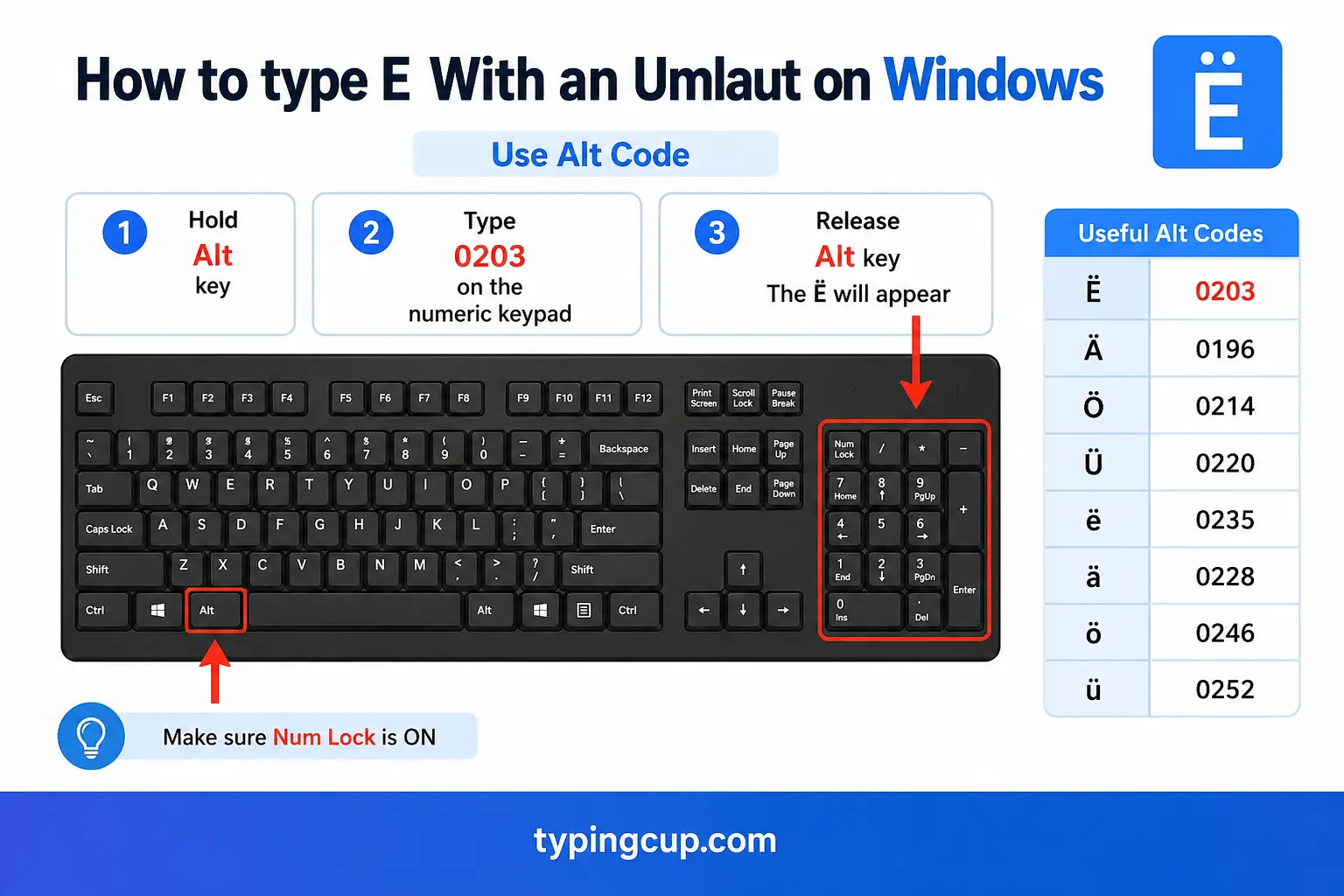
Turn on Num Lock, hold Alt, and type 0235 on the numeric keypad for ë, or 0203 for Ë. The top-row numbers won’t work; it has to be the keypad. On the US-International layout, type a quote (“) then e, or press Windows + . and pick ë from the symbol panel.
Type ë on Mac
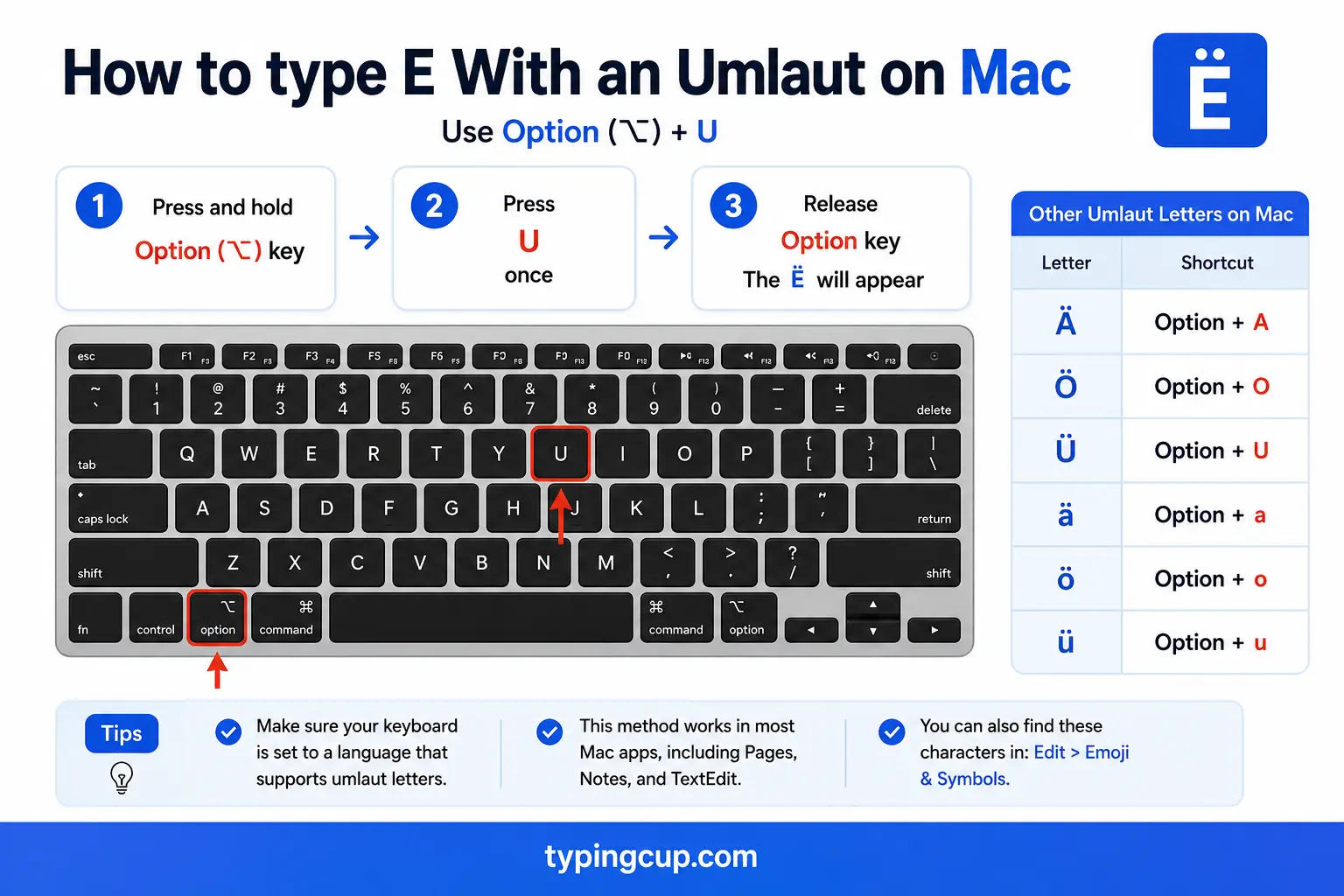
Press Option + u together and let go; nothing shows yet. Press e and ë appears. For the capital, it’s Option + u, then Shift + E. Holding the e key down also brings up a menu with ë on it.
Type ë on iPhone and Android
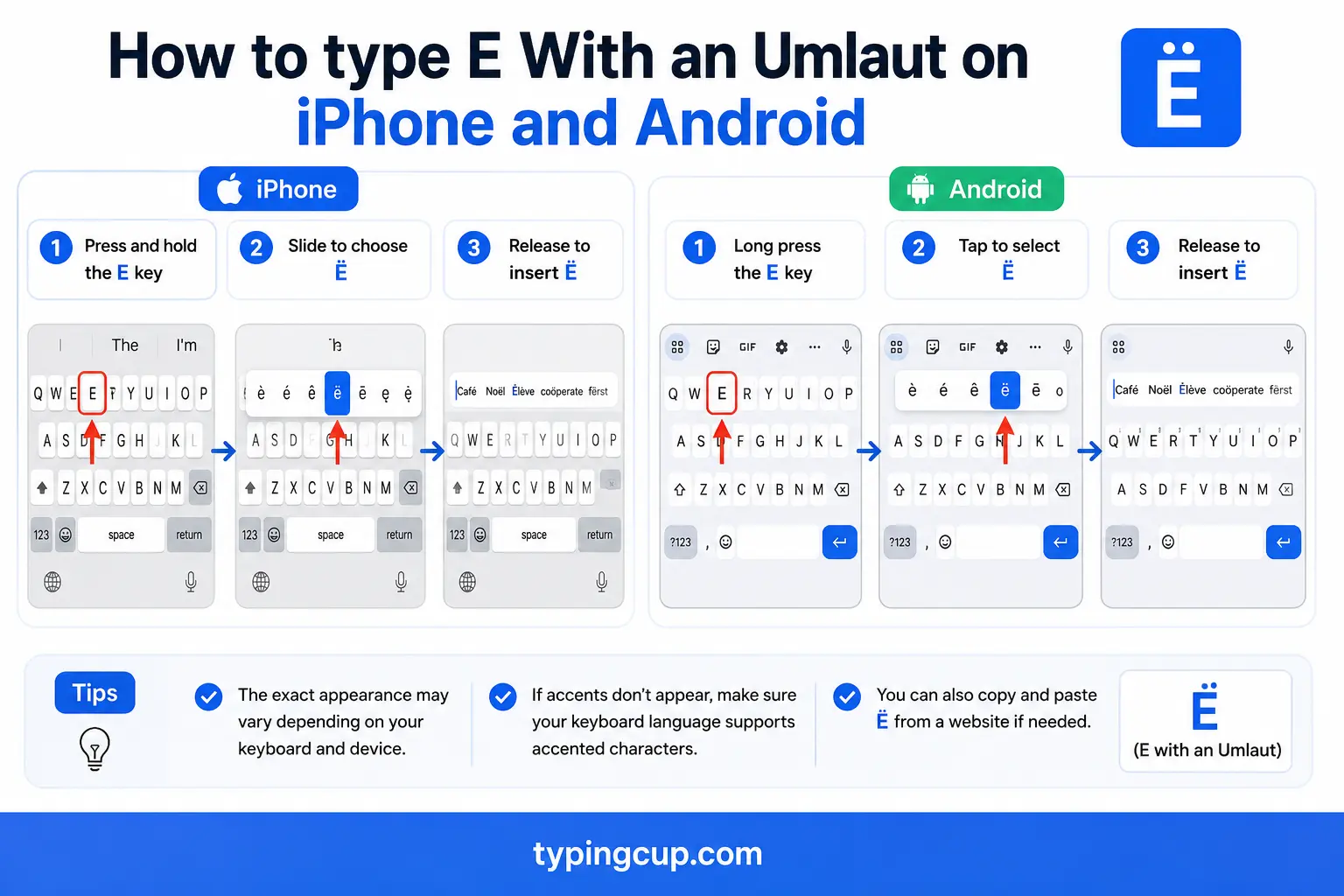
Press and hold the e key on the on-screen keyboard, then slide onto ë and lift your finger. Nothing to set up, and it works the same in nearly every app.
Type ë in Microsoft Word
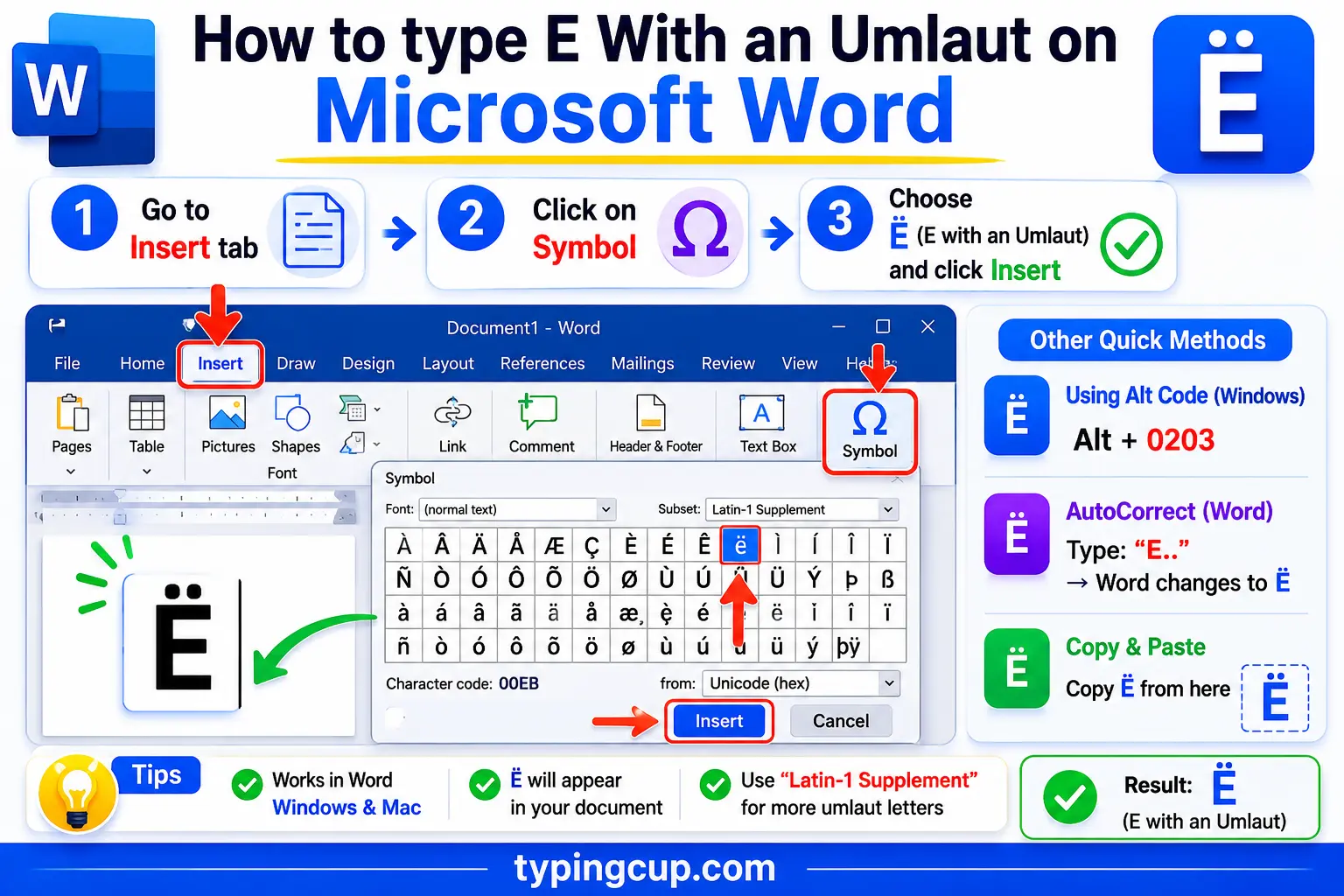
Press Ctrl + Shift + : (the colon), let go, then press e. Add Shift on the e for Ë. The Windows Alt code works here too.
Type ë on Linux
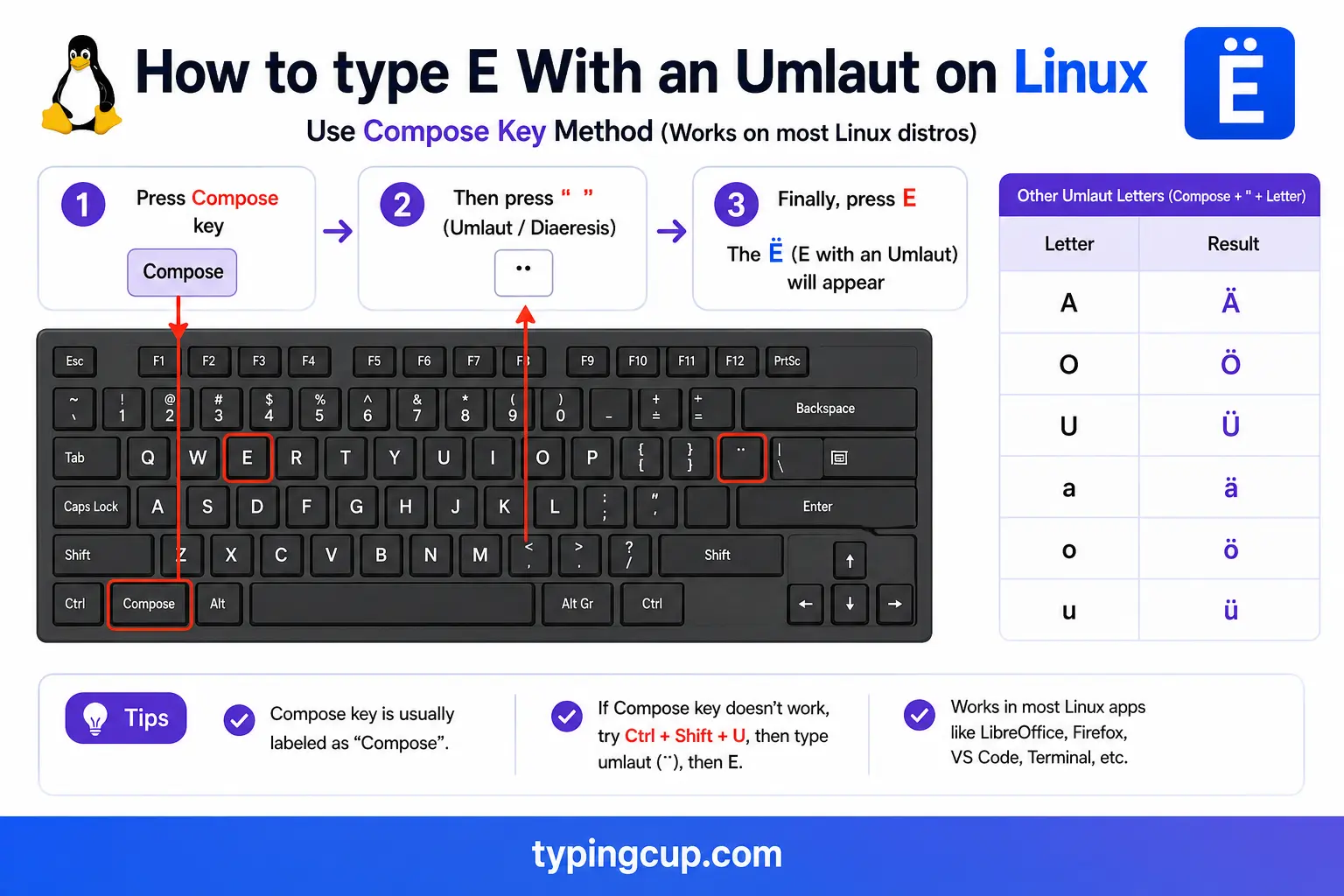
Press Ctrl + Shift + U, type 00eb, then press Enter. With a Compose key, it’s Compose, then “, then e.
Type ë in Excel and Google Sheets
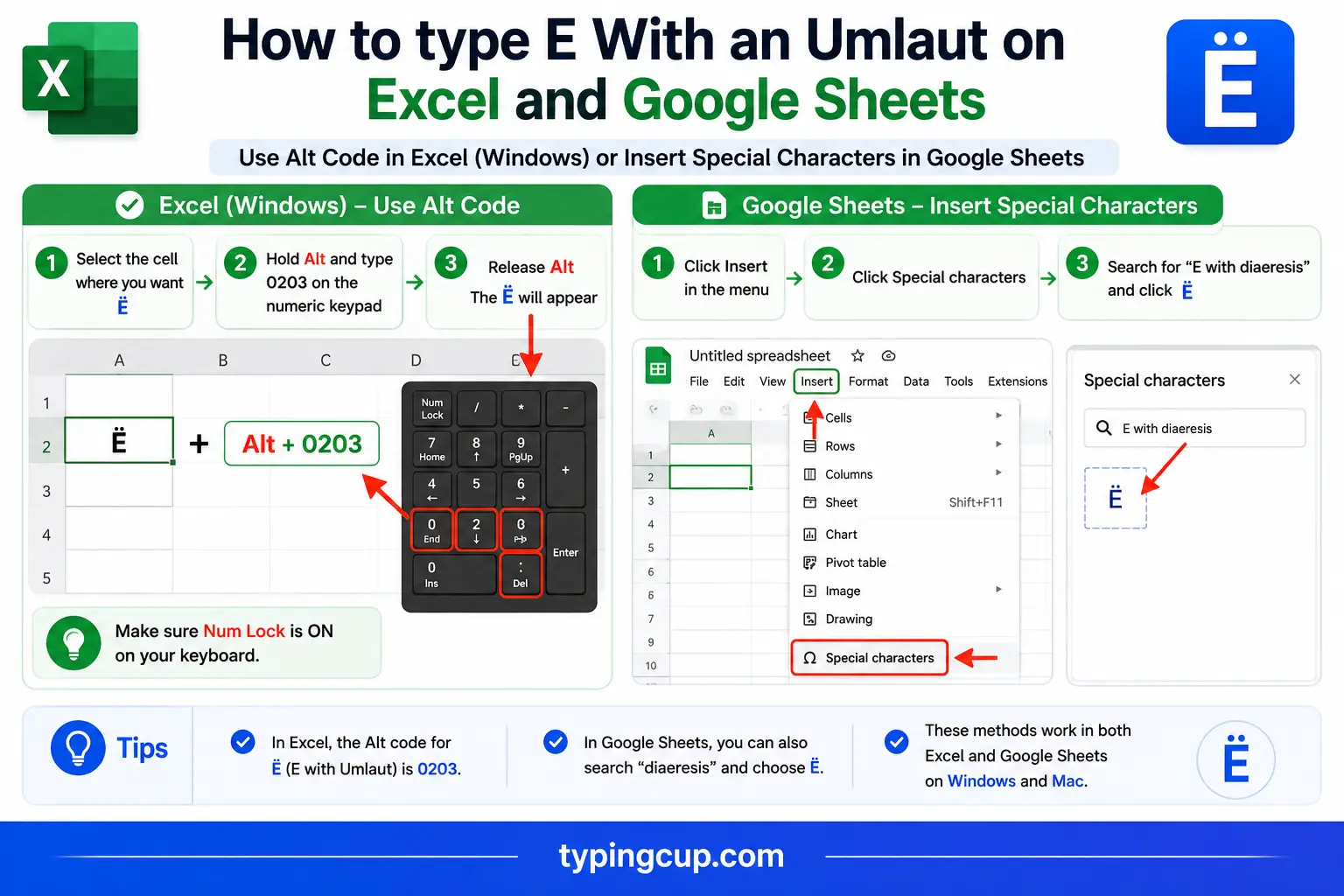
Use the Alt code on the keypad, or the UNICHAR formula: =UNICHAR(235) returns ë and =UNICHAR(203) returns Ë. The same works in Google Sheets.
Umlaut or diaeresis? What the two dots on ë mean
Most people call ë an “e with an umlaut,” and that’s the usual search term, but the two dots here are nearly always a diaeresis, not a German umlaut. The distinction matters, because the two marks do opposite jobs.
A German umlaut, on ä, ö, or ü, changes a vowel’s sound. A diaeresis, on ë, tells you to pronounce the vowel separately from the one before it, rather than blending them together. That’s why Noël is “no-EL,” two clear syllables, and the name Zoë ends in a sounded “ee” instead of a silent e.
The glyph is identical either way, and Unicode doesn’t tell them apart, so ë is one character whether a French writer or a German speaker typed it. Which name is correct just depends on what the dots are doing. The full set of two-dot letters is covered in the umlaut letters guide.
The English diaeresis: Brontë, Zoë, and “coöperate”
English mostly abandoned the diaeresis, but it still clings on in a few places, and ë is where you’ll spot it most. Names keep it: the Brontë sisters, and first names like Zoë and Chloë, where the dots signal that the final e is pronounced, not silent.
The most famous holdout is The New Yorker magazine, which to this day writes coöperate and reëlect with a diaeresis over the second vowel, marking that it begins a new syllable. Almost no one else bothers, which is exactly why the spelling stands out. When you need the dots for a name or a house style, the copy grid at the top is the quickest way to get them.
The Albanian ë: a whole language’s favourite letter
Away from names and loanwords, ë has a serious day job: in Albanian it’s a full letter of the alphabet, and the single most common letter in the written language. There it stands for a schwa, the neutral “uh” sound, or falls silent at the end of a word.
It runs through Albanian text constantly, from të and që to the capital Tiranë and the country’s own name, Shqipëri. So while an English writer might reach for ë once a year for Noël, an Albanian writer uses it in almost every sentence. Same character, wildly different workload.
Names and words with ë
A quick tour of where the letter turns up.
| Word or name | Language | Note |
|---|---|---|
| Noël | French | Christmas, or a first name |
| Citroën | French | the car brand |
| Israël | French / Dutch | Israel |
| Brontë | English | the literary sisters |
| Zoë | English / Greek | the final e is sounded |
| coëfficiënt | Dutch | coefficient |
| Tiranë | Albanian | the capital of Albania |
Dropping the dots in these changes how they’re read, and in a name like Citroën or Brontë, it changes the spelling itself.
ë in web addresses, URLs, and email
You can use ë in a domain name. It’s stored as a Punycode address beginning with xn--, which the browser turns back into ë for display, so a real domain can briefly look like a run of random letters.
Inside a URL path or query, ë is percent-encoded as %C3%AB, the two UTF-8 bytes (0xC3 and 0xAB) for the character. The capital Ë is %C3%8B. A link with %C3%AB in it has an ë inside.
Email is more cautious. An address can carry ë through the same system, but many servers still stumble over non-ASCII addresses, so it’s safest to keep ë out of an email address unless both ends support it.
ë in code and passwords
In code, ë is an ordinary Unicode character and works fine in strings and comments. The usual snag is encoding: a file saved as UTF-8 but read as Latin-1 turns ë into ë, the classic sign of a crossed encoding rather than a broken character.
Passwords are the place to be careful. A ë in a password can lock you out on another device, because a different keyboard or login form may encode it differently and produce different bytes. For a password you’ll type across systems, plain ASCII is safer.
When you want ë in code, the escapes help: \u00eb in JavaScript, Java, JSON, and Python, and ë or ë in HTML.
Copy-paste HTML codes
Everything you need for the web and for links, in one place. Click a cell and copy.
| Character | Named entity | Numeric entity | URL (percent) code |
|---|---|---|---|
| ë | ë | ë | %C3%AB |
| Ë | Ë | Ë | %C3%8B |
In a CSS content value, use the escaped code point \00eb. Serve the page as UTF-8 so the character holds. For the other accented e’s like é and è, see the e with accent guide; for the two-dot letters ä, ö, and ü, see the umlaut letters guide.
Troubleshooting
“My ë shows up as ë or a box.”
The text was saved as UTF-8 but is being read as an older encoding like Latin-1. Set the file or page to UTF-8 and the ë returns. The ë pattern is the classic UTF-8-read-as-Latin-1 mix-up.
“Alt + 0235 just beeps or types nothing.”
Num Lock is off, you’re using the top-row numbers, or the laptop has no keypad. Turn Num Lock on and use the keypad. No keypad? Use the copy grid, the US-International layout, or Windows + .
“I get floating dots, like ¨e.”
The dots and the e were pressed too far apart, or with a space between them. On the Mac and US-International, load the dots first (Option + u, or the quote) and then press e immediately after.
“A password with ë won’t log me in elsewhere.”
Different keyboards and login forms can encode ë differently, so the bytes may not match what you first set. For a password you’ll type on many devices, stick to plain ASCII.
FAQ
How do I type ë?
On Windows, Alt + 0235 (Alt + 0203 for Ë). On a Mac, Option + u then e. On a phone, long-press the e key. Or click it in the grid above.
Is ë an umlaut or a diaeresis?
Usually a diaeresis. It tells you to pronounce the e separately, as in Noël, rather than changing its sound the way a German umlaut does. The two look identical and share one Unicode character.
Why does The New Yorker write “coöperate”?
The two dots are a diaeresis marking that the second o starts a new syllable, co-operate rather than coop-erate. It’s an old English convention the magazine has kept long after almost everyone else dropped it.
How do I write ë in a URL or HTML?
In a URL, ë is %C3%AB (Ë is %C3%8B), and domains store it as Punycode beginning with xn--. In HTML, use ë or ë.
How do you pronounce ë?
As a diaeresis it’s just a normal e, sounded on its own, as in Noël. In Albanian it’s a schwa, the neutral “uh” sound, and is often nearly silent at the end of a word.
