Ü / ü (U With an Umlaut): How to Type, Copy, and Use It
ü is a lowercase u with an umlaut, the two dots on top. Its capital is Ü. In German it’s a rounded front vowel; in Spanish the same two dots do a different job entirely; and it’s the letter behind the word English borrowed as über.
If you just need the character, copy ü or Ü from the grid below, along with its HTML entity or URL code. If you can’t type it at all, German has a standard workaround, covered further down, that most guides skip.
Below you’ll find how to type ü on every device, how to write it as “ue,” what it means in Spanish, the letters it gets confused with, and how it behaves in links and code.
In a hurry?
- Copy it: click ü or Ü in the grid below.
- On Windows: hold Alt and type 0252 for ü (0220 for Ü).
- On a Mac: press Option + u, then press u again.
- On a phone: press and hold the u key, then slide to ü.
- Can’t type it? In German, ü can be written as ue (München → Muenchen).
Click to copy: ü, and its codes
Grab the letter, the HTML entity, or the URL code
Table of Contents
Copy and paste ü
The two characters, with every code you’re likely to need in one row. Use the grid above to copy with a click; this table is the reference.
| Character | Name | Unicode | Windows | Mac | HTML |
|---|---|---|---|---|---|
| ü | u with umlaut | U+00FC | Alt + 0252 | Option + u, u | ü |
| Ü | U with umlaut | U+00DC | Alt + 0220 | Option + u, Shift + U | Ü |
How to type ü on any device
ü sits in the old Latin range, so it’s easy to reach almost everywhere.
Windows
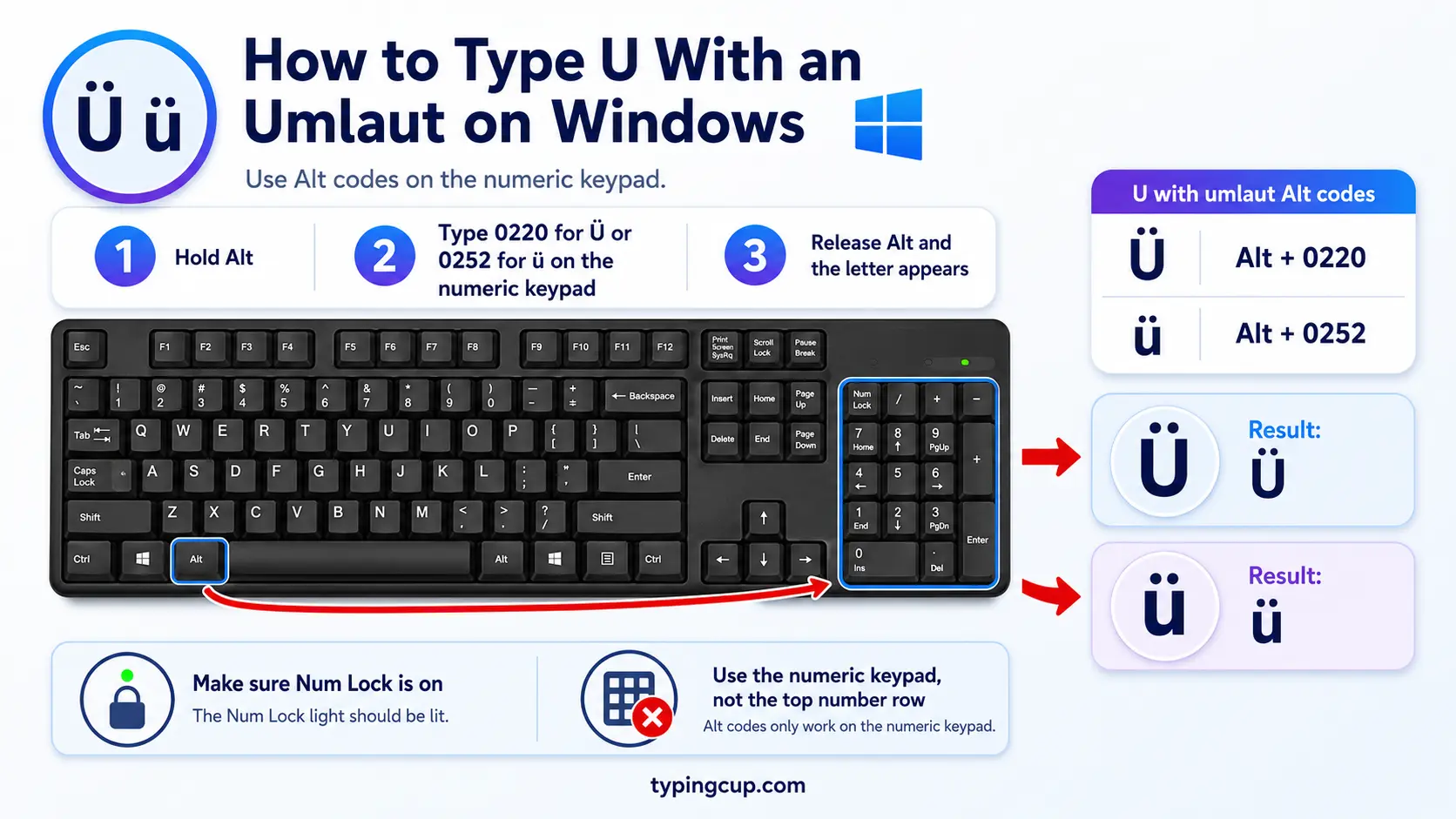
Turn on Num Lock, hold Alt, and type 0252 on the numeric keypad for ü, or 0220 for Ü. The top-row numbers won’t work; it has to be the keypad.
For regular use, switch to the US-International layout and type a quote (“) then u, or add the German keyboard, where ü has its own dedicated key. You can also press Windows + . and pick ü from the symbol panel.
Mac
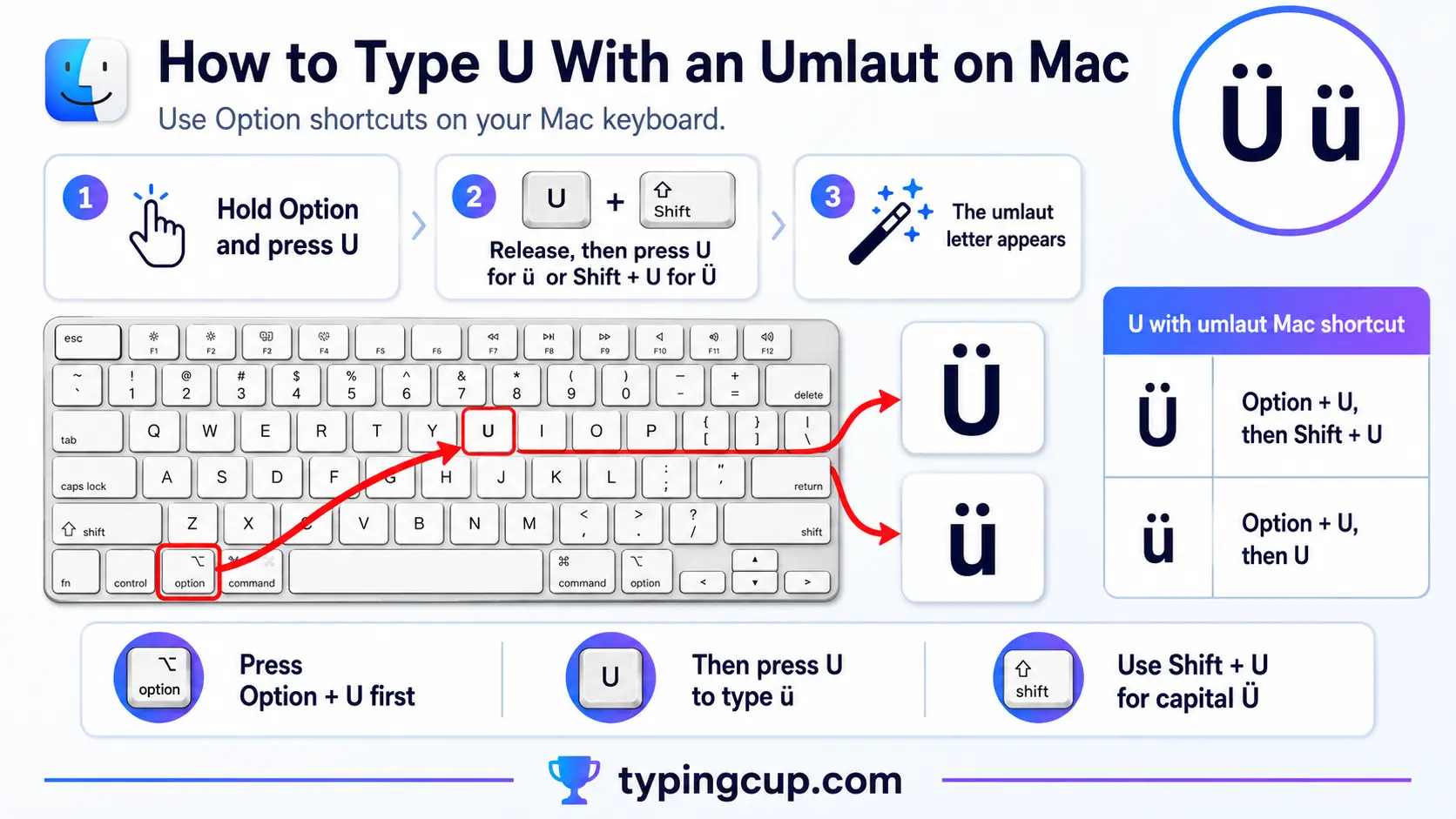
Press Option + u together and let go; nothing shows yet. Press u again and ü appears. For the capital, it’s Option + u, then Shift + U. Holding the u key down also brings up a menu with ü on it.
iPhone and Android
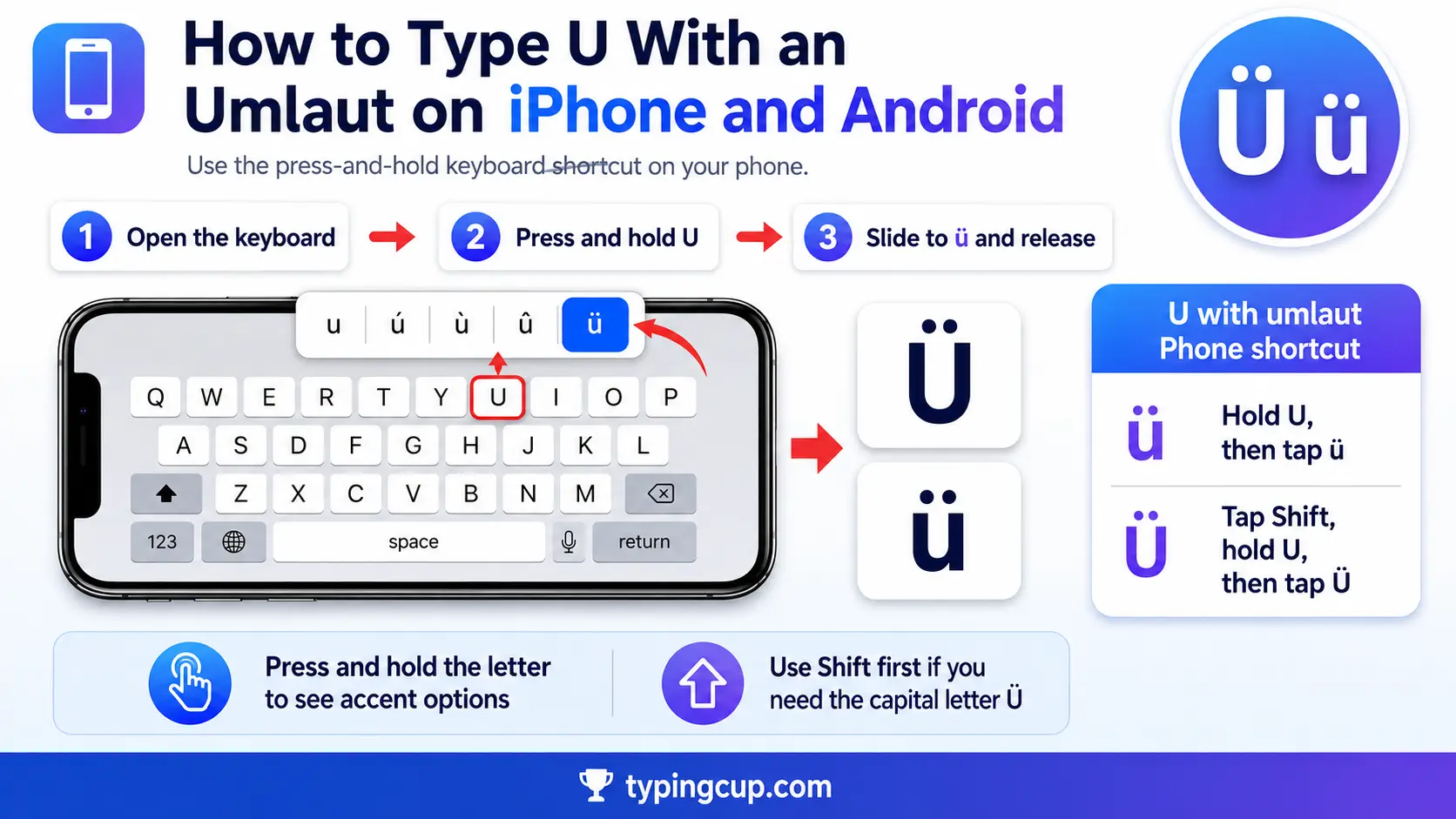
Press and hold the u key on the on-screen keyboard, then slide onto ü and lift your finger. Nothing to set up, and it works the same in nearly every app.
Microsoft Word
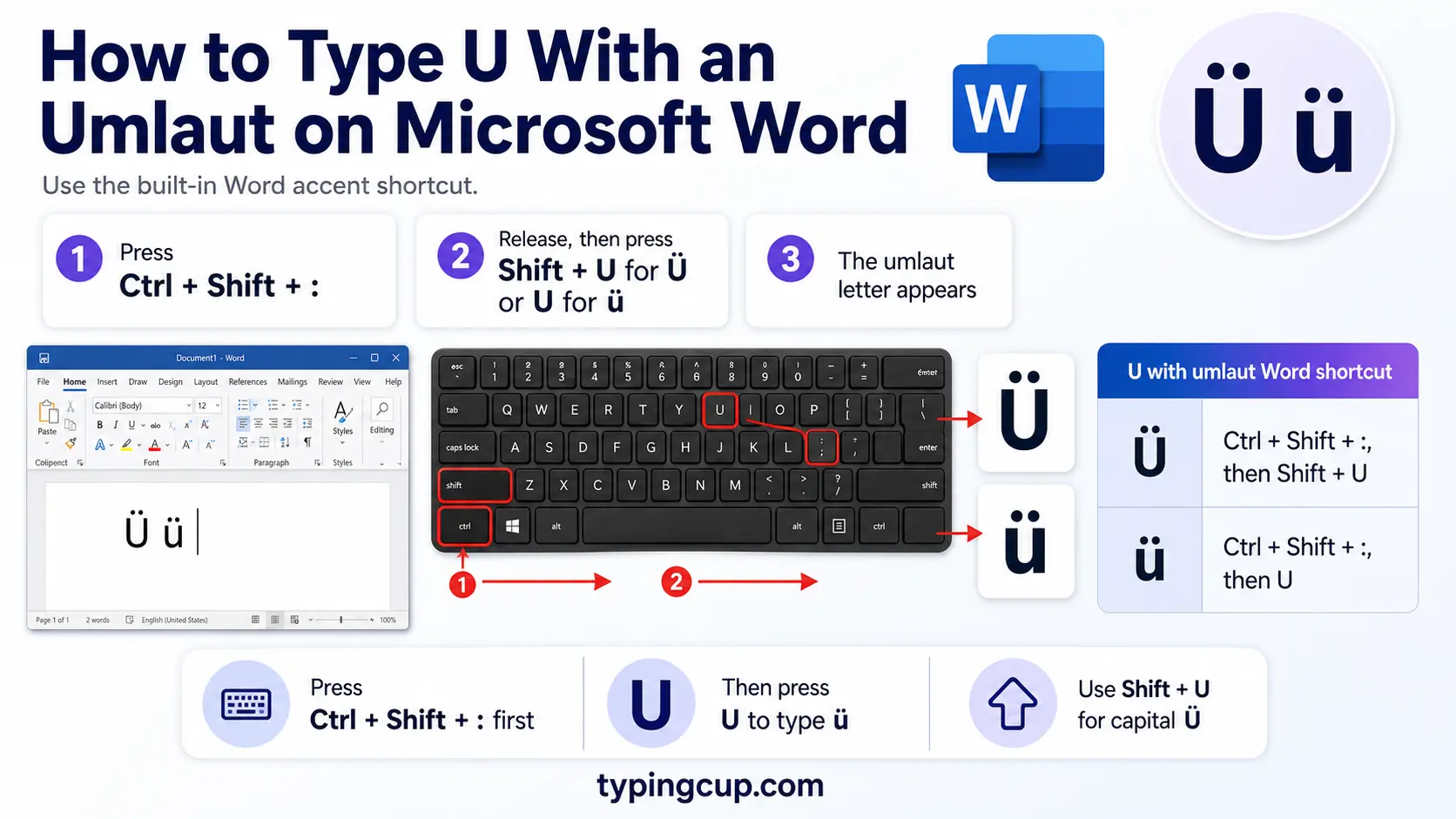
Press Ctrl + Shift + : (the colon), let go, then press u. Add Shift on the u for Ü. The Windows Alt code works here too.
Linux
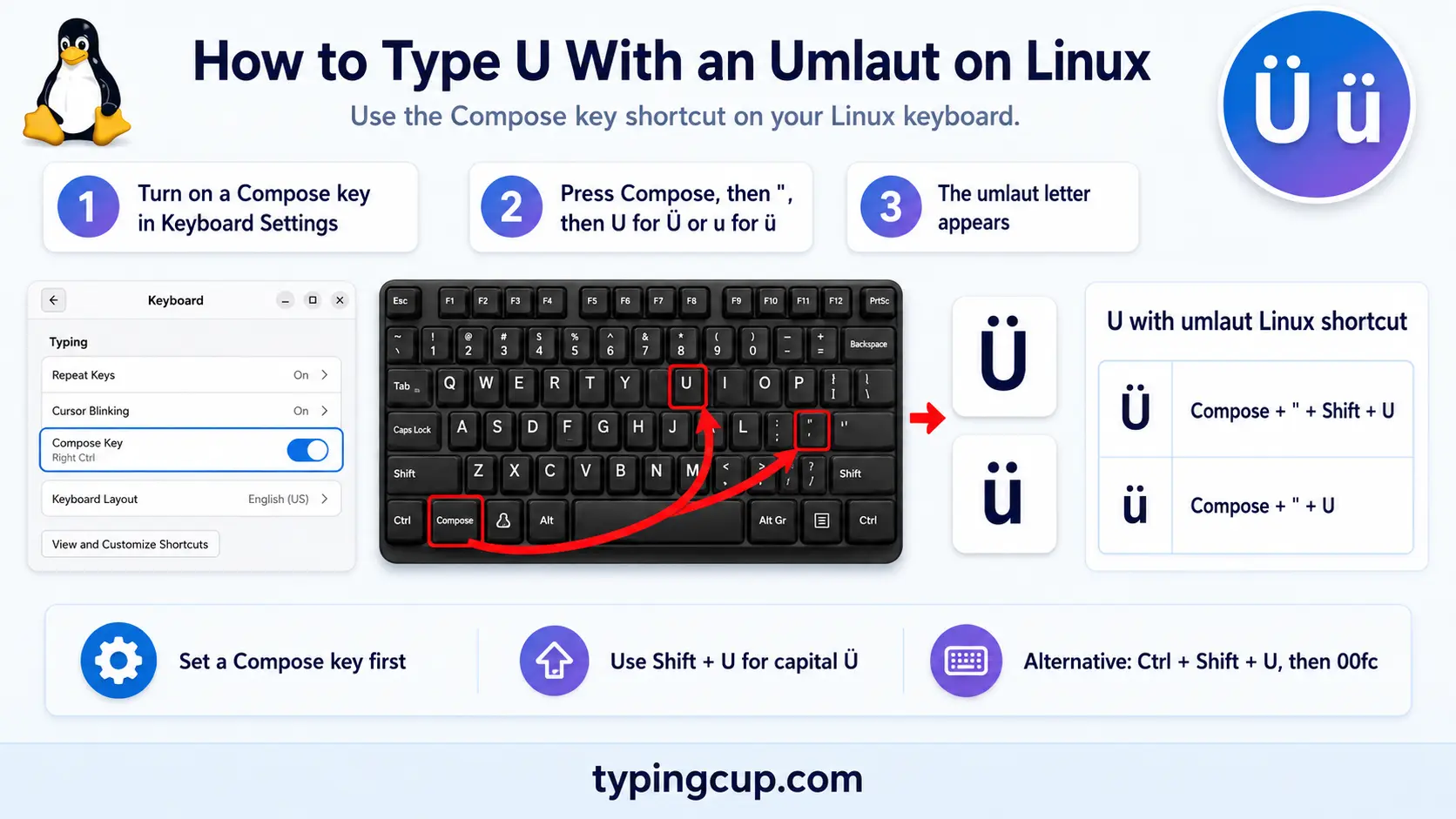
Press Ctrl + Shift + U, type 00fc, then press Enter. With a Compose key, it’s Compose, then “, then u.
Excel and Google Sheets
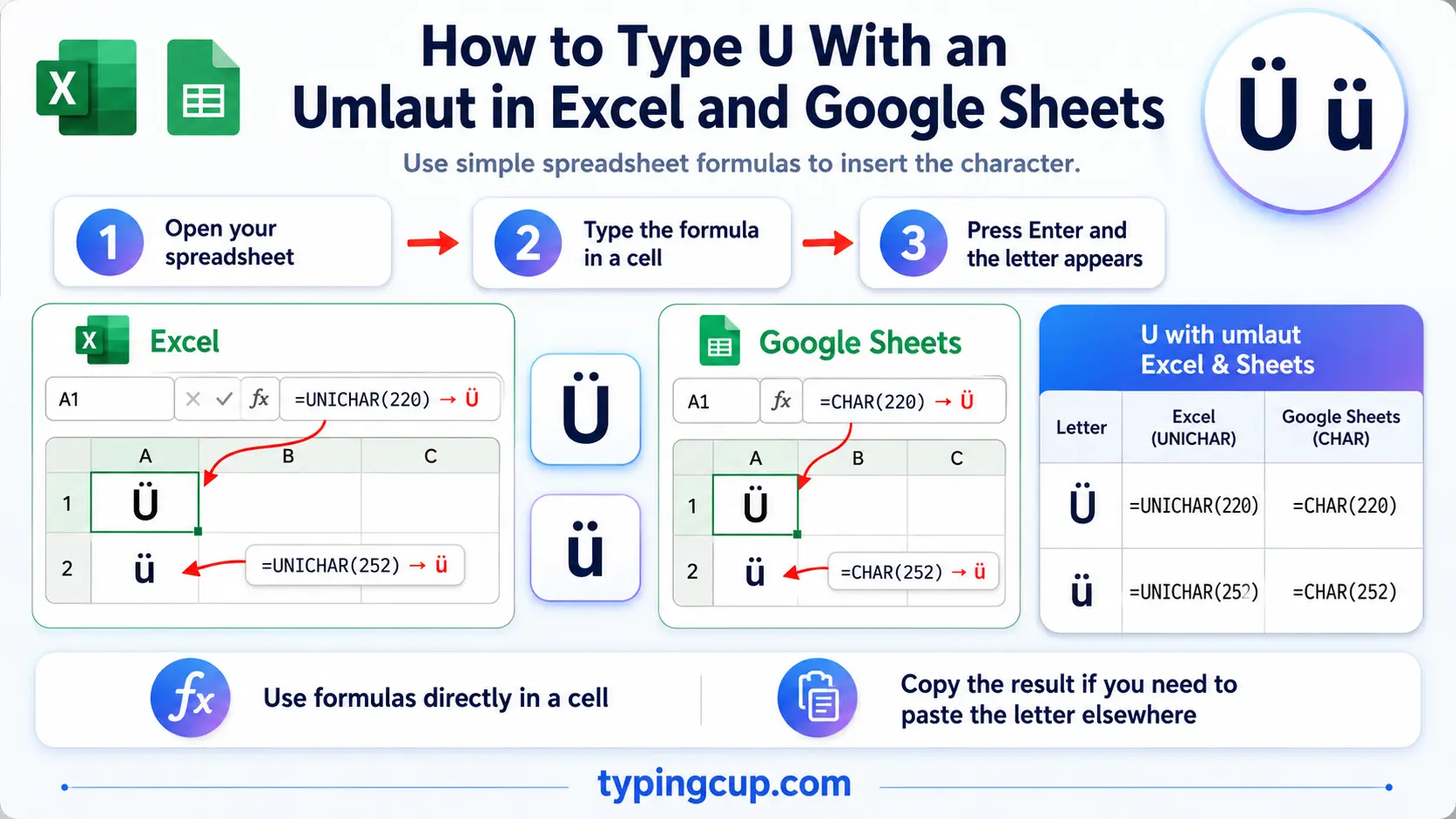
Use the Alt code on the keypad, or the UNICHAR formula: =UNICHAR(252) returns ü and =UNICHAR(220) returns Ü. The same works in Google Sheets.
Writing ü as “ue”: the umlaut substitution
When you can’t produce the character, German writes ü as ue, just as ä becomes ae and ö becomes oe. So Müller becomes Mueller, München becomes Muenchen, and für becomes fuer.
It’s the official fallback, used on German passports (the machine-readable strip prints Müller as MUELLER), on old typewriters, and wherever a system can’t handle the dots. If a form rejects ü, the ue spelling is the correct thing to type.
And, as with the other umlauts, it’s German-only. Turkish, Hungarian, and Estonian treat ü as its own letter, so swapping it for ue there would be wrong.
The Spanish ü: the two dots in pingüino
Spanish uses the same two dots for a different reason, which is worth knowing if you’re learning the language. There the mark is a diaeresis, and it appears only in the pairs güe and güi. It tells you to actually pronounce the u, which would otherwise fall silent after the g.
So pingüino (“penguin”), vergüenza (“shame”), and bilingüe (“bilingual”) all sound the u because of the dots. Take them away and the u goes quiet, turning güe into the hard gue of guerra (“war”). Same two dots as the German ü, a completely different job. For the whole Spanish set, see how to type Spanish letters.
“über”: the ü word English borrowed
One ü word has crossed into English almost intact: über, German for “over” or “above.” English uses it as an intensifier, so something can be über-cool or über-expensive, and Nietzsche’s Übermensch arrived in English as the “superman” or “overman.”
The ride-hailing company Uber took its name from the same word but dropped the umlaut for an English-speaking market, which is why the app is spelled without the two dots even though the word behind it has them. When you want the real über, the copy grid at the top is the fastest way to get the ü.
ü vs ū, ű, ų, and ǔ: the look-alikes
A few marks over u look similar at a glance but mean different things.
| Letter | Mark | Language | Note |
|---|---|---|---|
| ü | umlaut (two dots) | German, Turkish, Hungarian | the rounded front vowel |
| ū | macron (line) | Latvian, romaji | a long u |
| ű | double acute | Hungarian | a long ü |
| ų | ogonek (hook) | Lithuanian | a nasal u |
| ǔ | caron (v) | Pinyin | the third tone on u |
So the two dots of ü aren’t the line of ū or the two strokes of the Hungarian ű, even though Hungarian uses both ü and ű side by side. If a word looks slightly off, check exactly which mark is sitting on the u.
ü in web addresses, URLs, and email
ü is the poster child for internationalised domains. The city site münchen.de is stored in the domain system as xn--mnchen-3ya, a Punycode address that begins with xn--; the browser shows you münchen and does the translation behind the scenes.
Inside a URL path or query, ü is percent-encoded as %C3%BC, the two UTF-8 bytes (0xC3 and 0xBC) for the character. The capital Ü is %C3%9C. A link with %C3%BC in it has a ü inside.
Email is more cautious. An address can carry ü through the same system, but many servers still stumble over non-ASCII addresses, which is why German businesses often register both the ü domain and its ue spelling.
ü in code and passwords
In code, ü is an ordinary Unicode character and works fine in strings and comments. The usual snag is encoding: a file saved as UTF-8 but read as Latin-1 turns ü into ü, the classic sign of a crossed encoding rather than a broken character.
Passwords are the place to be careful. A ü in a password can lock you out on another device, because a different keyboard or login form may encode the character differently and produce different bytes. For a password you’ll type across systems, plain ASCII is safer.
When you want ü in code, the escapes help: \u00fc in JavaScript, Java, JSON, and Python, and ü or ü in HTML.
Copy-paste HTML codes
Everything you need for the web and for links, in one place. Click a cell and copy.
| Character | Named entity | Numeric entity | URL (percent) code |
|---|---|---|---|
| ü | ü | ü | %C3%BC |
| Ü | Ü | Ü | %C3%9C |
In a CSS content value, use the escaped code point \00fc. Serve the page as UTF-8 so the character holds. For the sibling umlauts ä and ö, the umlaut letters hub, and every other mark, see the full letters-with-accents list.
Troubleshooting
“My ü shows up as ü or a box.”
The text was saved as UTF-8 but is being read as an older encoding like Latin-1. Set the file or page to UTF-8 and the ü returns. The ü pattern is the classic UTF-8-read-as-Latin-1 mix-up.
“Alt + 0252 just beeps or types nothing.”
Num Lock is off, you’re using the top-row numbers, or the laptop has no keypad. Turn Num Lock on and use the keypad. No keypad? Use the copy grid, the US-International layout, or Windows + .
“A form or username won’t accept ü.”
For German text, type the ue spelling instead: ü becomes ue, so München becomes Muenchen. It’s the accepted substitution and most systems handle it fine.
“A password with ü won’t log me in elsewhere.”
Different keyboards and login forms can encode ü differently, so the bytes may not match what you first set. For a password you’ll type on many devices, stick to plain ASCII.
FAQ
How do I type ü?
On Windows, Alt + 0252 (Alt + 0220 for Ü). On a Mac, Option + u then u. On a phone, long-press the u key. Or click it in the grid above.
How do I write ü without the umlaut?
In German, replace ü with ue, so München becomes Muenchen and für becomes fuer. It’s a German rule; Turkish, Hungarian, and Estonian keep ü as its own letter.
What does ü mean in Spanish?
It’s a diaeresis, used only in güe and güi, that tells you to pronounce the u instead of leaving it silent, as in pingüino and vergüenza. That’s a different job from the German umlaut.
How do I write ü in a URL or HTML?
In a URL, ü is %C3%BC (Ü is %C3%9C), and a domain like münchen.de is stored as Punycode, xn--mnchen-3ya. In HTML, use ü or ü.
How do you pronounce ü?
Say “ee” and then round your lips without moving your tongue. That rounded front vowel is ü, the sound in German über and French tu. It’s not a u and an e said separately.
