Ö / ö (O With an Umlaut): How to Type, Copy, and Use It
ö is a lowercase o with an umlaut, the two dots on top. Its capital is Ö. In German it’s a rounded, fronted o; in Finnish, Swedish, Hungarian, and Turkish it’s a separate letter of the alphabet; and it has a life of its own on heavy metal album covers.
If you just need the character, copy ö or Ö from the grid below, along with its HTML entity or URL code. If you can’t type it at all, German has a standard workaround, covered further down, that most guides skip.
Below you’ll find how to type ö on every device, how to write it as “oe,” the letters it gets confused with, and how it behaves in links and code.
In a hurry?
- Copy it: click ö or Ö in the grid below.
- On Windows: hold Alt and type 0246 for ö (0214 for Ö).
- On a Mac: press Option + u, then press o.
- On a phone: press and hold the o key, then slide to ö.
- Can’t type it? In German, ö can be written as oe (Schröder → Schroeder).
Click to copy: ö, and its codes
Grab the letter, the HTML entity, or the URL code
Table of Contents
Copy and paste ö
The two characters, with every code you’re likely to need in one row. Use the grid above to copy with a click; this table is the reference.
| Character | Name | Unicode | Windows | Mac | HTML |
|---|---|---|---|---|---|
| ö | o with umlaut | U+00F6 | Alt + 0246 | Option + u, o | ö |
| Ö | O with umlaut | U+00D6 | Alt + 0214 | Option + u, Shift + O | Ö |
How to type ö on any device
ö sits in the old Latin range, so it’s easy to reach almost everywhere.
Windows
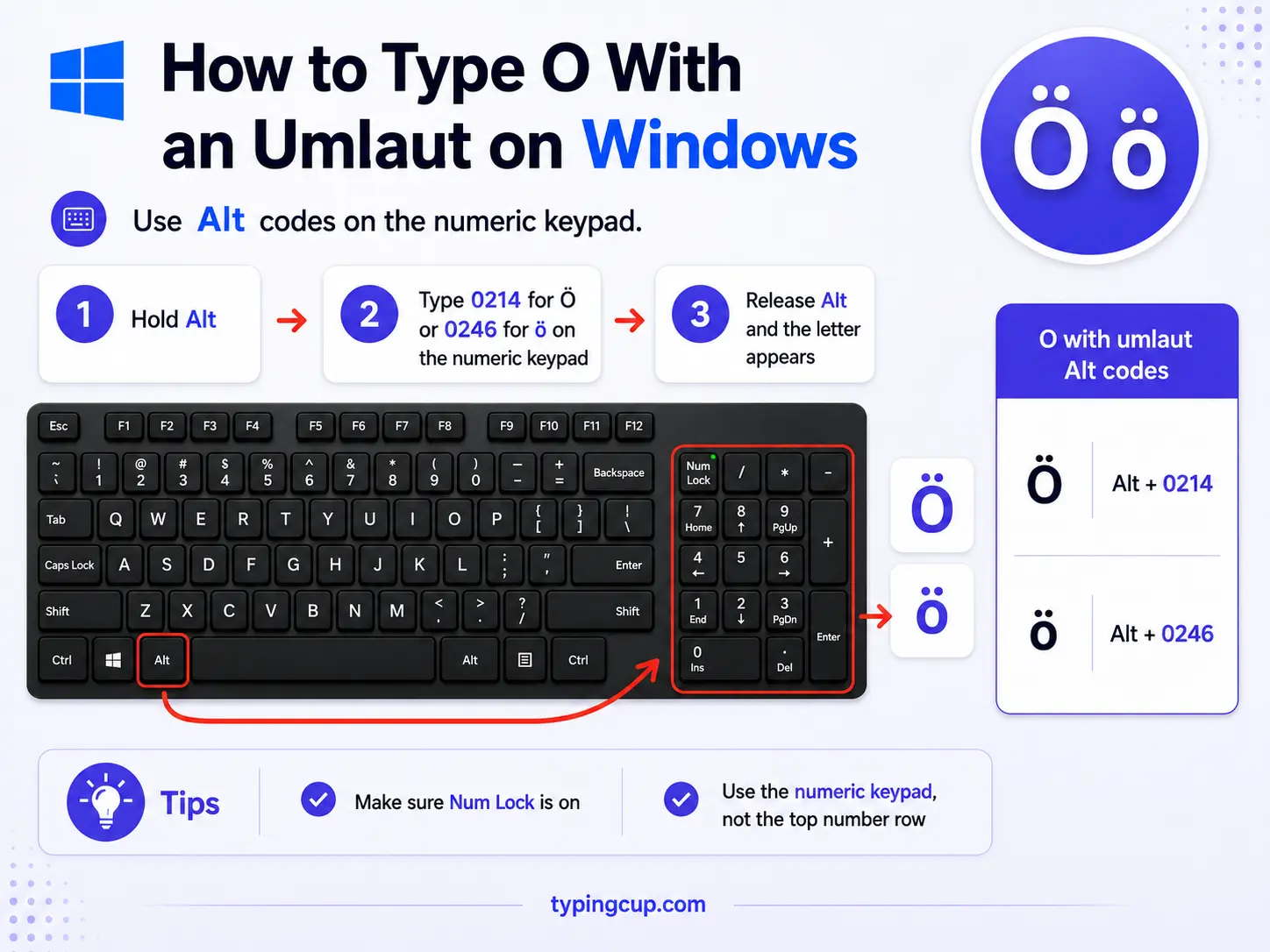
Turn on Num Lock, hold Alt, and type 0246 on the numeric keypad for ö, or 0214 for Ö. The top-row numbers won’t work; it has to be the keypad.
For regular use, switch to the US-International layout and type a quote (“) then o, or add the German keyboard, where ö has its own dedicated key. You can also press Windows + . and pick ö from the symbol panel.
Mac
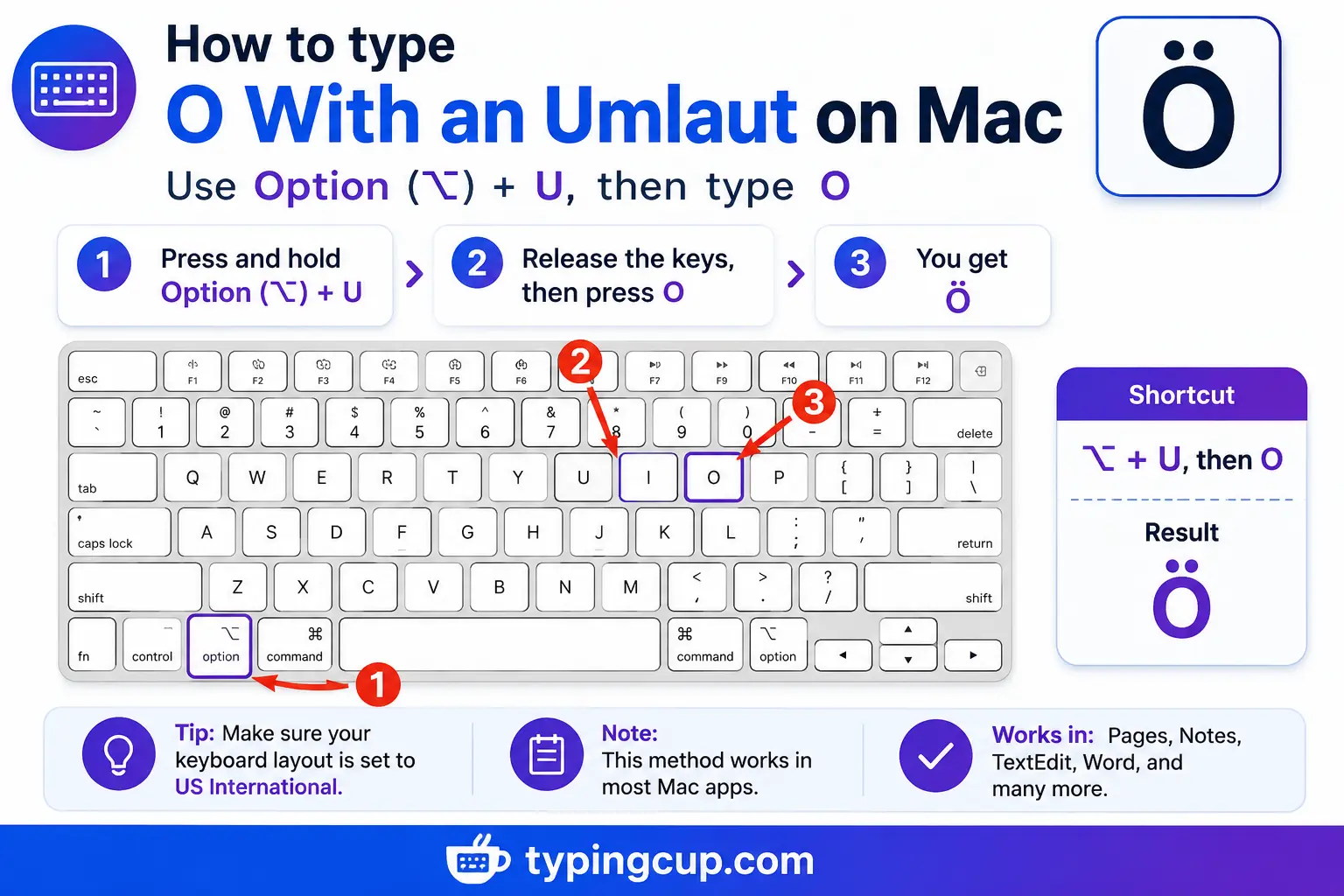
Press Option + u together and let go; nothing shows yet. Press o and ö appears. For the capital, it’s Option + u, then Shift + O. Holding the o key down also brings up a menu with ö on it.
iPhone and Android
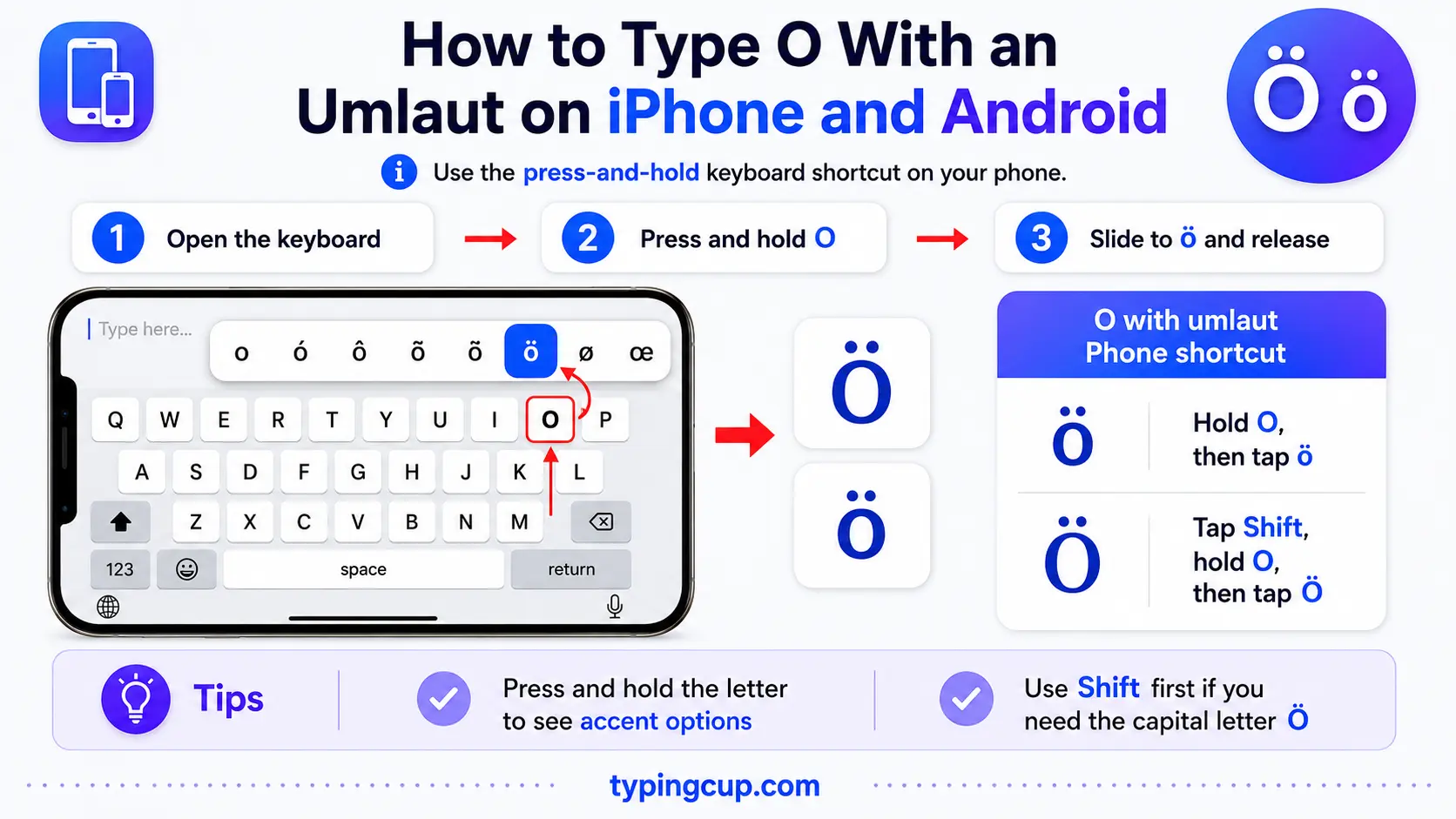
Press and hold the o key on the on-screen keyboard, then slide onto ö and lift your finger. Nothing to set up, and it works the same in nearly every app.
Microsoft Word
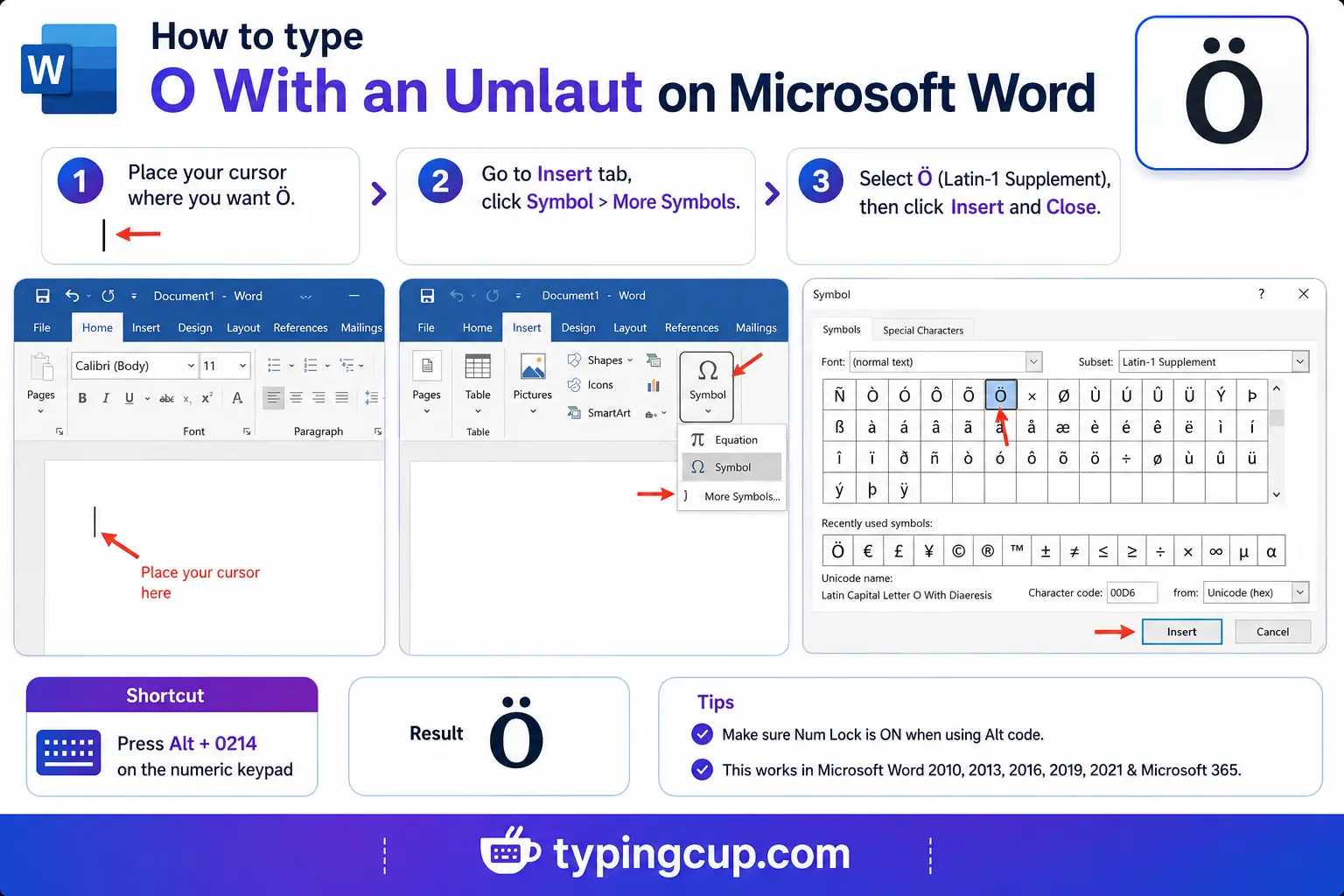
Press Ctrl + Shift + : (the colon), let go, then press o. Add Shift on the o for Ö. The Windows Alt code works here too.
Linux
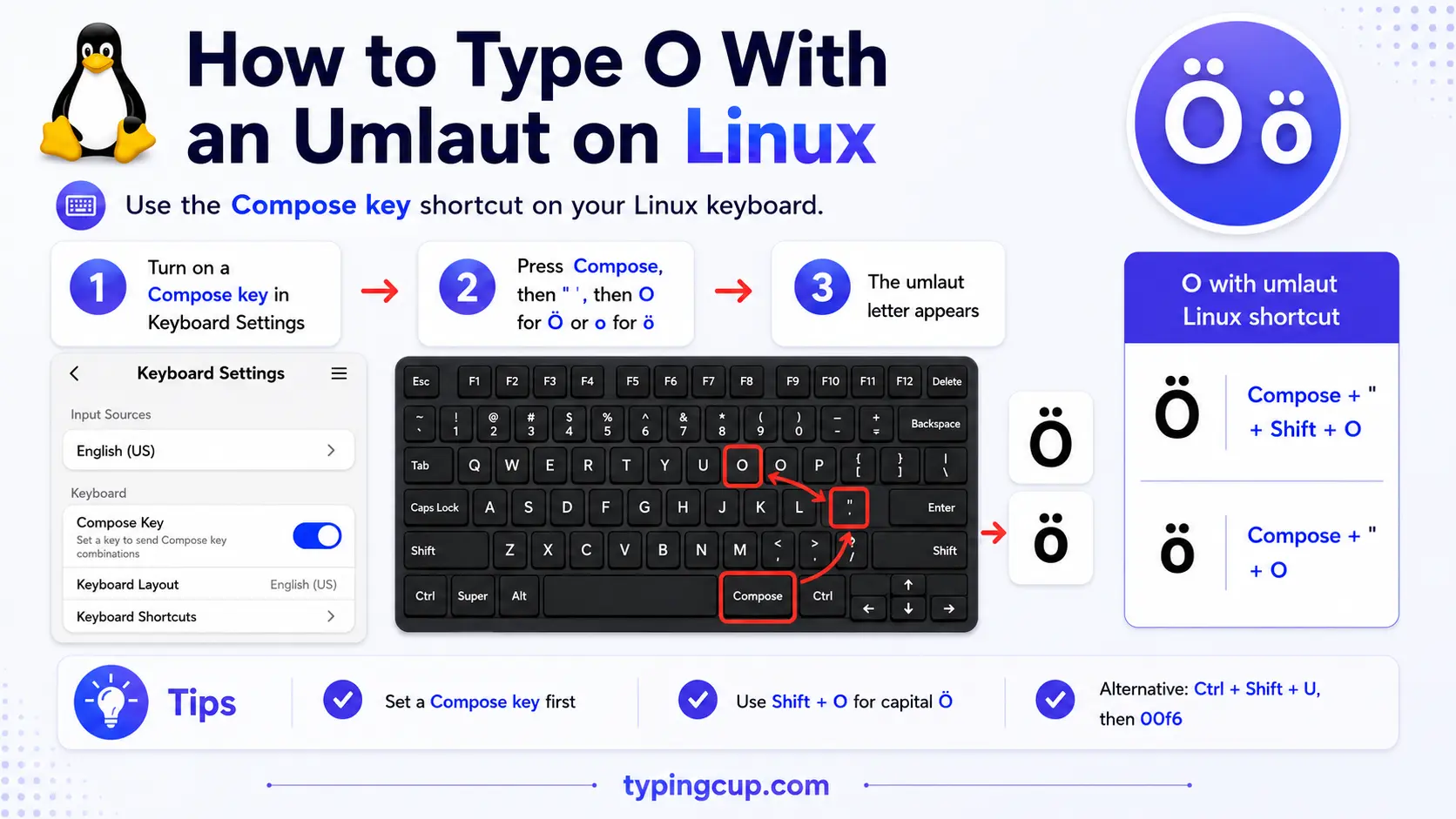
Press Ctrl + Shift + U, type 00f6, then press Enter. With a Compose key, it’s Compose, then “, then o.
Excel and Google Sheets
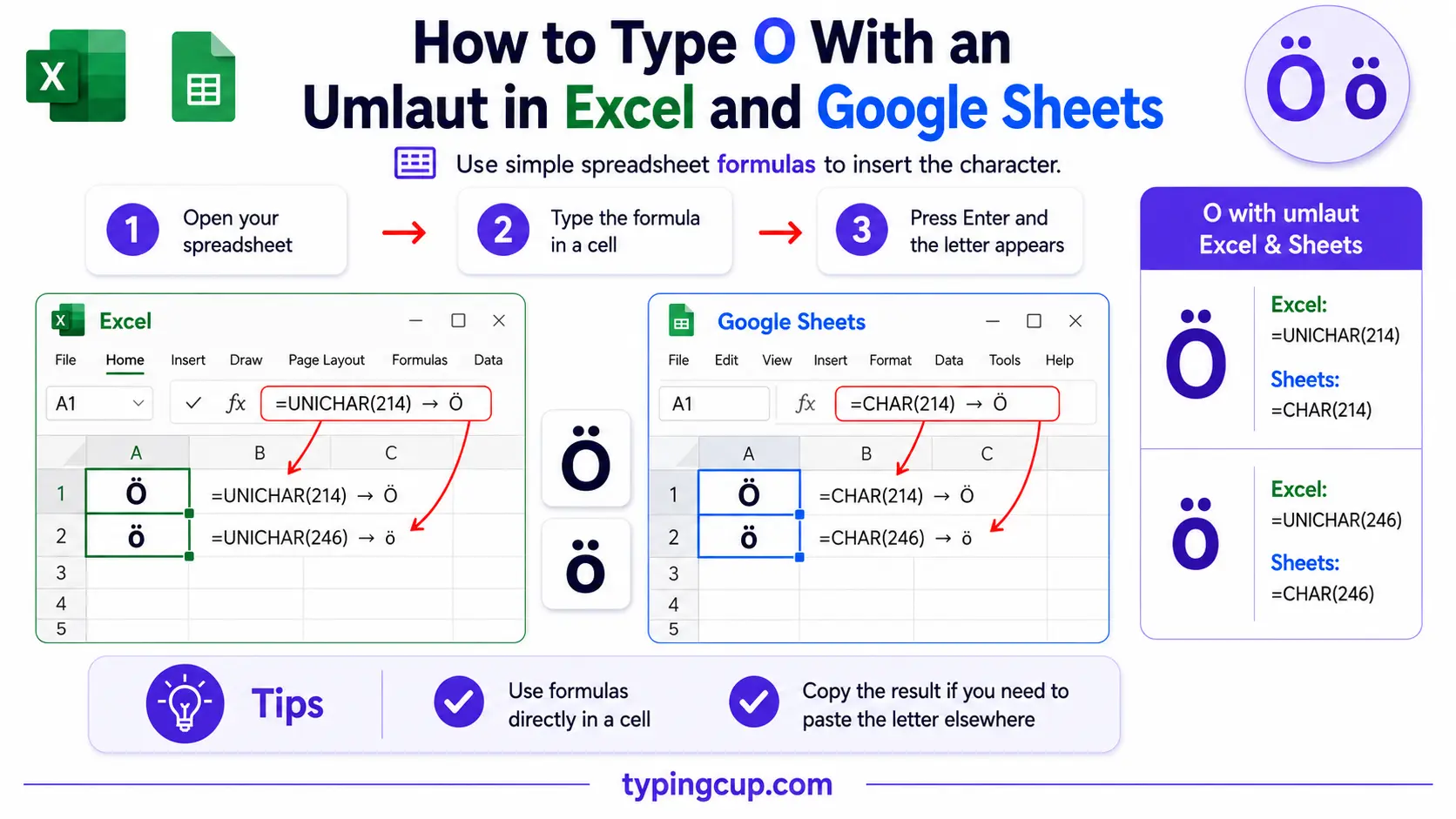
Use the Alt code on the keypad, or the UNICHAR formula: =UNICHAR(246) returns ö and =UNICHAR(214) returns Ö. The same works in Google Sheets.
Writing ö as “oe”: the umlaut substitution
When you can’t produce the character, German writes ö as oe, the same way ä becomes ae and ü becomes ue. So Schröder becomes Schroeder and Köln becomes Koeln.
This substitution is so old that it’s frozen into some famous names. The poet Goethe is really Göthe with the ö spelled out, and the physicist Röntgen, who discovered X-rays, is often written Roentgen, which is why element 111 is called roentgenium. The oe wasn’t a mistake; it was the standard way to write ö before the dotted form settled in.
As with the other umlauts, the trick is German-only. In Finnish, Swedish, Hungarian, or Turkish, ö is its own letter, so swapping it for oe would be wrong.
ö vs ø, ő, and õ: the look-alikes
A few letters sit close to ö and get mistaken for it. It’s worth a glance to be sure you’ve got the right one.
| Letter | Mark | Language | Note |
|---|---|---|---|
| ö | umlaut (two dots) | German, Turkish, Finnish | the rounded front vowel |
| ø | slash | Danish, Norwegian | almost the same sound, different letter |
| ő | double acute | Hungarian | a long ö |
| õ | tilde | Estonian, Portuguese | a different vowel entirely |
So ø with its slash is not ö with its dots, even though a Dane and a German would pronounce them almost alike. If a name looks slightly off, check whether the mark is two dots, a slash, two strokes, or a wave.
The metal umlaut: ö just for looks
There’s one place ö turns up for no linguistic reason at all: heavy metal band names. Motörhead, Mötley Crüe, and Blue Öyster Cult scatter umlauts over vowels purely for effect, a style fondly nicknamed the “metal umlaut,” or “röck döts.”
The joke is that the dots change nothing about how English speakers say the names, and would actually change the vowel for a German reader. Motörhead’s Lemmy reportedly added the umlaut just to look mean. If you’re recreating one of these names, the copy grid at the top is the quickest way to get the dots in the right spot.
How ö is sorted, and is it its own letter
In German, ö isn’t a separate letter; it’s a variant of o and sorts with the o’s in dictionary order, or as oe in phonebook order. In Finnish and Swedish it’s a full letter, and a late one: it sits at the very end of the alphabet, after z, as the final letter of all.
So in a Swedish list, a name beginning with Ö comes dead last, not up among the O’s. Sorting software that treats ö as a plain o quietly gets Nordic name lists in the wrong order, which is worth knowing if you’re alphabetising anything Scandinavian.
ö in web addresses, URLs, and email
You can use ö in a domain name. It’s stored as a Punycode address beginning with xn--, which the browser turns back into ö for display, so a real domain can look like a run of random letters in its raw form.
Inside a URL path or query, ö is percent-encoded as %C3%B6, the two UTF-8 bytes (0xC3 and 0xB6) for the character. The capital Ö is %C3%96. A link with %C3%B6 in it has an ö inside.
Email is more cautious. An address can carry ö through the same system, but many servers still stumble over non-ASCII addresses, which is one reason a German or Nordic business will often register both the ö domain and its oe spelling.
ö in code and passwords
In code, ö is an ordinary Unicode character and works fine in strings and comments. The usual snag is encoding: a file saved as UTF-8 but read as Latin-1 turns ö into ö, the classic sign of a crossed encoding rather than a broken character.
Passwords are the place to be careful. A ö in a password can lock you out on another device, because a different keyboard or login form may encode the character differently and produce different bytes. For a password you’ll type across systems, plain ASCII is safer.
When you want ö in code, the escapes help: \u00f6 in JavaScript, Java, JSON, and Python, and ö or ö in HTML.
Copy-paste HTML codes
Everything you need for the web and for links, in one place. Click a cell and copy.
| Character | Named entity | Numeric entity | URL (percent) code |
|---|---|---|---|
| ö | ö | ö | %C3%B6 |
| Ö | Ö | Ö | %C3%96 |
In a CSS content value, use the escaped code point \00f6. Serve the page as UTF-8 so the character holds. For the sibling ä, the other umlaut letters, and the wider o family, follow the links.
Troubleshooting
“My ö shows up as ö or a box.”
The text was saved as UTF-8 but is being read as an older encoding like Latin-1. Set the file or page to UTF-8 and the ö returns. The ö pattern is the classic UTF-8-read-as-Latin-1 mix-up.
“Alt + 0246 just beeps or types nothing.”
Num Lock is off, you’re using the top-row numbers, or the laptop has no keypad. Turn Num Lock on and use the keypad. No keypad? Use the copy grid, the US-International layout, or Windows + .
“A form or username won’t accept ö.”
For German text, type the oe spelling instead: ö becomes oe, so Schröder becomes Schroeder. It’s the accepted substitution and most systems handle it fine.
“A password with ö won’t log me in elsewhere.”
Different keyboards and login forms can encode ö differently, so the bytes may not match what you first set. For a password you’ll type on many devices, stick to plain ASCII.
FAQ
How do I type ö?
On Windows, Alt + 0246 (Alt + 0214 for Ö). On a Mac, Option + u then o. On a phone, long-press the o key. Or click it in the grid above.
How do I write ö without the umlaut?
In German, replace ö with oe, so Schröder becomes Schroeder and Köln becomes Koeln. It’s a German rule, though; Finnish, Swedish, and Turkish keep ö as its own letter.
Is ö the same as ø?
No. ö is written with two dots (German and others); ø is written with a slash (Danish and Norwegian). They sound almost the same but are different letters with different codes.
How do I write ö in a URL or HTML?
In a URL, ö is %C3%B6 (Ö is %C3%96), and domains store it as Punycode beginning with xn--. In HTML, use ö or ö.
How do you pronounce ö?
Round your lips as if to say “oh,” then try to say “eh.” That rounded front vowel is ö, the sound in German schön. It’s close to the French eu in peu.
