Cross Symbol (× ✗ ✝ †): How to Type, Copy, and Use It
“Cross symbol” points at several different characters, and the one you want depends on the job. There is the multiplication cross ×, the close-or-cancel ✕, the “wrong” mark ✗, the religious cross ✝, and the dagger †. They look related but sit at different code points and mean different things. Here is how to type each cross, where to copy every version, and which one fits math, a checklist, a form, or a memorial.
In a hurry?
- Copy it: click ×, ✗, ✝, or ❌ in the grid below.
- Times sign ×: on Windows, Alt + 0215; in Word, 00D7 then Alt + X.
- Wrong or close X (✗ ✕): copy it, or in Word type 2717 then Alt + X.
- Cross ✝ or dagger †: type 271D or 2020 then Alt + X († is also Alt + 0134).
- In HTML the times sign is
×and the cross mark is✗.
Table of Contents
These are not interchangeable: × multiplies, ✕ closes, ✗ marks something wrong, ✝ is religious, and † means a footnote or “died.” The sections below sort out which is which.
Cross symbol: every code in one table
The crosses people mean by “cross symbol,” with the code for each. Copy from the grid above, or use whichever method fits the app you are in.
| Symbol | Name | Unicode | Windows | HTML |
| × | Multiplication (times) | U+00D7 | Alt + 0215 | × |
| ✕ | Multiplication X (close) | U+2715 | Word 2715 + Alt+X | ✕ |
| ✗ | Ballot X (wrong) | U+2717 | Word 2717 + Alt+X | ✗ |
| ✝ | Latin cross | U+271D | Word 271D + Alt+X | ✝ |
| † | Dagger | U+2020 | Alt + 0134 | † |
| ‡ | Double dagger | U+2021 | Alt + 0135 | ‡ |
| ❌ | Cross mark (emoji) | U+274C | Emoji panel | ❌ |
The one with a genuine Alt code is the times sign: Alt + 0215 gives × (keep the leading zero). The dagger and double dagger have codes too, Alt + 0134 and Alt + 0135. The decorative crosses (✕, ✗, ✝) do not, so use Word (code then Alt + X), Character Map, or copy from the grid.
How to type the cross symbol on any device
On Windows
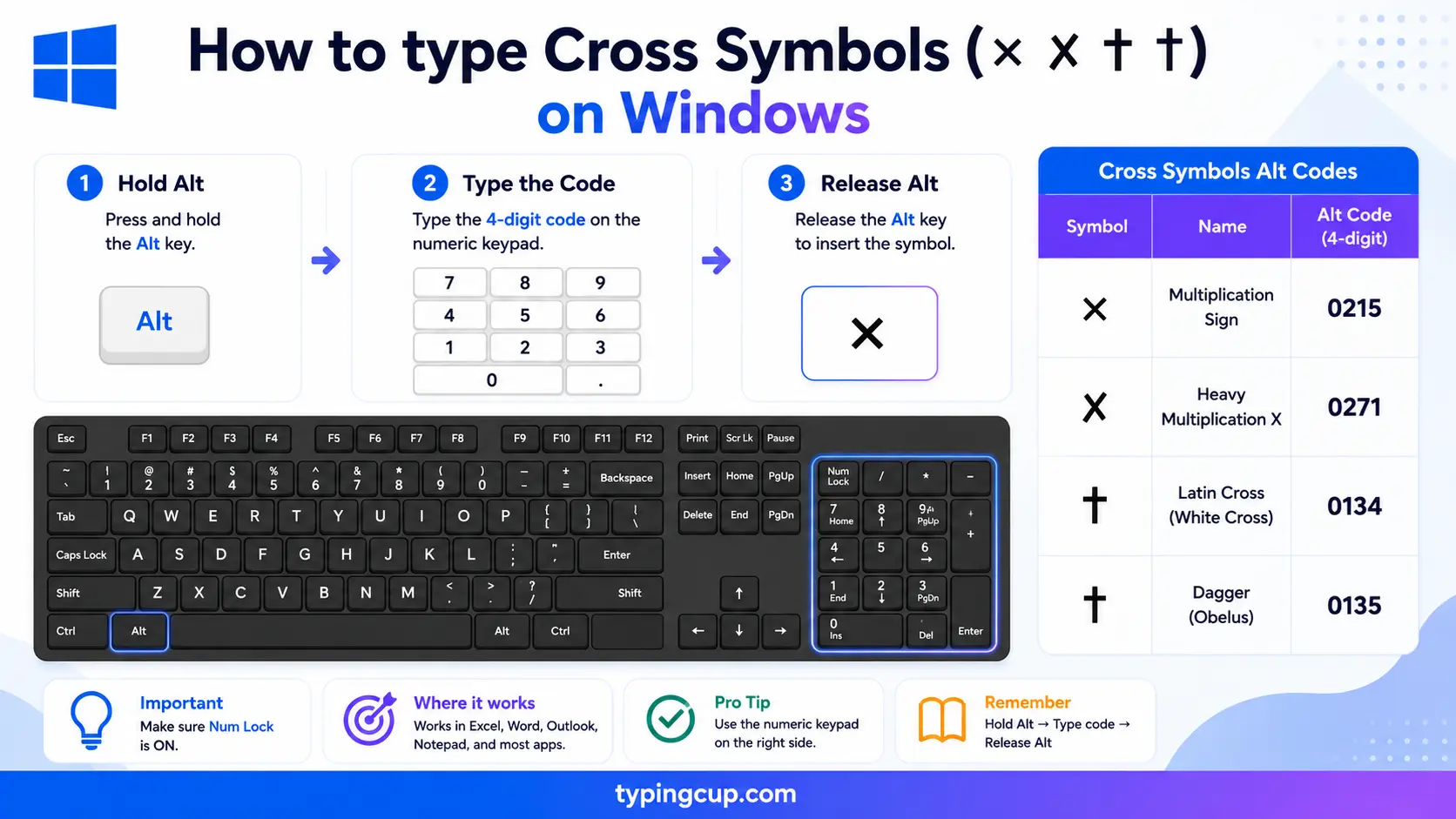
For the times sign, hold Alt and type 0215 on the numeric keypad to get ×; the dagger † is Alt + 0134 and the double dagger ‡ is Alt + 0135 (keep the leading zeros, Num Lock on). For the decorative crosses, type the code and press Alt + X in Word (2717 for ✗, 271D for ✝), or open Character Map. The emoji ❌ is under Windows + ., search “cross”.
On Mac
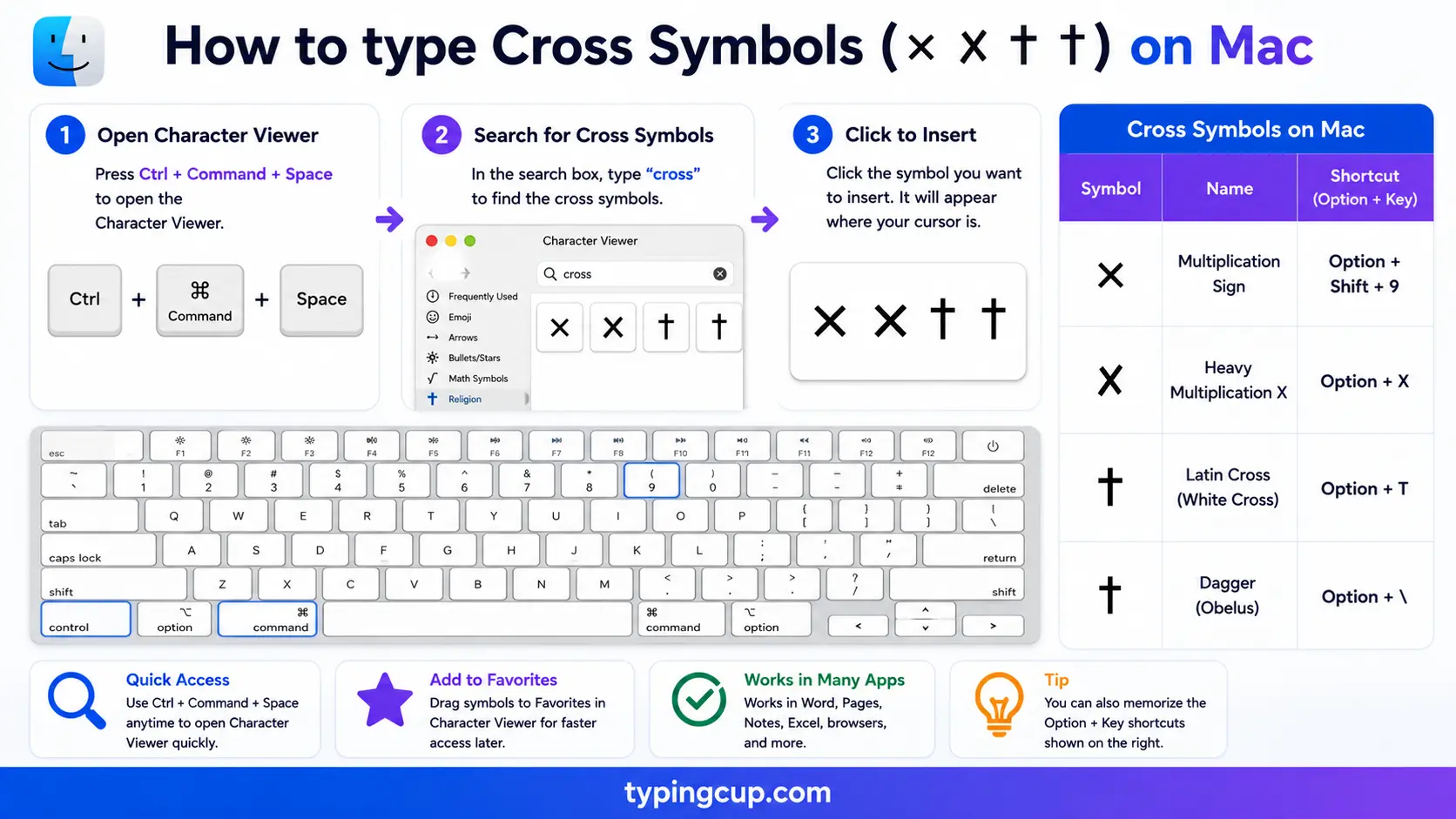
Open the Character Viewer with Control + Command + Space and search “multiplication”, “cross”, or “dagger”, then double-click the one you want. The emoji versions ❌ and ✝️ are in the same picker under “cross”.
On iPhone and Android
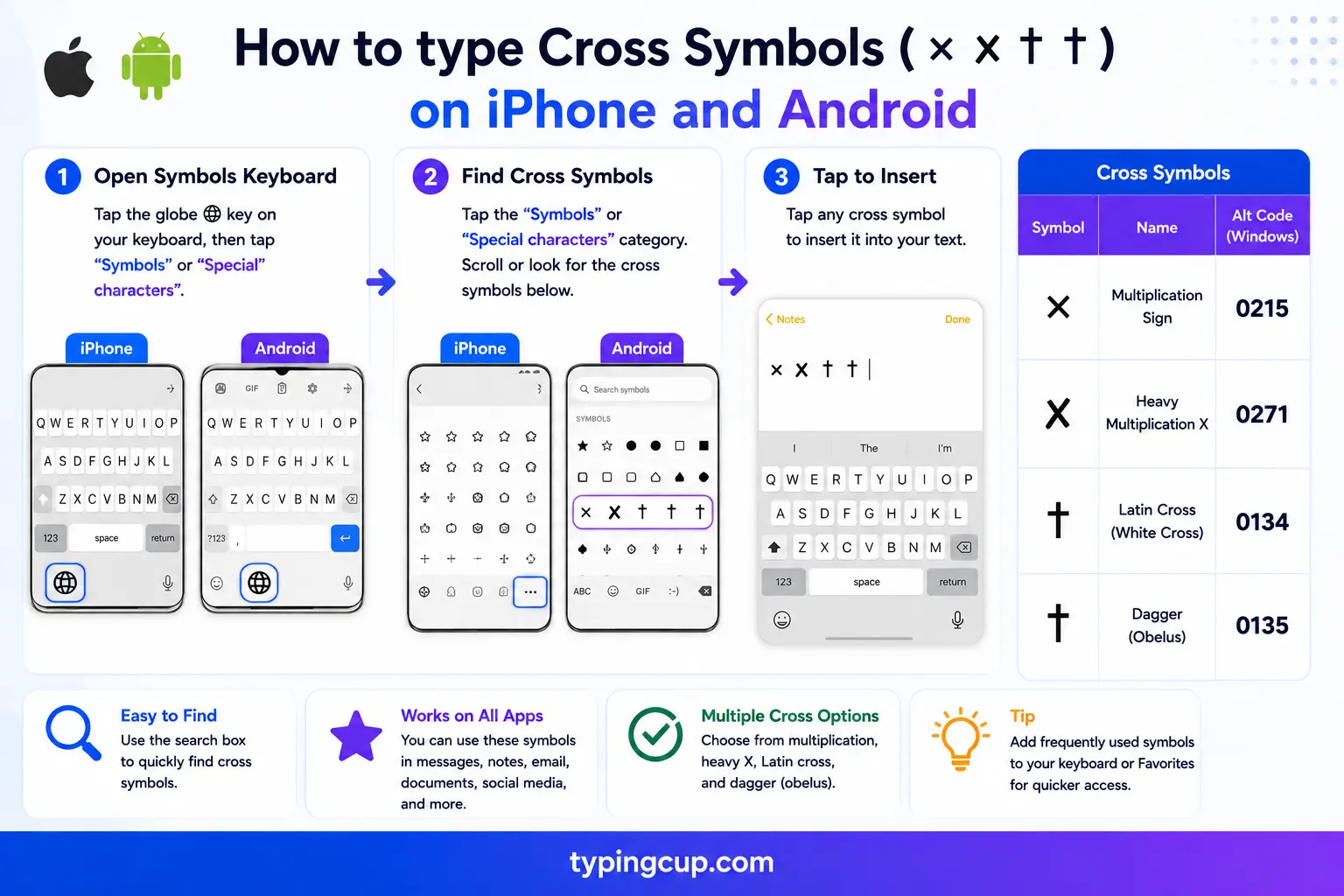
Most crosses have no key, so copy the one you need from the grid above. For the colored versions, open the emoji keyboard and search “cross” for ❌ or “latin cross” for ✝️.
In Microsoft Word
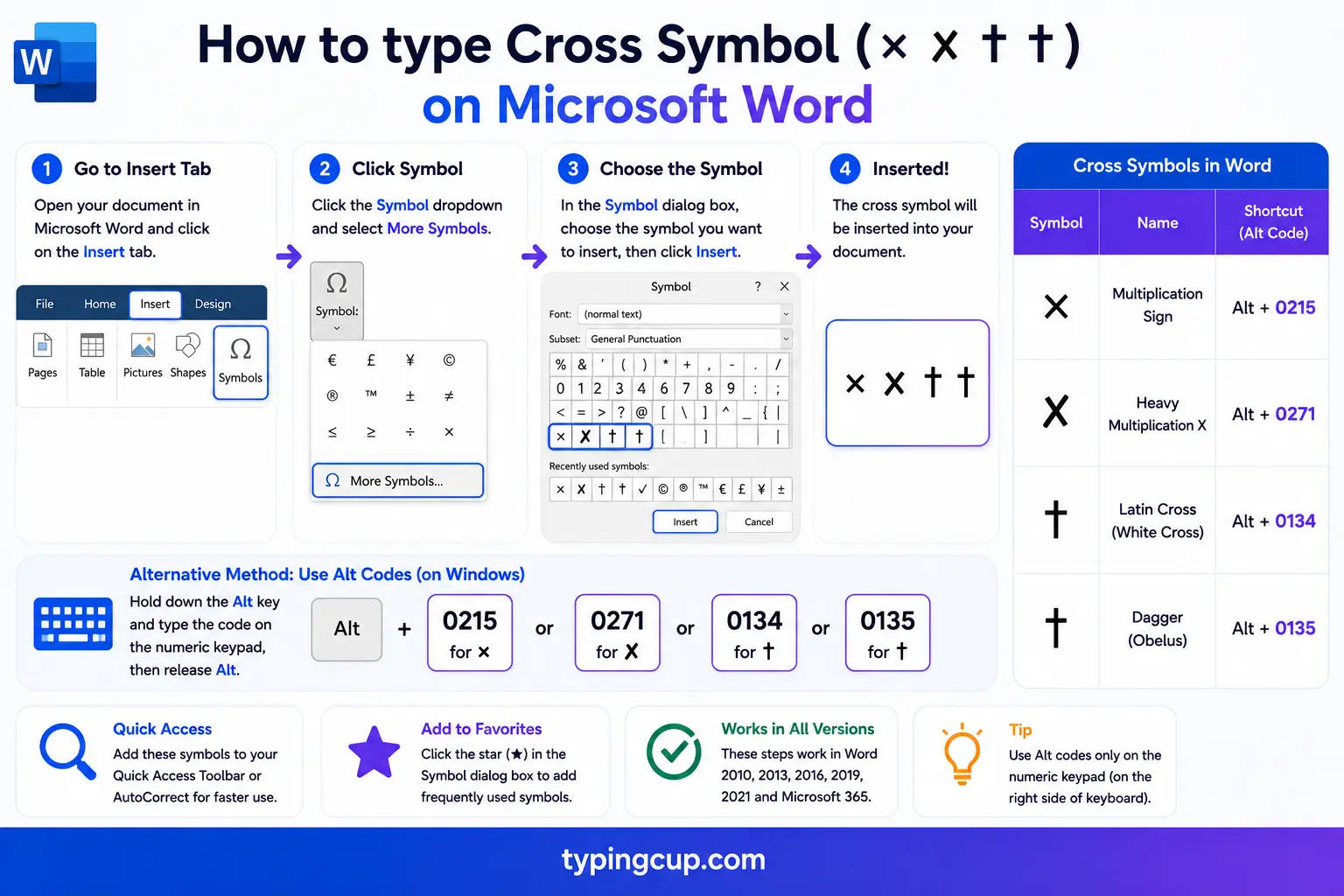
Type the code and press Alt + X: 00D7 for ×, 2717 for ✗, 271D for ✝, 2020 for the dagger †. Insert → Symbol lists them too, and AutoCorrect turns (x)-style shortcuts and some fractions into their proper signs.
On Linux
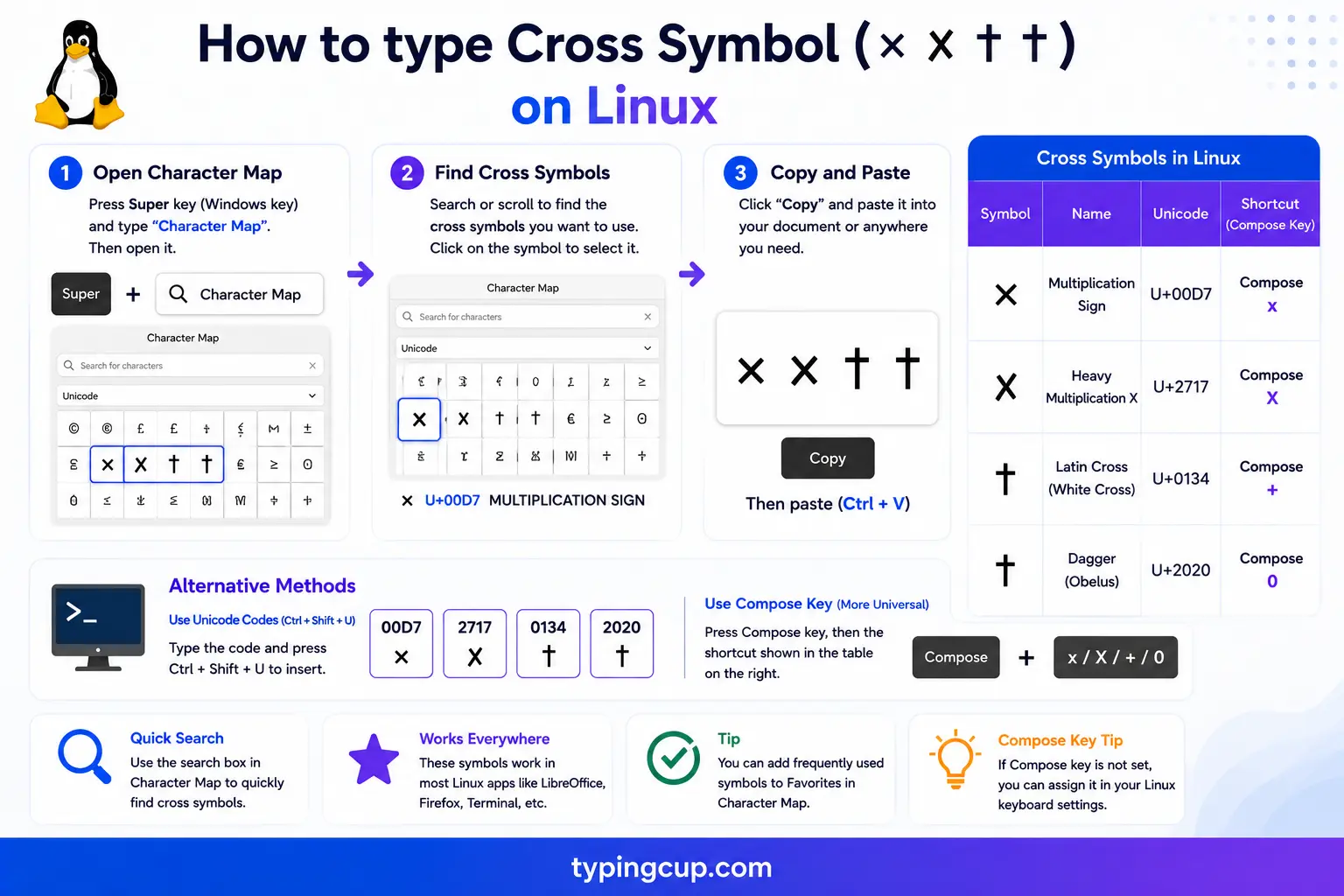
Press Ctrl + Shift + U, type the hex code, then Enter: 00d7 for ×, 2717 for ✗, 271d for ✝. Emoji pickers such as Super + . in GNOME carry the cross marks.
In HTML and CSS
The times sign has a friendly name: × (or ×). The dagger is † and the double dagger ‡. The decorative crosses use numbers — ✗ for ✗, ✝ for ✝. In a CSS content value, use \00d7 for the times sign.
What “cross symbol” can mean
Unlike most symbols, “cross” is not one character but a small family, and people arrive wanting very different ones. Some need the multiplication sign for a recipe or a screen size; some need the red X that closes a window; some need a checklist “no”; some need a religious cross or the little dagger that marks a death. The trick is matching the shape to the meaning, so here is each one in the context it belongs to.
The times sign × and the letter x: not the same
This is the mix-up worth fixing. The real multiplication sign is × (U+00D7), a math operator — not a lowercase x. Use it for sums (6 × 7), for dimensions (a 1920×1080 screen, an 8×10 photo, a 2×4 board), and for “times” in general (buy one, get one ×2). It centers on the line and spaces properly, where a typed “x” sits low and reads as a letter. On Windows it is Alt + 0215; in Word, 00D7 then Alt + X; in HTML, ×. Once you notice the difference, the letter “x” in a spec sheet looks wrong.
The close and cancel X: ✕ and ✖
The X in the corner that closes a window, dismisses a banner, or removes an item is its own idea. On screens it is usually an icon, but when it needs to be text, the multiplication X ✕ (U+2715) and the heavy multiplication X ✖ (U+2716) are the characters designers reach for — cleaner and more symmetric than either × or the letter x. If you are building an interface, one of these reads instantly as “close” or “delete,” while × reads as “multiply.”
The wrong mark: ✗, ✘, and ❌
For “no,” “incorrect,” or “failed,” the ballot X is the sign. The light ✗ (U+2717) and heavy ✘ (U+2718) pair naturally with the check mark ✓ on graded work, comparison tables, and checklists — check for yes, X for no. The bright ❌ is the emoji version, the red cross-mark you see in chats and as a “wrong answer” buzzer. Same message, different weight and color.
Religious crosses: the Latin cross ✝, the Orthodox cross ☦, and the dagger †
The upright cross of Christianity is the Latin cross ✝ (U+271D). The Orthodox cross ☦ (U+2626) adds the slanted lower bar of Eastern churches, and there are ornamental variants like ✞ too. Worth knowing: the plain dagger † (U+2020), which started as a small cross, still carries that echo — in obituaries and genealogy it means “died”, placed before a date or a name (born *, died †). So the same little mark can be a footnote in an essay and a death date in a family tree.
The dagger † and double dagger ‡ in footnotes
Before superscript numbers took over, footnotes were marked with symbols, and the order is still used in typeset books and academic tables. It runs * (asterisk), † (dagger), ‡ (double dagger), § (section), ‖ (parallels), then ¶ (pilcrow). So the dagger † is the second footnote after the asterisk, and the double dagger ‡ is the third. They are handy when numbers would clash with the content, like in a table of figures. On Windows they are Alt + 0134 and Alt + 0135; in HTML, † and ‡.
The medical and red cross: ✚ and ➕
A cross also stands for help and health. The heavy Greek cross ✚ (U+271A) is the plus-shaped symbol used for first aid, pharmacies, and health apps, and the heavy plus ➕ (U+2795) is its emoji cousin. One caution: the actual Red Cross emblem is legally protected under the Geneva Conventions, so a red version of this cross should not be used as a generic health icon — a green cross or the plus is the safer, and more common, choice.
Which cross? × vs ✕ vs ✗ vs ✝ vs †
They all look like crosses or Xs, but they are different characters with different jobs. Pick the one that matches your meaning.
| Symbol | Name | Unicode | Where it fits |
| × | Multiplication sign | U+00D7 | math, dimensions (10×20) |
| ✕ | Multiplication X | U+2715 | close, delete, remove |
| ✗ | Ballot X | U+2717 | wrong, no, failed |
| ✝ | Latin cross | U+271D | Christianity |
| ☦ | Orthodox cross | U+2626 | Eastern churches |
| † | Dagger | U+2020 | footnotes, “died” |
| ✚ | Heavy Greek cross | U+271A | health, first aid |
| ❌ | Cross mark (emoji) | U+274C | chats, “wrong”, in color |
× vs ❌: the plain cross and the emoji
Like the other symbols, the flat cross and the emoji are different characters. The plain × or ✗ is a text character that takes your font’s color, so it fits equations, tables, and print. The ❌ is the emoji, drawn as a bold red X by the device, made for chats and reactions. On a phone they look clearly different; in code they can read the same. Use the plain cross for documents, the emoji for messages.
Cross symbol in URLs and encoding
Here the times sign is unusual: × is one of the few of these that lives in the old Latin-1 set, so it survives on older pages and encodes as just %C3%97 in a URL. The decorative crosses sit higher in Unicode — ✗ is %E2%9C%97 and ✝ is %E2%9C%9D. If a cross shows as × or a box, the bytes are being read in the wrong encoding; set the file, database, and page to UTF-8.
Copy-paste HTML codes
The main crosses with their web codes, in one place. Copy the code you need.
| Symbol | Named entity | Numeric entity | URL (percent) code |
| × | × | × | %C3%97 |
| ✕ | (none) | ✕ | %E2%9C%95 |
| ✗ | (none) | ✗ | %E2%9C%97 |
| ✝ | (none) | ✝ | %E2%9C%9D |
| † | † | † | %E2%80%A0 |
| ‡ | ‡ | ‡ | %E2%80%A1 |
In a CSS content value, use \00d7 for the times sign or \2717 for the ballot X. For every other symbol and its codes, see the copy and paste symbols tool and the symbol Alt codes list.
Troubleshooting
My cross shows as a box or ×
A box means the font has no glyph for that character; the × pattern means UTF-8 bytes are being read as an older encoding. Set the file, database, and page charset to UTF-8 and use a font with good symbol coverage. The times sign × is the most likely to survive older encodings; the decorative crosses need UTF-8.
Alt + 0215 gives the wrong character
Two usual causes: the missing leading zero (it is 0215, not 215) or Num Lock being off. Alt + 215 without the zero produces a box-drawing character from the old code page, not ×. Keep the zero and use the numeric keypad, or type 00D7 then Alt + X in Word.
My times sign looks like the letter x
You likely typed a lowercase x instead of the multiplication sign. Replace it with × (Alt + 0215, or × on the web). It sits centered on the line and spaces like an operator, where the letter x sits on the baseline.
Frequently asked questions
How do I type the times sign ×?
On Windows, hold Alt and type 0215 on the numeric keypad. In Word, type 00D7 then Alt + X. In HTML it is ×. On a Mac, open the Character Viewer (Control + Command + Space) and search “multiplication”. Or copy it from the grid above.
What is the difference between × and the letter x?
× (U+00D7) is the multiplication sign, a math operator that centers on the line. The letter x is a lowercase letter that sits on the baseline. For math and dimensions like 10×20, use ×, not x.
How do I type the Christian cross ✝?
Copy ✝ from the grid above, or in Word type 271D then Alt + X. In HTML it is ✝. For the Orthodox cross use U+2626 (☦).
What does the dagger † symbol mean?
It has two common uses: as a footnote mark (the second one, after the asterisk), and in obituaries and genealogy it means “died,” placed before a date or name. Type it with Alt + 0134 or †.
How do I write a cross in HTML?
The times sign is ×, the dagger is †. The decorative crosses use numbers: ✗ for the ballot X and ✝ for the Latin cross.
