
Omega Symbol (Ω / ω): How to Type, Copy, and Use It
The omega symbol, Ω (capital) and ω (lowercase), is the last letter of the Greek alphabet — which is why “the Alpha and the Omega” means the beginning and the end. It’s also the sign for the ohm, the unit of electrical resistance. None of its forms are on an English keyboard, so most people copy them or use a shortcut. This page has both, plus what omega means in electronics, physics, and beyond.
If you just need the symbol, copy Ω (or ω) from the grid below. If you want the shortcuts and the meanings, the sections below cover both.
In a hurry?
- Copy it: click Ω in the grid below.
- On Windows: hold Alt and type 937 for Ω (969 for ω).
- On a Mac: press Option + z for Ω.
- In Word: type 03A9 then press Alt + X for Ω.
- In HTML: write Ω (or Ω).
Table of Contents
Copy and paste the omega symbol
Omega in its forms, with the codes you’re likely to need. Use the grid above to copy with one click; this table is the reference.
| Symbol | Name | Unicode | Windows | HTML |
|---|---|---|---|---|
| Ω | Greek capital omega | U+03A9 | Alt + 937 | Ω |
| ω | Greek small omega | U+03C9 | Alt + 969 | ω |
| Ω | ohm sign | U+2126 | Alt + 8486 | Ω |
None of these are on a standard keyboard, so each takes a shortcut, a code, or a copy. The sections below cover each device, then the near-identical letter and unit that get mixed up.
How to type the omega symbol on any device
Type Ω on Windows
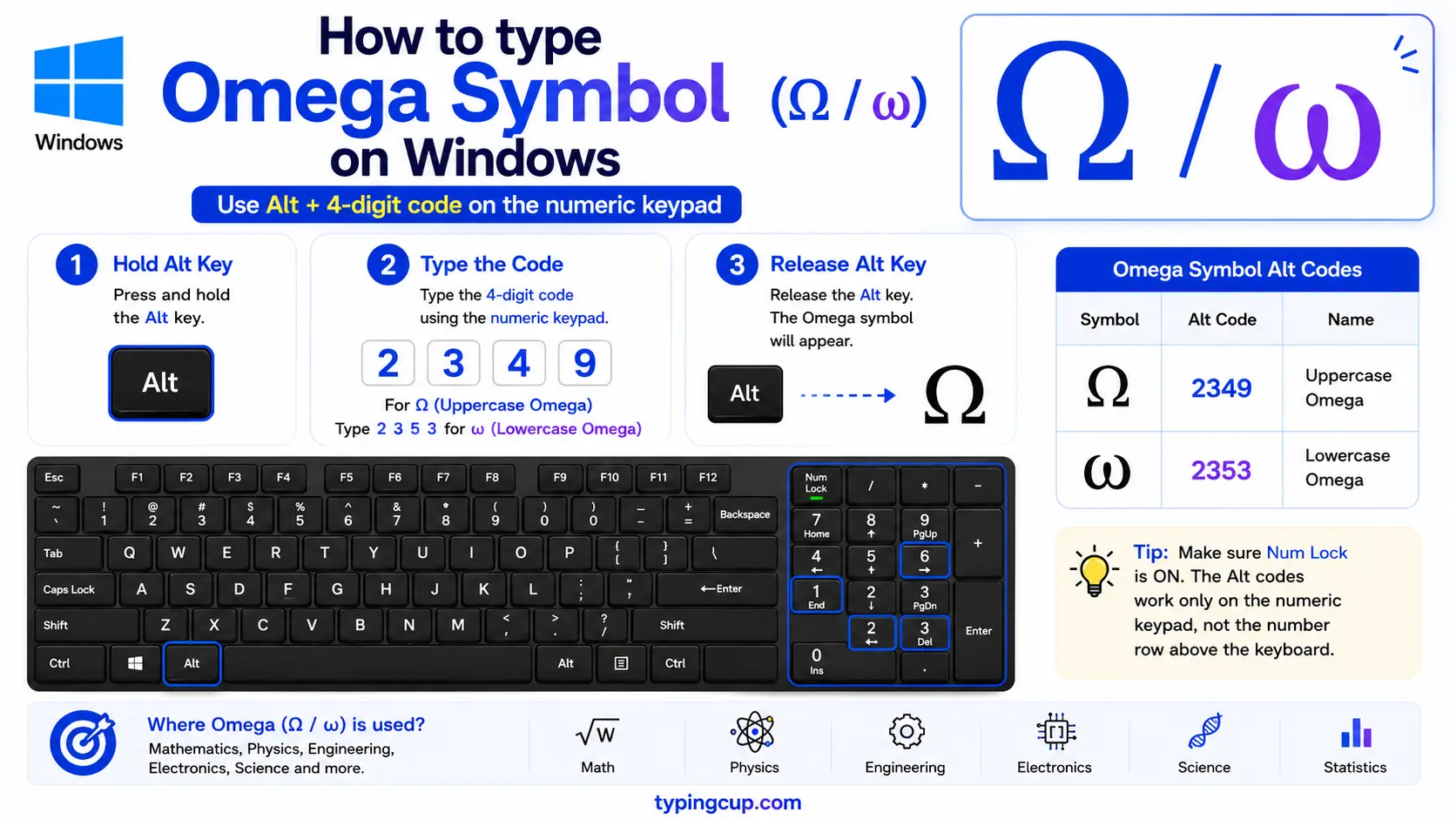
Use the Alt code: turn on Num Lock, hold Alt, and type 937 on the numeric keypad for Ω, or 969 for ω. (The shorter Alt + 234 also gives Ω in many apps.) On a laptop with no keypad, press Windows + . and search “omega.”
Type Ω on Mac
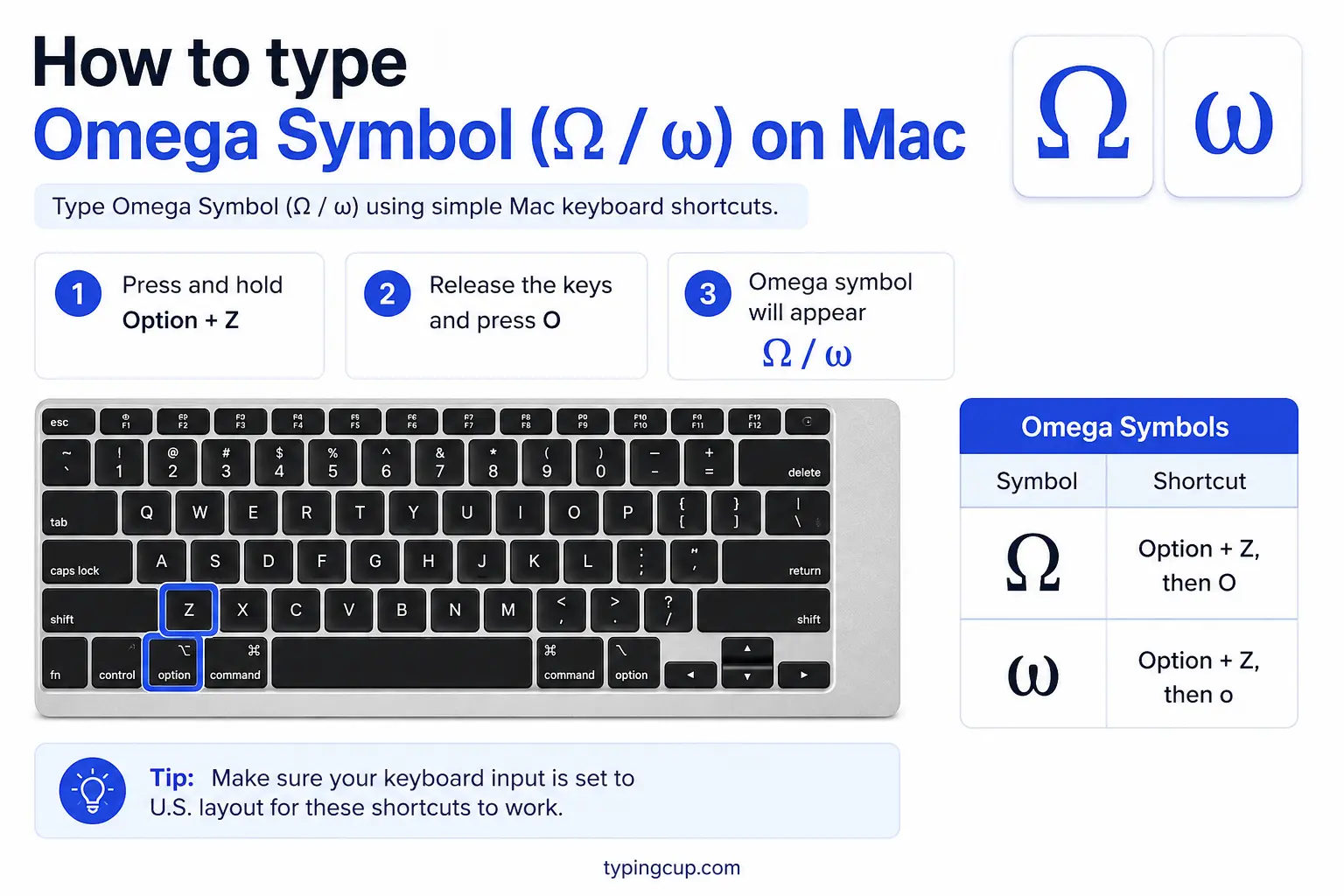
On a Mac, press Option + z for Ω — a rare case where a Greek letter has a direct Mac shortcut. For the lowercase ω, use the Character Viewer (Control + Command + Space) and search “omega,” or add a Greek keyboard where ω sits on the V key.
Type Ω on iPhone and Android
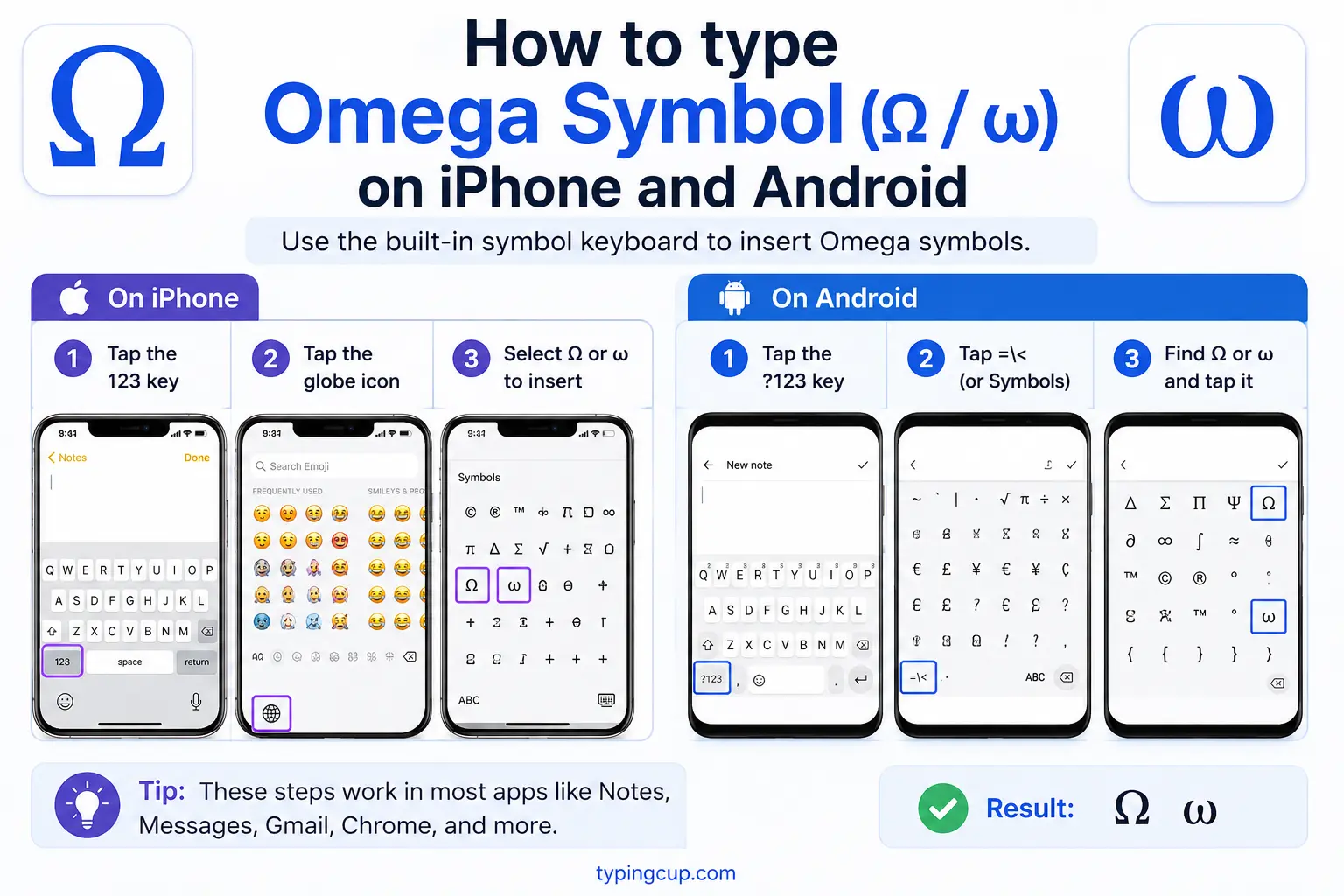
Add a Greek keyboard in settings, where omega is available; otherwise copy it from the grid above. Scientific-calculator and maths keyboards often include Ω and ω, handy for the ohm in electronics.
Type Ω in Microsoft Word
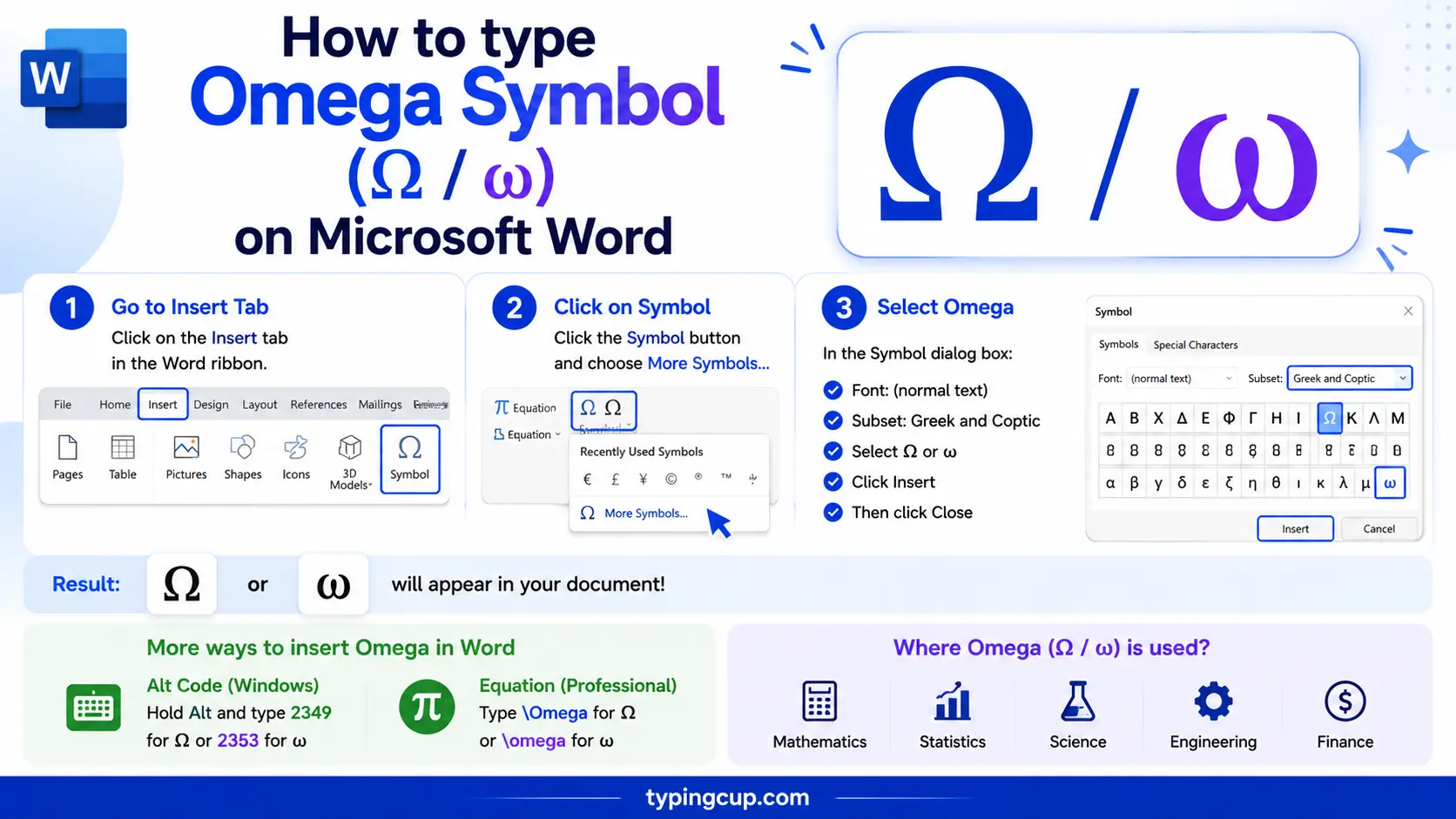
Type 03A9 then press Alt + X for Ω (use 03C9 for ω). Or use Insert → Symbol, where the Greek letters are listed. In the equation editor (Alt + =), \Omega and \omega work.
Type Ω on Linux
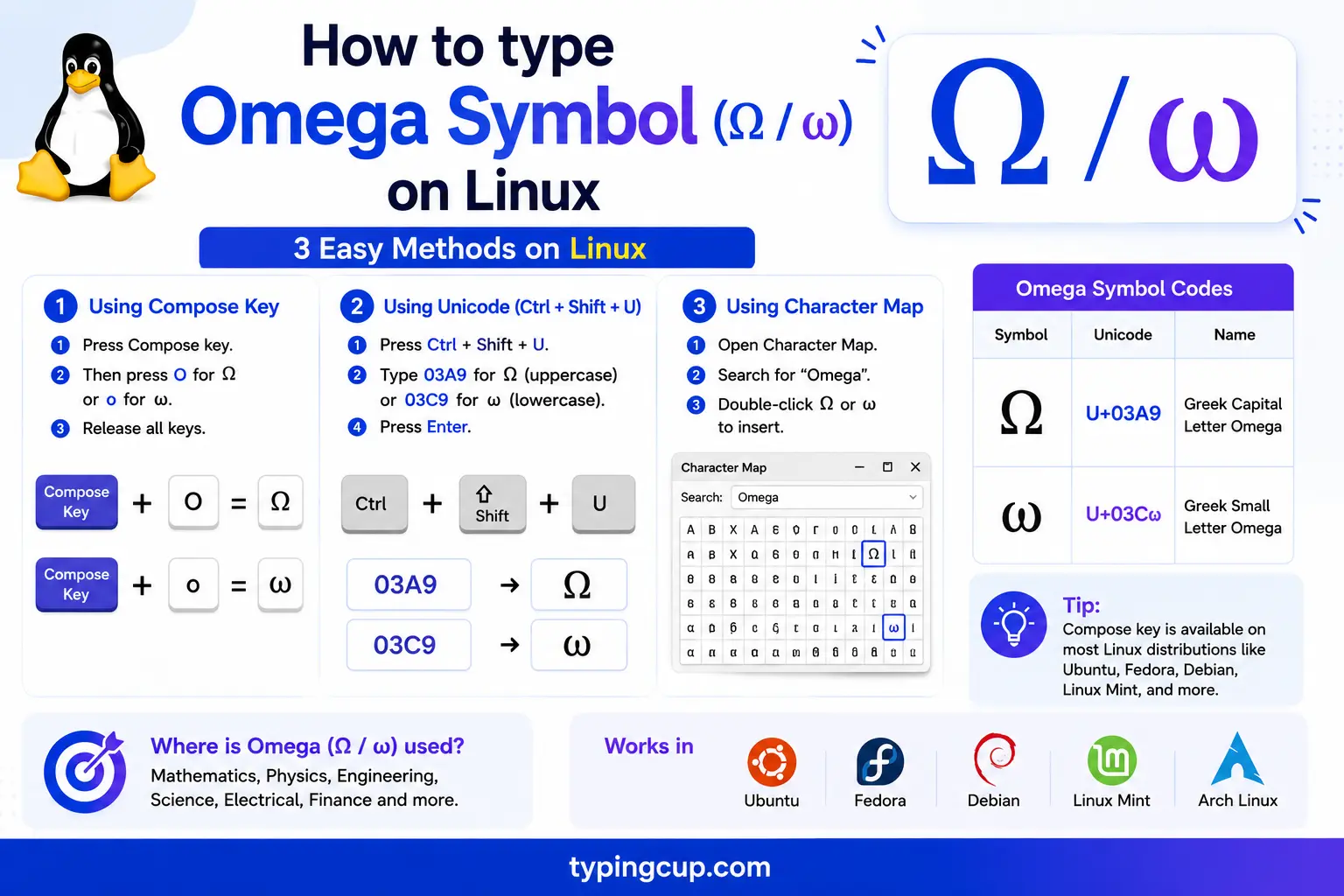
Press Ctrl + Shift + U, type 03a9, then Enter for Ω (03c9 for ω). A Greek keyboard layout also gives you omega.
Add Ω in HTML and CSS
In HTML, Ω is Ω (capital) or ω (lowercase), or the numeric Ω. In CSS, a Ω in a content value is the escaped code point \03A9.
Ω the Greek letter vs Ω the ohm sign
Omega has the same twin-character quirk as sigma and delta: there are two Ω characters that look identical. The Greek capital omega Ω is U+03A9, a letter. The ohm sign Ω is U+2126, a dedicated symbol for the electrical unit. They render the same, but they’re catalogued as different characters.
Which should you use for resistance? Perhaps surprisingly, the answer is the Greek Ω (U+03A9). Unicode itself recommends against the separate ohm sign and says to use the ordinary Greek capital omega instead — the dedicated ohm character exists mainly for compatibility with older systems. So a resistor value like 10 kΩ should really use the Greek letter, not the special ohm sign, which also avoids the search and encoding oddities that come with rarely-used compatibility characters. In short: type the Greek Ω for everything, ohms included.
| Character | Name | Use it for |
|---|---|---|
| Ω | Greek capital omega (U+03A9) | the letter and the ohm (recommended) |
| Ω | ohm sign (U+2126) | legacy systems only |
| ω | Greek small omega (U+03C9) | physics, frequency |
Alpha and Omega: the first and the last
Omega is the twenty-fourth and final letter of the Greek alphabet, and that position is the source of one of the most famous phrases in Western culture. “I am the Alpha and the Omega” — from the Book of Revelation — uses the first and last letters of the Greek alphabet to mean “the beginning and the end,” the whole of everything. Alpha (Α) opens the alphabet; omega (Ω) closes it.
That’s why omega carries a sense of finality wherever it appears: the “omega point” as an ultimate goal, an “omega” as the last or lowest in a ranking (the counterpart to the “alpha”), the end of a series. The very name says it: omega literally means “great O” (o-mega), as opposed to omicron, “little o” — which is the next section. So the letter that closes the Greek alphabet has come to stand for endings of every kind.
Ω as the ohm: electrical resistance
The most common everyday use of Ω is as the ohm, the unit of electrical resistance — how much a component pushes back against the flow of current. It’s named after Georg Ohm, and it anchors Ohm’s law, V = IR (voltage equals current times resistance). Any time you see a resistor value, it’s in ohms: 220 Ω, 10 kΩ (ten thousand ohms), 1 MΩ (a million).
If you build or repair electronics, you’ll type Ω constantly — on schematics, in parts lists, on multimeter readouts. The related units use the same symbol with prefixes: kΩ (kilo-ohm) and MΩ (mega-ohm) for large resistances, mΩ (milliohm) for tiny ones. And as noted above, the character to use is the ordinary Greek Ω, not the special ohm sign. It’s a neat example of a Greek letter that became a household unit — the last letter of an ancient alphabet, printed on the side of a resistor.
Omega vs omicron: Greek’s two O’s
Greek has two letters for the O sound, and their names spell out the difference. Omicron (ο) is literally “o mikron,” little O; omega (ω) is “o mega,” great or big O. Originally the distinction was about length — omicron a short o, omega a long one — and their shapes reflect it, with omega being the more open, drawn-out form.
Most people met this pair for the first time in 2021, when the naming of COVID variants ran through the Greek alphabet and reached Omicron — skipping a couple of letters, and prompting a lot of “why not Omega?” (the answer: the naming system simply hadn’t got that far, and later variants were named differently). It put two obscure Greek letters into everyday news. So if you’ve wondered why Greek seems to have a spare O, that’s it: omicron the little one, omega the great one, sitting near opposite ends of the alphabet.
| Letter | Name means | Sound |
|---|---|---|
| ο | omicron (“little o”) | short o |
| ω | omega (“great o”) | long o |
Lowercase ω and ‘omega’ beyond maths
The lowercase ω has its own busy career, mostly in physics, where it stands for angular frequency or angular velocity — how fast something rotates, in radians per second. It turns up in waves, oscillations, and orbits. In computer science, capital Ω appears in big-Omega notation, the partner of big-O: where O(n) describes an algorithm’s worst case (upper bound), Ω(n) describes its best case (lower bound).
And like sigma, omega has slipped into pop culture. “Omega” is used as the counterpart to “alpha” in informal personality talk (and internet slang), usually meaning the bottom of a hierarchy — the opposite end from the top. There’s also omega-3 (the fatty acids), the Omega watch brand, and countless logos that borrow the letter for its “ultimate / final” vibe. Whatever the field, it leans on the same idea baked into the letter: omega is the end.
Ω in URLs and encoding
In a URL, Ω is percent-encoded as %CE%A9 (its two UTF-8 bytes); lowercase ω is %CF%89 and the ohm sign is %E2%84%A6. In code, the escape for the character in a string is \u03A9 for Ω and \u03C9 for ω. If Ω ever shows as garbled characters or a box, the page is being read in the wrong encoding — serve it as UTF-8.
Copy-paste HTML codes
Every code for the omega letters and the ohm sign in one place. Click a cell and copy.
| Symbol | Named entity | Numeric entity | URL (percent) code |
|---|---|---|---|
| Ω | Ω | Ω | %CE%A9 |
| ω | ω | ω | %CF%89 |
| Ω (ohm) | — | Ω | %E2%84%A6 |
In a CSS content value, use \03A9 for Ω. For its Greek-letter siblings, see the [sigma symbol](/sigma-symbol/), [delta symbol](/delta-symbol/), and [pi symbol](/pi-symbol/) guides, and for every Greek letter the [math symbols Alt codes](/math-symbols-on-keyboard-alt-codes/) reference.
Troubleshooting
My Ω shows as a box or garbled text
That’s an encoding mismatch: the UTF-8 bytes for Ω are being read as an older encoding. Set the file, database, and page charset to UTF-8 and Ω displays correctly.
Should I use the Greek Ω or the ohm sign for resistance?
Use the Greek capital omega Ω (U+03A9). Unicode recommends against the separate ohm sign (U+2126), which exists mainly for legacy compatibility, so 10 kΩ should use the Greek letter.
Alt + 937 isn’t working
That decimal code needs app support; try Alt + 234 instead. If it fails, type 03A9 then Alt + X in Word, use Option + z on a Mac, or copy Ω from the grid above.
FAQ
How do I type the omega symbol?
On Windows, hold Alt and type 937 for Ω (969 for ω). On a Mac, press Option + z. In Word, type 03A9 then Alt + X. In HTML, write Ω. Or click Ω in the grid above.
What does the omega symbol mean?
Omega is the last letter of the Greek alphabet, so it stands for “the end” (as in “the Alpha and the Omega”). As a unit, Ω is the ohm, measuring electrical resistance. Lowercase ω is angular frequency in physics.
Is the ohm sign the same as the Greek omega?
They look identical but are different characters: Greek capital omega is U+03A9, the ohm sign is U+2126. Unicode recommends using the Greek Ω even for ohms, so 10 kΩ should use the letter.
What’s the difference between omega and omicron?
They’re Greek’s two O letters. Omicron (ο) means “little o” (a short o), and omega (ω) means “great o” (a long o). Omega is the last letter of the alphabet; omicron sits earlier.
How do I write Ω in HTML?
Use Ω (capital) or ω (lowercase), or the numeric Ω. In a URL, Ω is percent-encoded as %CE%A9.
